Idols of Lord Ganesha dumped in garbage heap by police in Tamil Nadu's Tirunelveli ahead of Ganesh Chaturthi celebrations
 Tirunelveli, Tamil Nadu, India
  8 September, 2026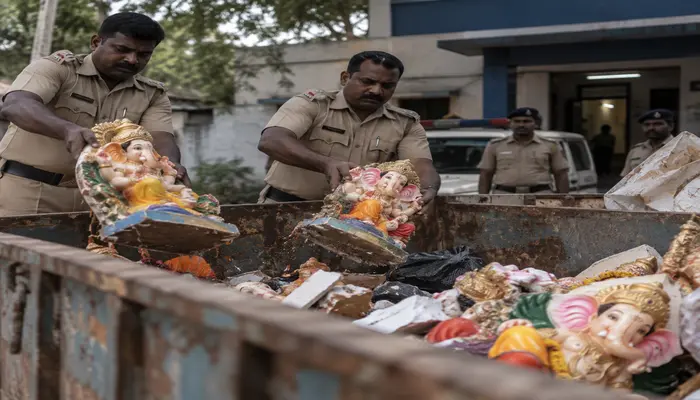
Case Summary
In South Poolangulam, Tirunelveli district, Tamil Nadu, idols of Lord Ganesha were desecrated by police personnel. The police threw away the idols and dumped them in a garbage heap behind the Devarkulam police station. The incident occurred just days ahead of the Ganesh Chaturthi festival. The incident involved Police Sub-Inspectors Luke Hasan and Abraham Joseph of the Devarkulam police station. The officers entered the premises of the Karuppasamy Temple in South Poolangulam, where Ganesha idols had been prepared for the upcoming Ganesh Chaturthi celebrations. Their action followed a petition submitted by Village Administrative Officer Rasaiah over the use of Plaster of Paris (PoP) in making the idols. The police under this pretext seized 75 completed Ganesha idols, 17 incomplete idols, eight bags of Plaster of Paris powder and casting moulds from the temple premises and transported them to the Devarkulam police station. Rather than ensuring that the seized Ganesha idols were respectfully and safely stored, the idols were kept in an open area behind the police station, where they were subsequently seen dumped in a garbage heap. The 17 incomplete idols were left exposed, while the completed idols were covered with tarpaulins. The manner in which the Ganesha idols were kept at the police station was captured in a video by an unidentified person and circulated on social media. The footage showed the idols lying in the open, including idols that had been left uncovered. The police later stated that some idols visible in the video had been covered with tarpaulins. The Ganesha idols were subsequently found in a damaged condition, further provoking outrage among Hindu devotees and organisations. Hindu Munnani functionaries objected to the manner in which the idols had been handled and demanded action against the police personnel involved. They described the treatment of the Ganesha idols as disrespectful and sacrilegious towards Hindu deities and also objected to the circumstances surrounding the seizure itself. The police stated that the seizure had been carried out in accordance with the law because the idols had been made using Plaster of Paris and that the seized material was being treated as case property. Nellai Hindu Munnani functionary Brahmanayagam demanded action against Police Sub-Inspectors Luke Hasan and Abraham Joseph. He announced that Hindu Munnani would not participate in peace committee meetings or other official meetings until action was taken against those responsible. The organisation also stated that it would not approach the authorities for permission to install Ganesha idols and would leave the matter to the government. Following the backlash, the police covered all the seized Ganesha idols with tarpaulins, again citing their status as case property. The idols were subsequently shifted to another location for safe custody, while members of the public were not permitted to view them.
Why it is Hate Crime ?
The primary category selected in this case is: Attack on Hindu religious representations. The subcategory selected is: Desecration of Hindu religious symbol. Icons and symbols or a religious representation of a spiritual ideal are widely revered in Hinduism. Iconography is of vital significance in the Hindu milieu. It helps connect people’s spiritual beliefs with the real world. Iconography within the Hindu faith takes several shapes and forms. Murtis are of most significance to Hindus, to which daily rituals, prayers and offerings are done. Besides the murtis, there are several other symbols which have deep significance in the Hindu faith – the Om and Swastika for example. Since these Hindu religious symbols hold paramount importance in Hinduism, any desecration of symbols, icons, murtis, religious representations and manifestations, is driven by animosity towards the faith itself which manifests itself through these murtis, icons and symbols. Therefore, any desecration of these Hindu religious symbols and representations is considered religiously motivated hate crimes under this category. This case was a clear example of a religiously motivated hate crime because the police authorities desecrated idols of Lord Ganesha that had been prepared for the Ganesh Chaturthi festival. The idols were seized from the Karuppasamy Temple premises and taken to the Devarkulam police station, where they were subsequently dumped in a garbage heap behind the station. They were left in the open and were later found in a damaged condition. The conduct therefore went beyond the seizure of idols made from a restricted material and involved the degrading treatment of sacred Hindu objects. Hindu murtis hold deep religious significance and form an important part of devotional worship. They are not treated merely as artistic representations but as sacred embodiments or manifestations of the deity through which devotees offer prayers, rituals and other forms of worship. Their sanctity is maintained through cleanliness, respectful handling and proper placement in consecrated or worshipful spaces. Lord Ganesha is especially revered as the remover of obstacles and the deity associated with auspicious beginnings, wisdom and prosperity. Ganesh Chaturthi is a festival dedicated to his worship and involves the installation of Ganesha murtis, followed by prayers, offerings and other religious rituals. The preparation and installation of the murti are therefore an integral part of the festival, and its treatment carries direct religious significance for devotees. Therefore, the act of dumping these sacred Ganesha idols in a garbage heap amounted to clear desecration and profound disrespect towards the sanctity of Hindu religious symbols. Waste and refuse are associated with dirt and impurity, while murtis used for worship are treated with reverence and kept in clean and sanctified surroundings. Placing idols of Lord Ganesha among discarded waste, leaving them exposed and allowing them to become damaged, directly violated the religious norms governing the respectful treatment of sacred objects. Such deliberate degradation of murtis prepared for worship showcased hostility towards Hindu religious practices and disregard for the sacred symbols central to Hindu devotion. The manner in which the idols were discarded therefore not only undermined their religious sanctity but also deeply hurt the religious sentiments of Hindu devotees. Taken together, this desecration and the contemptuous treatment of sacred Hindu symbols amounted to a religiously driven hate crime against the Hindu community. Some may argue that the seizure of the PoP idols had a distinct legal and environmental dimension. Restrictions on the use of Plaster of Paris for idols have been introduced in different parts of India because of concerns about the environmental consequences of immersing such idols in water bodies. Authorities may therefore seize idols made from prohibited materials in accordance with applicable law. However, that legal basis did not require the seized idols to be discarded in a garbage heap. Once taken into official custody, they could have been kept in a secure location and handled in a manner that preserved both their physical condition and the religious sensitivities associated with them. The decision to leave them exposed and among waste was therefore separate from the underlying environmental enforcement and could not be justified merely by the fact that the idols had been seized as case property. The circumstances were further aggravated by the timing of the incident. The idols had been created specifically for Ganesh Chaturthi and were seized only days before the festival, when devotees were preparing to begin their worship of Lord Ganesha. The degrading treatment of the idols at this particular time therefore affected the Hindu community during an important period of religious observance. The combination of the authorities' treatment of sacred Hindu murtis, the manner in which they were discarded and damaged, and the timing immediately preceding Ganesh Chaturthi demonstrated serious disregard for Hindu religious sentiments and sacred symbols. Therefore, the incident was added to the hate crime database of the Hinduphobia Tracker. Disclaimer: The exact date on which the Ganesha murtis were seized is not specified in the available sources. However, the sources confirm that the murtis had been seized by the Devarkulam police and were being kept at the police station by 9 September 2026. The tracker records incident dates based on when the crime occurred rather than when it was reported or published. Accordingly, 9 September 2026 has been used as the indicative incident date and recorded for documentation purposes only.


Case Status
Unknown


Perpetrators Details
Perpetrators
State and Establishment
Perpetrators Range
From 2 To 5
Perpetrators Gender
male
 Sources




