Hindu woman forced to consume beef and remove tulsi mala; subjected to derogatory insults against Hindu faith by Muslim man
 West Bengal, India
  5 June, 2026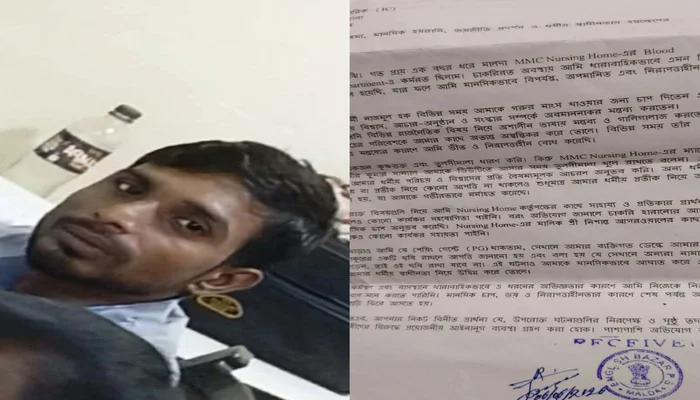
Case Summary
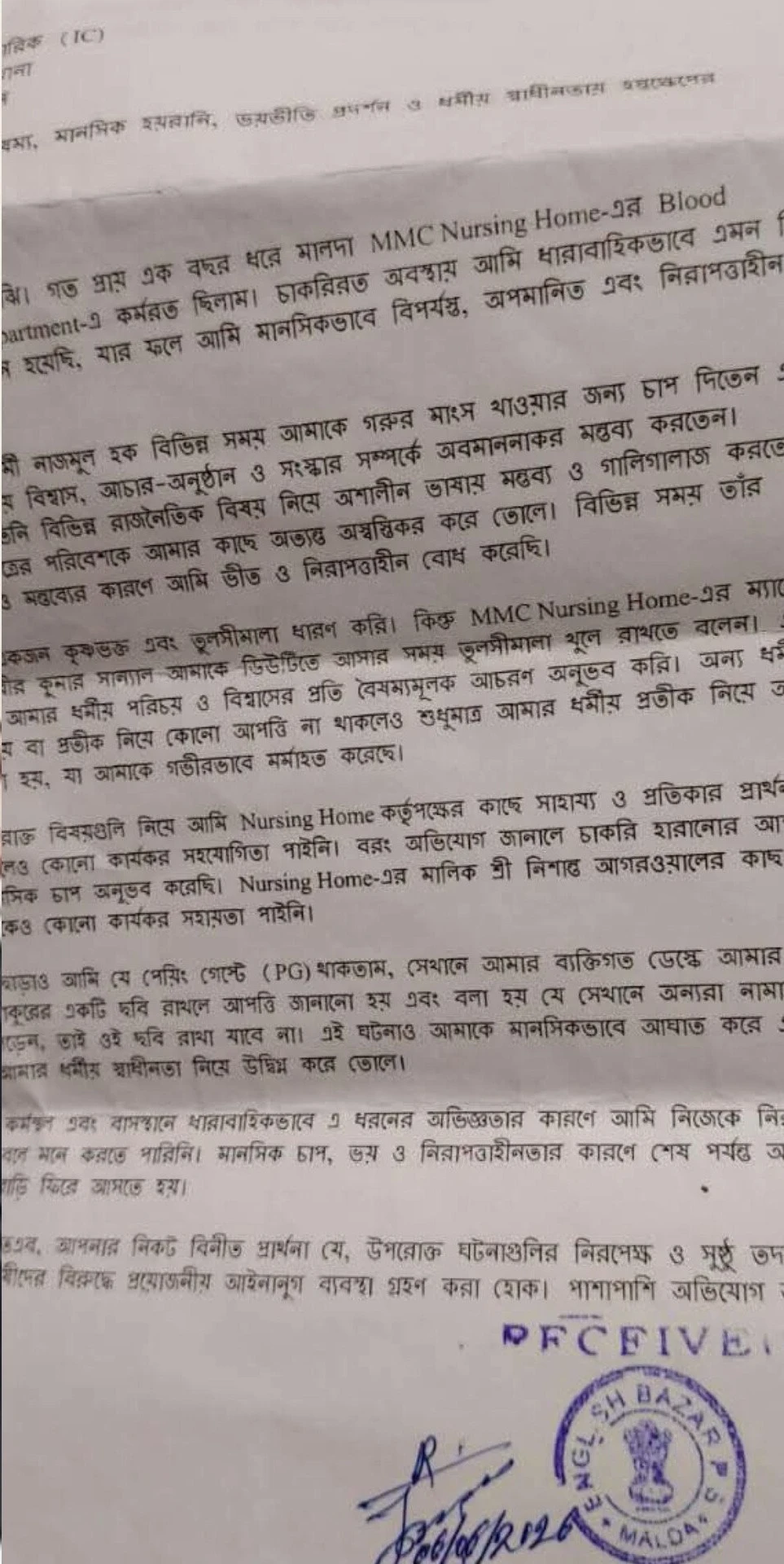
In Malda, West Bengal, a Hindu woman was forced to consume beef and was subjected to derogatory and insulting remarks concerning the Hindu faith by a Muslim colleague. She was also forced to remove the tulsi mala she wore as a religious symbol and was prevented from keeping a picture of her revered deity at a paying-guest accommodation because Muslim residents offered namaz there. Yamuna Majhi had worked for nearly a year in the Blood Collection Department of MMC Nursing Home, Malda. During her employment, her colleague Nazmul Haque pressured her on several occasions to consume beef and made derogatory remarks about her religious beliefs, customs and traditions. He also used abusive and obscene language while discussing political issues, which created an uncomfortable atmosphere at the workplace. Majhi was a devotee of Lord Krishna and wore a tulsi mala as a religious symbol. Sudhir Kumar Sanyal, the nursing home manager, forced her to remove the tulsi mala when she reported for duty. She regarded the instruction as discriminatory towards her religious identity, and the incident caused her considerable distress. Majhi approached the MMC Nursing Home authorities for intervention but did not receive effective assistance. She subsequently faced additional mental pressure and feared losing her employment. She also stated that Nishant Agarwal, the nursing home owner, did not provide effective assistance. While staying at a paying-guest accommodation, Majhi kept a picture of her revered deity, Lord Krishna, on her personal desk. She was prevented from keeping the picture there and was told that Muslim residents offered namaz at the location and that the picture should therefore be removed. The cumulative effect of the incidents at her workplace and residence left Majhi feeling unsafe and under severe mental stress, eventually forcing her to return home. She subsequently submitted a written complaint to the Officer-in-Charge of English Bazar Police Station, seeking an impartial investigation into the incidents and appropriate legal action. She also offered to provide relevant documents and other evidence and to cooperate with the investigation.
Case Images
Why it is Hate Crime ?
The first primary category selected in this case is: Attack not resulting in death, and within this, the subcategory selected is- Attacked for Hindu identity. In several cases, Hindus are attacked merely for their Hindu identity without any perceived provocation. A classic example of this category of religiously motivated hate crime is a murder in 2016. 7 ISIS terrorists were convicted for shooting a school principal in Kanpur because they got ‘triggered’ seeing the Kalava on his wrist and tilak that he had put. In this, the Hindu victim had offered no provocation except for his Hindu religious identity. The motivation for the murder was purely religious, driven by religious supremacy. Such cases where Hindus are targeted merely for their religious identity would be documented as a hate crime under this category. The religious dimension of this case was not incidental; the harassment repeatedly focused on practices and symbols that identified the victim as a Hindu. The pressure to consume beef was especially significant because the cow holds deep religious reverence in Hinduism, and forcing a Hindu to consume beef against her wishes amounts to an assault on a deeply held religious and dietary practice. Coupled with derogatory remarks about Hindu beliefs, customs and traditions, this went beyond ordinary workplace misconduct and directly attacked the victim’s faith. The targeting also extended to visible expressions of her Hindu identity. Her Tulsi mala, worn as an act of devotion to Lord Krishna, was singled out, and she was told to remove it before entering the workplace. This demand directly interfered with her ability to openly observe her faith. A similar pattern was evident in the treatment of her image of Lord Krishna, which she was prevented from keeping in her personal space because Muslim residents offered namaz there. The reasoning effectively placed a Hindu religious symbol in a position where it was considered unacceptable simply because another religious practice was taking place. Taken together, these incidents created an environment in which the victim was repeatedly made to feel that visible expressions of Hindu faith were unwelcome or incompatible with the spaces in which she worked and lived. What makes the case a hate crime is the repeated and specific focus on her Hindu identity, religious practices and sacred symbols. The harassment was not limited to personal disagreement; it repeatedly sought to restrict what she could wear, what she could keep in her personal space, what she could consume, and how she could express her faith. The cumulative pattern therefore reflected religiously targeted harassment. Each individual act centred on a different aspect of Hindu identity, but together they conveyed the same message: that the victim’s Hindu faith had to be suppressed or accommodated around the religious preferences of others. Given that the fundamental motivation behind these actions was contempt for Hindus and their religion, this instance has been added to the tracker under the following category. Disclaimer: The Hinduphobia Tracker records incidents based on when an event occurred or when the victim's ordeal began. In this case, the available media coverage did not specify the exact date the alleged incidents occurred. However, the written complaint was lodged at English Bazar Police Station, Malda, on 6th June 2026. Therefore, for documentation purposes, the case date has been recorded as 6th June 2026, corresponding to the date the complaint was lodged with the police.
Victim Details
Total Victim
1
Deceased
0
Gender
- Male 0
- Female 1
- Third Gender 0
- Unknown 0
Caste
- SC/ST 0
- OBC 0
- General 0
- Unknown 1
Age Group
- Minor 0
- Adult 1
- Senior Citizen 0
- Unknown 0


Case Status
Complaint filed


Perpetrators Details
Perpetrators
Muslim Extremists
Perpetrators Range
One Person
Perpetrators Gender
male
 Sources




