Hindu man pressured to convert to Islam, assaulted and threatened by Muslim wife’s family for refusing in Dehradun, Uttarakhand
 Dehradun, Uttarakhand, India
  11 September, 2023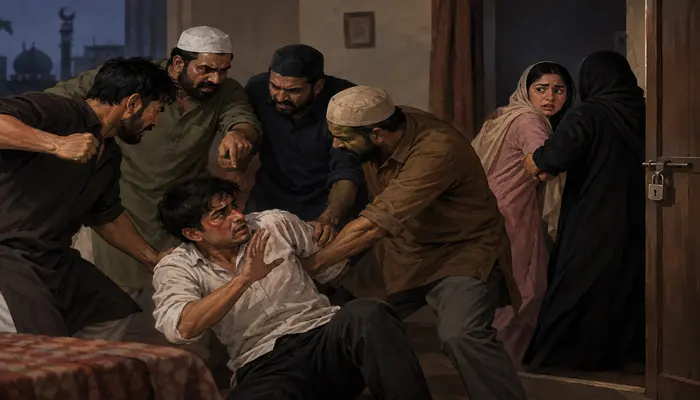
Case Summary
In Dehradun, a Hindu man named Krishna Kumar was pressured to convert to Islam and was subjected to assault and death threats following his interfaith marriage with a Muslim woman. The Muslim woman’s family and some local Muslim residents pressured Kumar to convert to Islam. Kumar, a resident of Rampur Choui Basti in the Sahaspur Kotwali area, had married Sadiya approximately three years before the incident (2023). According to Kumar’s complaint, following the marriage, some Muslim residents and members of Sadiya’s family repeatedly pressured him to convert to Islam. Salman, Usman, Kunnu, Islam and Islam’s wife, Bhuri, were named in connection with the threats and pressure. Kumar stated that he was threatened with death and warned that he would not be allowed to remain in the area if he refused to convert. He also stated that a local Block Development Council (BDC) member was supporting the accused. On the night of 12 September 2026, the accused entered Kumar’s residence and assaulted him after he refused to convert to Islam. During the incident, they locked his wife, Sadiya, outside the room before physically assaulting Kumar. Following the incident, Kumar approached the Sahaspur police with a complaint, in which he and his wife expressed concern for their lives and property and sought police action against those involved. Kumar and his supporters subsequently stated that, instead of taking action against the accused, a police officer intimidated and threatened him. In response, activists from the Vishva Hindu Parishad (VHP) and Bajrang Dal surrounded the Sahaspur police station and staged a protest demanding an impartial investigation and action against those named in the complaint. The demonstration was led by VHP District President Ramesh Dhoundiyal and District Coordinator Shekhar Bansal. During the protest, VHP leaders said that pressuring any person to change their religion against their wishes and assaulting them were serious matters. Dhoundiyal demanded immediate and impartial action on Kumar’s complaint and said that if the police had failed to take the complaint seriously and had instead attempted to intimidate the victim, the organisation would oppose it. He further warned that the VHP and Bajrang Dal would intensify their agitation if there was no improvement in the functioning of the police. The protesters also demanded that the complaint that a police officer had intimidated Kumar be investigated impartially. Following the demonstration, Sahaspur Kotwali Inspector Manoj Nautiyal confirmed that a case had been registered under relevant statutory sections against six individuals, including one woman, on the basis of Kumar’s complaint. At the time of writing this report, the police initiated an investigation and said that all aspects connected with the incident and the available evidence would be examined.
Why it is Hate Crime ?
The first primary category selected in this case is: Men attacked for being associated with non-Hindu woman. The subcategory selected is: Threatened to convert by family of partner. When Hindu men are in a relationship with non-Hindu women, there are cases where the man faces threats to convert and change his religious identity by the non-Hindu woman or her family. Such relationships may be consensual with the religious identity of the non-Hindu woman known to the victim. Somewhere along the relationship, the non-Hindu woman or her family starts forcing/pressurizing the Hindu man to convert to Islam and also assaults the victim to force him to convert. Such cases are driven by specific religious motivations and against the religious identity of the victim and are therefore qualified as hate crimes. Cases where the Hindu man converts to Islam and does not file a complaint about the force or threat, are not considered a part of the hate tracker, even though, it may be argued that the man was brainwashed or threatened to convert to Islam. The other subcategory selected is: Assaulted for refusal to convert. When Hindu men are in a relationship with non-Hindu women, there are cases where the Hindu man faces assault after he refuses to convert and change his religious identity owing to pressure/force by the non-Hindu woman or her family. Such relationships may be consensual with the religious identity of the non-Hindu woman known to the victim. Somewhere along the relationship, the non-Hindu woman or her family starts forcing/pressurizing the Hindu man to convert to Islam and upon his refusal, assaults the victim. Such cases are driven by specific religious motivations and against the religious identity of the victim and are therefore qualified as hate crimes. Cases where the Hindu man converts to Islam and does not file a complaint about the force or threat, are not considered a part of the hate tracker, even though, it may be argued that the man was brainwashed or threatened to convert to Islam. The other subcategory selected in this case is: Attacked by non-Hindu partner or/and her family. When Hindu men are in a relationship with non-Hindu women, there are cases where the man is forced to convert his religion and upon his refusal to do so, the partner or/and her family attacks the victim. Such relationships may be consensual with the religious identity of the non-Hindu woman known to the victim. Somewhere along the relationship, the non-Hindu woman or her family starts forcing/pressurizing the Hindu man to convert. In some of these cases, the association could be non-consensual as well or, the religious identity of the non-Hindu woman could be previously unknown to the Hindu victim. In such cases, the Hindu man is first forced/pressurized to change his religion by the non-Hindu woman or her family. The force/pressure could involve threats. The trigger for directing violence against the Hindu man is in these cases his refusal to comply and change his religion under threat and/or force. In other cases that have been documented, it is also seen that the Hindu partner is assaulted by the non-Hindu woman or her family simply for his relationship with the non-Hindu woman and by virtue of him following the Hindu faith and not the religion of the non-Hindu woman. In such cases, the relationship is consensual in most cases and the religion of both partners is known to the other. Often, in such cases, there is no direct force/pressure to convert either, however, the attack is a result of the Hindu man being in a relationship with the non-Hindu partner and not following her religion/following Hinduism specifically. Such cases are driven by specific religious motivations and against the religious identity of the victim and are therefore qualified as hate crimes. The second primary category selected in this case is: Attack not resulting in death. The subcategory selected is: Attacked for refusal to convert. When there is pressure, threat or coercion employed upon the Hindu victim to convert to a different religion, in several cases, the victim refuses to succumb to the pressure/threats. Once the victim refuses, the perpetrator proceeds to attack/assault the victim owing to his/her refusal to convert. In such cases, the pressure/threat/intimidation/coercion/violence itself is driven by animosity towards the victim’s Hindu faith. The violence then is another hate crime driven by the victim’s refusal to abandon his professed faith, Hinduism, and convert to the religion of a non-Hindu perpetrator. Since the victim’s faith is at the heart of the pressure to convert and the ensuing violence towards the victim, such cases are considered religiously motivated hate crimes. This case was a clear example of a religiously driven hate crime because Kumar was targeted for being Hindu and subjected to pressure to convert to Islam, death threats and physical assault when he refused. Members of his Muslim wife’s family and local residents sought to make him abandon Hinduism and adopt Islam, making his religious identity the central reason for the persecution he faced. The circumstances of the marriage further distinguished this incident from a dispute arising simply from family opposition to an interfaith relationship. Kumar and Sadiya were both adults who had entered into a consensual marriage, and their different religious identities had not prevented them from forming a marital relationship. The subsequent conduct of Sadiya’s family and local residents went beyond objecting to the marriage or expressing disapproval of an interfaith relationship. They sought to make Kumar abandon his own religion and accept Islam as a condition for remaining within the community. While opposition to marriages outside one’s caste, community, social group or religion can occur for reasons relating to family or social norms, the conduct in this case assumed a distinctly religious character because the perpetrators did not merely reject Kumar as Sadiya’s Hindu husband; they sought to alter his religious identity itself. Their actions therefore transformed opposition to an interfaith marriage into an attempt to impose a different faith upon the Hindu spouse through coercion. Conversion is voluntary only when a person freely chooses to change their faith without threats, intimidation or coercion. Kumar was repeatedly pressured to convert to Islam, threatened with death and warned that he would have to leave the area if he refused, leaving no genuine scope for free religious choice. Such conduct violated his religious autonomy by denying him the right to retain and practise his Hindu faith according to his own conscience. The attempt to compel him to abandon Hinduism treated his existing faith as something that could be forcibly discarded and replaced rather than a religious identity entitled to respect. By seeking to impose Islam through threats and coercion, the perpetrators sought to override Kumar’s freedom of belief and compel him to surrender his Hindu identity, making the attempted conversion an act of religious coercion rather than a voluntary change of faith. The coercion ultimately escalated into violence when Kumar refused to comply. The Muslim perpetrators entered his residence and physically assaulted him, while he and his wife had already faced threats concerning their lives and property. This escalation was significant because it demonstrated that the demand for conversion was backed by force. When verbal pressure failed to secure Kumar’s compliance, the perpetrators resorted to intimidation and physical violence rather than respecting his decision to remain Hindu. The sequence of events, repeated demands to convert, threats for refusing, and finally physical assault, established a clear pattern of coercion directed at Kumar because of his religious identity. The use of violence to enforce a demand that he abandon Hinduism therefore made the religious nature of the persecution particularly clear and brought the incident within the parameters of a religiously driven hate crime. Since this incident met the parameters of a religiously driven hate crime, the case was added to the hate crime database of the Hinduphobia Tracker. Disclaimer: The Hinduphobia Tracker records incident dates based on when the victim’s ordeal began, rather than when the incident was subsequently reported by the media. In this case, the available media reports did not specify the exact date on which Kumar’s ordeal began. They stated that he had been pressured to convert to Islam after his marriage in 2023 and that he was assaulted by members of his Muslim wife’s family on 12 September 2026. Based on these details, 12 September 2023, approximately three years before the reported assault, has been selected as the indicative incident date for documentation purposes only.
Victim Details
Total Victim
1
Deceased
0
Gender
- Male 1
- Female 0
- Third Gender 0
- Unknown 0
Caste
- SC/ST 0
- OBC 0
- General 0
- Unknown 1
Age Group
- Minor 0
- Adult 1
- Senior Citizen 0
- Unknown 0


Case Status
Complaint registered


Perpetrators Details
Perpetrators
Muslim Extremists
Perpetrators Range
From 5 to 10
Perpetrators Gender
both
 Sources




