Hindu devotees assaulted and subjected to casteist slurs for requesting Krishna bhajans at Dahi Handi Utsav in Hardoi, Uttar Pradesh
 Hardoi, Uttar Pradesh, India
  9 September, 2026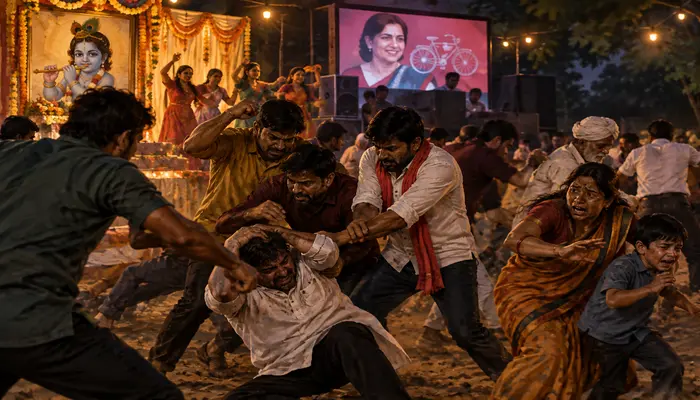
Case Summary
In Rehariyamau village, Hardoi district, Uttar Pradesh, on 10 September 2026, Hindu devotees attending a religious Dahi Handi Utsav (celebrated after Janmashtami) programme were subjected to casteist abuse and physical assault by a group of men after the former requested devotional songs of Lord Krishna to be played at the event instead of a political musical track. The incident occurred on the night of 10 September 2026 during a Dahi Handi celebration organised at a local villager's residence. While the festivities were underway, the organisers repeatedly played a political campaign song celebrating Samajwadi Party leader Dimple Yadav's electoral victory ("Mainpuri ne saath nibhaya, Dimple Yadav jeet gayin"). The complainant, Deshraj, who attended the gathering alongside several companions, requested the organisers to switch off the political music and play Krishna bhajans instead. Enraged by the request, a group including Raju Yadav, Durgesh Yadav, Vivek Yadav, Sachin Yadav, and Ritesh Yadav confronted Deshraj, subjected him to casteist slurs, and attacked him. The violence quickly spread across the venue as the assailants chased and beat other attendees, including women and children. Several devotees, including Ranjeet, Arun, Rajesh, Prem, Anuj, Golu, Rajendra, Joginder, Ashish, and a woman named Usha, were assaulted, with Ranjeet and Arun sustaining injuries that required medical treatment. On 12 September 2026, Deshraj's son, Santu, submitted a formal written complaint at the Atrauli police station. The police registered a First Information Report against five named individuals and thirty to forty unidentified persons under relevant statutory provisions. Additional Superintendent of Police (East) Subodh Gautam confirmed that authorities arrested one accused person, initiated preventive legal action, and commenced statutory proceedings.
Why it is Hate Crime ?
This case has been added to the tracker under the primary category- Attack on Hindu Religious Representations. The subcategory selected is- Defiling Religious Customs. Sanatan Dharma is not a religion of one book, which is to say that while it has religious scriptures that form the central tenets of the faith, there are several traditions followed through thousands of years, mostly passed from generation to generation orally. There are several such customs and traditions that are followed by various Hindus and Hindu sects. Defiling of these traditions and customs is a breach of an individual or group’s religious practices. Such practices can range from dietary restrictions like not eating non-vegetarian food for a certain period of the year, not eating non-vegetarian food at all, not eating beef since the cow is considered holy in Hinduism, the sanctity of religious customs followed in the house (like many ISCKON devotees), etc. Any malicious action leading to the breach of such traditions or defilement of these traditions owing to animosity towards the faith or for the sake of activism stems not only from the lack of faith in the religion itself but also from disregard for the faith of the devotees who follow the customs/traditions and implicit bias against the faith, the tradition itself. Since these specific traditions are central to the faith of the devotees of that specific sect of Hindus, any non-compliance with these traditional rules would be considered a religiously motivated hate crime. The second Primary category relevant to this case is Hate speech against Hindus. The subcategory selected is- Anti-Hindu slurs, mocking faith. Anti-Hindu slurs and the deliberate mocking of the Hindu faith owing to religious animosity involve the usage of derogatory terms, stereotypes, or offensive references to religious practices, symbols, or figures. One of the common anti-Hindu slurs used against Hindus is “cow-worshipper” and “cow piss drinker”. The intention of using this term is to demean and mock Hindus as a group and their religious beliefs since Hindus consider the cow holy. Additionally, some symbols and the slurs attached to them have a historical context that exacerbates the insult, hate, stereotyping, dehumanisation and oppression against Hindus. Cow worship has been used for centuries to denigrate Hindus, insult their faith and oppress Hindus specifically as a religious group. There has been overwhelming documentation about how cow slaughter has been used to persecute Hindus with cow meat being thrown in temples and places of worship. There has also been overwhelming documentation where cow meat (beef) has been force-fed to Hindus to either forcefully convert them to Islam or denigrate their faith. Apart from cow worship, the Swastika – which holds deep religious significance for the Hindus – has also been misinterpreted and distorted to use as a slur against Hindus. Similarly, the worship of the Shivling has been used by supremacist ideologies and religions to denigrate Hindus owing to religious animosity. Such slurs and denigration stem out of inherent animosity and hate towards Hindus and their faith, therefore, it is categorised as hate speech targeted at Hindus specifically owing to their religious identity. The third primary category relevant to this case is Attack not resulting in death. The subcategory selected is- Attacked for opposing radicals or trying to save victim. In several cases, Hindus are attacked for opposing religiously motivated crimes being committed against a fellow Hindu or simply for voicing an opinion opposing radical elements, who either have in the past or continue to persecute Hindus. In such cases, the initial attack against the victim, against which the Hindu was trying to defend the victim, would also need to be classified as a religiously motivated hate crime. Since the initial crime itself was religiously motivated and the subsequent crime of attempting to save the victim or speaking against the radical elements ends up inviting a violent attack, it would also be classified as a religiously motivated hate crime under this category. This incident qualified as a religiously motivated hate crime because the violence stemmed directly from an attempt to enforce and preserve the sanctity of a sacred Hindu festival. Dadhi Utsav is a traditional devotional celebration dedicated to Lord Krishna, where devotional singing is an essential element of worship. Supplanting these devotional hymns with partisan political tracks constituted a direct defilement of a sacred religious observance. The hostile reaction to a simple request for devotional music revealed intolerance of traditional faith within its dedicated festive space. The assault was further marked by targeted derogatory abuse aimed at humiliating devotees who sought to participate in collective religious customs. By resorting to demeaning slurs and verbal degradation against attendees asserting their spiritual rights, the aggressors exhibited contemptuous hostility toward the worshippers. Rather than respecting the shared religious context, the perpetrators deployed targeted invective to demean the individual identity and dignity of the devotees, reinforcing social marginalisation to suppress their religious expressions. Here, some may argue that a caste-specific slur is aimed at her micro identity of belonging to the Dalit section of the Hindu community and not her Hindu identity itself. However, in Abrahamic religions, the micro identities of caste, region, and language are secondary. It is the religious identity that drives the animosity of the perpetrator against the Hindu victim. In this case, while Qadir hurled caste abuses at the victim, the animosity was driven by his animosity towards Hinduism and Hindus. While the immediate trigger of the violence could be something else, the fact that caste slurs were hurled at the victim by the perpetrator makes it a religiously motivated hate crime against the victim. Moreover, the escalation into physical violence targeted individuals solely because they objected to the desecration of the devotional atmosphere and intervened to shield vulnerable participants. When worshippers raised their voices against the intrusion of non-religious political propaganda into a sacred gathering, they became direct targets of collective aggression. The mob turned violent against community members, pursuing women and children who attempted to de-escalate the confrontation or rescue others from harm, thereby penalising those who defended the integrity of the ritual. Finally, the incident demonstrated how the disruption of sacred traditions creates a hostile climate designed to intimidate practising Hindus from observing their faith without fear. Forcing the cessation of devotional worship through physical assaults on community gatherings serves to silence religious expression in public or communal settings. By transforming a holy celebration into a site of violent coercion, the perpetrators attacked the community’s collective right to conduct time-honoured religious rituals free from intimidation and sectarian dominance.
Victim Details
Total Victim
11
Deceased
0
Gender
- Male 10
- Female 1
- Third Gender 0
- Unknown 0
Caste
- SC/ST 1
- OBC 0
- General 0
- Unknown 10
Age Group
- Minor 0
- Adult 0
- Senior Citizen 0
- Unknown 11


Case Status
Arrested


Perpetrators Details
Perpetrators
Others
Perpetrators Range
From 5 to 10
Perpetrators Gender
male
 Sources




