Hindu monk imprisoned for almost two years for speaking out against the persecution of Hindus denied final meeting with his dying mother
 Chittagong District, Bangladesh
  9 September, 2026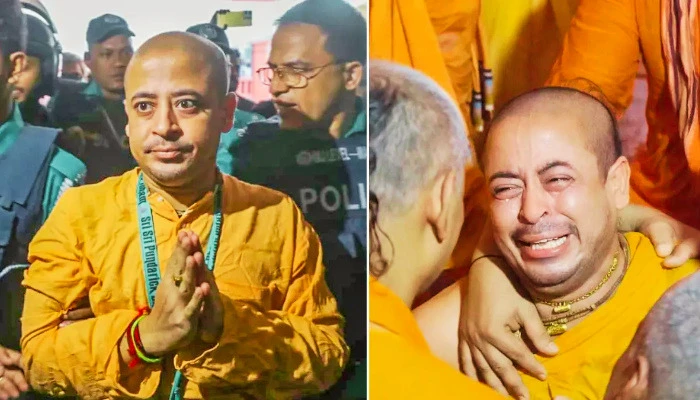
Case Summary
In Bangladesh, Hindu monk Chinmoy Krishna Das, who has been languishing in jail for almost two years, was not allowed to meet his dying mother, as the authorities had turned down the family’s request for parole to allow him to visit her in her last moments. Hours before her death, his mother, in a recorded message, had requested the Bangladesh government to let her meet him for some time. However, only after the mother's death was he granted five hours of parole to attend her funeral. Chinmoy Krishna Das Brahmachari is a Hindu monk and spokesperson of the Bangladesh Sammilito Sanatani Jagaran Jote. He was formerly associated with ISKCON and served as the head of Pundarik Dham in Chattogram. Following the political upheaval in Bangladesh in August 2024, he became a prominent voice in peaceful protests demanding security for Hindus, protection of Hindu homes and places of worship, and action against those responsible for attacks on the community. Against this backdrop, Chinmoy addressed a large gathering at Laldighi Maidan in Chattogram on 25 October 2024. The organisers presented an eight-point agenda that included creating a ministry for minority affairs, legislation to protect minorities, and the prompt trial of cases involving attacks on minorities. They also raised the issue of attacks on Hindu homes and places of worship. They also denounced the government’s failure to bring charges against the perpetrators of attacks on Hindu homes and places of worship. However, Firoz Khan, former general secretary of the Mohora ward unit of the Bangladesh Nationalist Party (BNP), lodged a complaint against Das and 18 others on 31st October, 2024. He asserted that a saffron flag had been hoisted above the national flag of Bangladesh at the “Independence Monument” by them. On 25 November, 2024, the Dhaka Metropolitan Detective Police arrested him at Hazrat Shahjalal International Airport and transferred him to the Chattogram Metropolitan Police. The court rejected his bail application, and he was sent to jail in connection with the sedition case. This resulted in violence around the court premises. A lawyer, Saiful Islam Alif, who was the public prosecutor in the case, was killed during the violence, while several other people were injured. Thereafter, Das also addressed his followers and expressed, “We are not against the state and the government. We, the Sanatanis, are a part of the state. We will not do anything to destabilise the state and destroy peaceful coexistence. We will hold a peaceful protest by controlling our emotions and turning them into strength.” Subsequently, his charges were expanded beyond the sedition case. He was charged in multiple cases, including cases involving murder, attempted murder, vandalism and obstruction of officials. Six criminal cases were ultimately brought against him, including the murder of the lawyer Saiful Islam Alif. The subsequent bail proceedings were also affected and postponed because defence counsel was absent. The lawyers were too intimidated to appear for him after extreme threats following the death of Saiful Islam Alif. On another occasion, Chinmoy was produced before the court from jail without a defence lawyer present. The case concerning Saiful Islam Alif's death later became one of the principal cases keeping Chinmoy in custody. On 19 January 2026, a Chattogram court framed charges against 39 people, including Chinmoy, in the murder case. Sections 302 and 109 of the Penal Code were invoked against him. Meanwhile, his bail applications continued before different courts. On 30 April 2025, the High Court granted him bail in the sedition case, but the Bangladesh Supreme Court's Appellate Division subsequently stayed that order. He was later granted bail in five cases involving charges of attempted murder, vandalism and obstructing officials in the discharge of their duties. Even after those orders, he remained in jail because two other cases ( the Saiful Islam murder case and sedition case) continued to prevent his release. While Chinmoy remained in prison, his mother, Sandhya Rani Dhar, was undergoing treatment for illness. She died on 10 September 2026 at Pundarik Dham in Hathazari, Chattogram. Before her death, his family sought permission for Chinmoy to meet her, but the request was not granted. She died without seeing her son. Following her death, Chinmoy's family submitted an application for parole so that he could attend her funeral. The Chattogram District Deputy Commissioner approved five hours of parole. Chinmoy was released from Chattogram Central Jail under police security and taken to Pundarik Dham, where he attended his mother's funeral rites. He was then required to return to prison after the five hours. Thereafter, a video circulated on social media showing Chinmoy Das lying at his mother’s feet and crying inconsolably. He was later seen touching the feet of the Radha-Krishna idol at Pundarik Dham temple, tears in his eyes, before returning to jail. The scenes offered a powerful reminder of the personal cost of his imprisonment while also showing that his faith and resilience remained unshaken. Despite the intensely adversarial environment, he remained steadfast in his convictions, reflecting the resilience many Hindus facing hostility in Bangladesh have shown. This incident occurred against the broader backdrop of the historical persecution faced by Hindus in Bangladesh. While the Hindu minority has endured discrimination, targeted violence, and religious hostility over decades, such persecution has intensified in distinct spurts during periods of political and social instability. The latest major escalation began after the ouster of Sheikh Hasina’s government in August 2024, continued after the death of Sharif Osman Bin Hadi in December 2025, and resurfaced immediately after the 13th National Parliamentary Election in 2026. Following the ouster of Sheikh Hasina, multiple incidents involving attacks on Hindu homes, temples and religious institutions were documented, alongside intimidation, arson and mob violence targeting Hindu localities. The Hinduphobia Tracker recorded 336 incidents involving the Hindu minority during this period, reflecting the scale of the escalation and the continuing vulnerability of Hindus in Bangladesh. A further spurt of violence followed the death of Sharif Osman Bin Hadi, a Muslim political activist and student leader known for his anti-Hindu and anti-India rhetoric, in December 2025. In the aftermath, Hindu communities were subjected to retaliatory violence, with Hindu homes and properties selectively attacked and several families forced to flee. Among the victims was Dipu Chandra Das, who was lynched and whose body was subsequently set ablaze by a Muslim mob over false blasphemy allegations. The Hinduphobia Tracker documented 51 incidents of anti-Hindu violence in the period following Hadi’s death alone, further illustrating how existing hostility towards the Hindu minority intensified during moments of communal mobilisation. During the same period, posters and written material calling for the extermination of Hindus were also displayed in public spaces. Such rhetoric, when viewed alongside incidents of arson, vandalism, assault and targeted intimidation, reflected an environment in which hostility towards Hindus was not merely episodic but repeatedly resurfaced in more intense forms during periods of unrest. The most recent escalation followed the 13th National Parliamentary Election in 2026. In the immediate aftermath of the election results, Hindu families in districts including Noakhali, Rangpur, Nilphamari, Sylhet, Thakurgaon and Dinajpur faced attacks involving arson, looting, assault and vandalism of Hindu homes and temples. In several instances, Hindu properties were selectively targeted, and families were threatened with displacement. The present incident therefore occurred within a much longer history of persecution of Hindus in Bangladesh, where hostility towards the community has persisted over time and intensified in repeated spurts. The latest cycle began after the ouster of Sheikh Hasina and continued through subsequent periods of political and communal upheaval, leaving the Hindu minority increasingly vulnerable to targeted violence, intimidation and religious hostility.
Why it is Hate Crime ?
This case is added to the tracker under the primary category: Attack not resulting in death. The subcategory selected is: Attacked for Hindu identity. In several cases, Hindus are attacked merely for their Hindu identity without any perceived provocation. A classic example of this category of religiously motivated hate crime is a murder in 2016. 7 ISIS terrorists were convicted for shooting a school principal in Kanpur because they got ‘triggered’ seeing the Kalava on his wrist and the tilak that he had put. In this, the Hindu victim had offered no provocation except for his Hindu religious identity. The motivation for the murder was purely religious, driven by religious supremacy. Such cases where Hindus are targeted merely for their religious identity would be documented as a hate crime under this category. The other category selected for the case is: Attacked for supporting/being part of a perceived Hindu party/org or working for Hindu community. In several cases, Hindus are attacked specifically or tangentially for their association with parties or organisations perceived to be pro-Hindu and/or for working in favour of the Hindu community. One of the classic cases was the attack against a Bharatiya Janata Party Yuva Morcha (BJYM) worker, Praveen Nettaru. Nettaru was attacked and hacked to death for his association with Hindu organisations and his work for the Hindu community. He was murdered by PFI, a terror organisation that aimed to commit genocide of Hindus, target Hindu leaders specifically and turn India into an Islamic Nation. In such cases, the immediate trigger for the violence may be non-religious – either according to the perpetrator or the police. However, there are surrounding circumstances from which the conclusion can be reached that the victim was attacked for his association with a Hindu organisation. In a similar case, Rinku Sharma was attacked by radicals. He was a member of Bajrang Dal and regularly worked for the Hindu community. While the police cited a different non-religious trigger for the attack, he was indeed associated with a Hindu organisation, and the family of Rinku Sharma specifically attributed his gruesome murder to him working for Bajrang Dal and raising Jai Shree Ram slogans. Such cases are intrinsically driven by religious hate and would therefore be documented as a hate crime under this category. This case was a clear example of a religiously motivated hate crime because Chinmoy Das was targeted as a Hindu monk who openly spoke for the rights, safety and dignity of Hindus in Bangladesh. His Hindu identity was central to the hostility directed towards him. As a visible religious representative of the Hindu minority, he had raised his voice against atrocities committed against Hindus and demanded protection for his community. He was arrested on the pretext of sedition and was not afforded bail, even though he was a peaceful religious figure who had used his voice to speak about the persecution of Hindus. His persecution therefore targeted both his Hindu identity and his refusal to remain silent about the suffering of his community. The manner in which he was treated reinforced this religious targeting. After his arrest, no defence lawyer was provided to him, which led to the rejection of his bail application. He was subsequently denied the opportunity to meet his dying mother. A peaceful Hindu monk who had spoken about the persecution of his community was thus denied basic legal protection and the final opportunity to see his mother. The cruelty of this treatment was particularly significant because it was directed at a person who had used his public position to speak about the rights and safety of Hindus. His treatment also carried a wider message for the Hindu community. When a person who peacefully spoke about the persecution of Hindus was arrested, denied legal representation and prevented from meeting his dying mother, his punishment served as a warning to others who might raise their voices. His voice was not merely silenced at an individual level. His treatment served to frighten a wider minority community into silently enduring the inhumanities inflicted upon it rather than resisting or speaking out against them. This was particularly grave because the Hindu minority had already faced repeated attacks on its homes, temples and sacred sites, resulting in killings, sexual violence, looting, vandalism, arson, intimidation and terrorising of Hindu localities, particularly after the forced ouster of Prime Minister Sheikh Hasina. The Hinduphobia Tracker recorded 336 incidents involving the Hindu minority following the ouster of Sheikh Hasina's government in August 2024. A further 51 incidents were documented after the death of Sharif Osman Bin Hadi in December 2025. These incidents demonstrated the increasingly hostile environment in which Hindus had been forced to live. The persecution had also reached a level where Hindus had been mercilessly killed over their religious identity and, in documented cases, even for refusing to pay jizya. Such incidents demonstrated the extreme insecurity faced by the minority community. Against this backdrop, the persecution of a peaceful Hindu monk who spoke for Hindu rights carried an even deeper significance. Hindus had faced violence simply for remaining Hindu, while a monk who raised his voice against that persecution suffered imprisonment and the denial of basic human dignity. The targeting of Chinmoy Das therefore reflected more than ordinary criminal or political persecution. His Hindu identity placed him within a vulnerable religious minority, his position as a Hindu monk made him a visible representative of that community, and his advocacy made him a direct voice against the persecution of Hindus. These factors converged in his treatment. Instead of receiving protection, he was arrested, denied a defence lawyer, denied bail and prevented from seeing his dying mother. His suffering demonstrated the consequences faced by a Hindu who publicly challenged the persecution of his community. The incident therefore warranted inclusion under the category of attacks on Hindus for their Hindu identity because the persecution directed at Chinmoy Das was inseparable from his Hindu identity, his religious position and his decision to speak for the rights of Hindus. His treatment not only harmed him personally but also sought to suppress a Hindu voice at a time when the wider community was already facing severe violence and intimidation.
Victim Details
Total Victim
1
Deceased
0
Gender
- Male 1
- Female 0
- Third Gender 0
- Unknown 0
Caste
- SC/ST 0
- OBC 0
- General 1
- Unknown 0
Age Group
- Minor 0
- Adult 1
- Senior Citizen 0
- Unknown 0


Case Status
Unknown


Perpetrators Details
Perpetrators
State and Establishment
Perpetrators Range
Unknown
Perpetrators Gender
unknown
 Sources




