Hindu temple’s sanctity desecrated by man performing obscene acts inside its premises; Hindu devotee beaten and threatened with death for objecting
 Gorakhpur, Uttar Pradesh, India
  11 September, 2026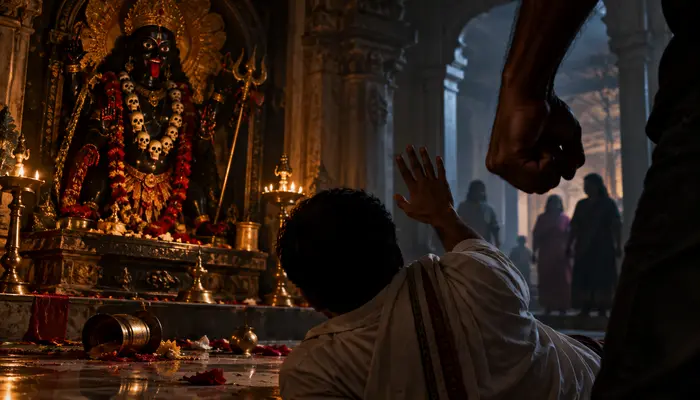
Case Summary
In Bhiti Tiwari village, under Bansgaon Police Station in Gorakhpur district of Uttar Pradesh, the sanctity of a Kali temple was desecrated by a man who performed obscene acts inside the temple premises. When a Hindu villager objected to the conduct, he was abused, subsequently assaulted and threatened with death after approaching the police. On 12 September 2026, the perpetrator was performing extremely obscene acts inside the Kali temple premises. Village resident Omkar Pandey objected to the conduct, pointing out that the area had regular movement of villagers and that women visited the temple for worship. Children also passed through the area while going to the government school situated beside the temple. Following his objection, the man verbally abused Pandey. Pandey subsequently informed the Dial 112 police service about the incident. By the time the police team reached the temple, the man had already left the premises. The police team then went to his residence, informed his family members about the incident and showed them the video recording of the act. Pandey stated that the video remained stored on his mobile phone and that he would provide it to the police as evidence. The matter escalated after the man's family came to know that Pandey had approached the police. According to the written complaint submitted at Bansgaon Police Station, after the Dial 112 team had left, two of the perpetrator's brothers waylaid Pandey on the road. They confronted him over his complaint to the police, verbally abused him and assaulted him with sticks and fists. Pandey further stated that the two men threatened to kill him. Following the assault, Pandey expressed apprehension regarding the safety and well-being of himself and his family. He submitted a written complaint at Bansgaon Police Station seeking an impartial investigation into the entire incident, registration of a case under the relevant legal provisions, necessary legal action against those responsible and protection for himself and his family. The complaint stated that the video of the obscene acts at the temple remained on Pandey's mobile phone and could be produced before the police during the investigation. It also stated that some other villagers had witnessed the incident. The complaint sought that the video, eyewitness accounts and statements of the parties concerned be considered while determining the circumstances surrounding both the incident at the temple and the subsequent assault. The man identified in connection with the obscene acts at the temple was Sunil Chaubey, son of Ramgopal Chaubey, aged approximately 40 years. His brothers, Manish Chaubey and Rajnish Chaubey, were named in connection with the subsequent assault and death threats against Pandey. Notably, in this case, the Hinduphobia Tracker contacted Bansgaon Police Station regarding the incident. A police officer confirmed that the incident had taken place and that obscene acts had been committed at the temple. However, the officer declined to disclose the specific nature of the obscene acts and did not provide further details about the incident.
Why it is Hate Crime ?
The primary category selected in this case is: Attack on Hindu religious representations. The subcategory selected is: Breaking rules of place of worship. Sanatan Dharma is not a religion of one book, which is to say that while it has religious scriptures that form the central tenets of the faith, there are several traditions followed through thousands of years, mostly passed from generation to generation orally. One of these oral traditions or written traditions is the rules of specific temples. Certain temples have rules which are traditional rules, dependent on the worship of the presiding deities. These rules and traditions have been followed for thousands of years whether they find scriptural mention or not. Such traditions are based on the nature and rules of worship of the presiding deity of that temple. Any non-compliance of these traditions owing to animosity towards the faith or for the sake of activism stems not only from the lack of faith in the presiding deity but also disregard for the faith of the devotees of that deity/temple and implicit bias against the faith, the tradition and the deity itself. Since these specific traditions are central to the faith of the devotees of that specific temple and presiding deity, any non-compliance with these traditional rules would be considered a religiously motivated hate crime. The other subcategory selected is: Defiling religious customs. Sanatan Dharma is not a religion of one book, which is to say that while it has religious scriptures that form the central tenets of the faith, there are several traditions followed through thousands of years, mostly passed from generation to generation orally. There are several such customs and traditions that are followed by various Hindus and Hindu sects. Defiling of these traditions and customs is a breach of an individual or group’s religious practices. Such practices can range from dietary restrictions like not eating non-vegetarian food for a certain period of the year, not eating non-vegetarian food at all, not eating beef since the cow is considered holy in Hinduism, the sanctity of religious customs followed in the house (like many ISCKON devotees), etc. Any malicious action leading to the breach of such traditions or defilement of these traditions owing to animosity towards the faith or for the sake of activism stems not only from the lack of faith in the religion itself but also from disregard for the faith of the devotees who follow the customs/traditions and implicit bias against the faith, the tradition itself. Since these specific traditions are central to the faith of the devotees of that specific sect of Hindus, any non-compliance with these traditional rules would be considered a religiously motivated hate crime. Another primary category selected is: Attack not resulting in death. The subcategory selected is: Attacked for opposing radicals or trying to save victim. In several cases, Hindus are attacked for opposing religiously motivated crimes being committed against a fellow Hindu or simply for voicing an opinion opposing radical elements, who either have in the past or continue to persecute Hindus. In such cases, the initial attack against the victim, against which the Hindu was trying to defend the victim, would also need to be classified as a religiously motivated hate crime. Since the initial crime itself was religiously motivated and the subsequent crime of attempting to save the victim or speaking against the radical elements ends up inviting a violent attack, it would also be classified as a religiously motivated hate crime under this category. This case was a clear example of a hate crime because the perpetrator performed obscene acts inside a Hindu temple, directly violating the sanctity of a revered Hindu place of worship. When a Hindu devotee, Omkar Pandey, objected to the desecration and sought police intervention through lawful means, he was subjected to verbal abuse, physical assault and death threats by the perpetrator's brothers. The most significant religious offence in this case was the desecration of the sanctity of the Hindu temple through obscene acts. A Hindu temple is a deeply revered place of worship and holds profound religious and spiritual significance for Hindu devotees. Hindus approach temples as sacred spaces and maintain their purity and sanctity through established religious customs, practices and rules of conduct. Obscene behaviour has no place within such a sacred environment and directly violates the reverence with which Hindu places of worship are treated. By performing extremely obscene acts inside the temple premises, the perpetrator defiled a space regarded as sacred by the Hindu community, violated the religious norms governing conduct at a Hindu place of worship and showed complete disregard for Hindu sentiments. Such deliberate violation of the sanctity of a Hindu temple demonstrated deep-seated hostility towards Hindu religious beliefs, practices and sacred spaces. The act therefore went beyond ordinary misconduct and amounted to a direct affront to the religious dignity of the Hindu community, making it a clear instance of religiously driven hate crime. The hostility was further demonstrated by the treatment of the Hindu devotee who objected to the desecration. Pandey did not respond with violence or take the law into his own hands. He simply objected to the obscene conduct at the temple and informed the police through the Dial 112 emergency police service. He was exercising a legitimate and peaceful means of protecting a sacred Hindu place of worship from being defiled. Yet, merely for raising an objection and approaching the authorities, he was subsequently waylaid, abused, assaulted with sticks and fists and threatened with death. The violence sent a broader message that Hindus who stand up for the sanctity of their temples and oppose acts that offend their faith can themselves become targets of intimidation and violence. Such retaliation creates fear and insecurity among the Hindu community and seeks to discourage devotees from speaking out when their religious spaces are desecrated. The attack was therefore rooted not merely in a personal dispute but in hostility towards a Hindu who attempted to protect and defend a Hindu place of worship through completely peaceful and lawful means. Such actions are rooted in hostility towards Hinduism and the Hindu community, making this a clear example of an anti-Hindu hate crime. The active participation of the perpetrator's brothers in the subsequent assault further aggravated the religious dimension of the incident. Rather than distancing themselves from the conduct that had taken place inside the temple, the two men confronted Pandey after learning that he had approached the police and subjected him to violence and death threats. Their actions demonstrated support for the retaliation against a Hindu devotee who had objected to the desecration of the temple and sought lawful intervention. The fact that multiple members of the perpetrator's family became involved in targeting the person who opposed the desecration reinforced the hostile environment created around the Hindu place of worship and the devotee who sought to protect it. This collective retaliation demonstrated clear contempt for the victim's religious concerns and reinforced the religiously hostile nature of the incident. Overall, since this case meets the parameters of a hate crime, it is being added to the hate crime database of the Hinduphobia Tracker.
Victim Details
Total Victim
1
Deceased
0
Gender
- Male 1
- Female 0
- Third Gender 0
- Unknown 0
Caste
- SC/ST 0
- OBC 0
- General 1
- Unknown 0
Age Group
- Minor 0
- Adult 1
- Senior Citizen 0
- Unknown 0


Case Status
Complaint filed


Perpetrators Details
Perpetrators
Others
Perpetrators Range
From 2 To 5
Perpetrators Gender
male
 Sources




