Hindus targeted for Christian conversion through inducements and ‘healing’ meetings in Lucknow
 Lucknow, Uttar Pradesh, India
  12 September, 2026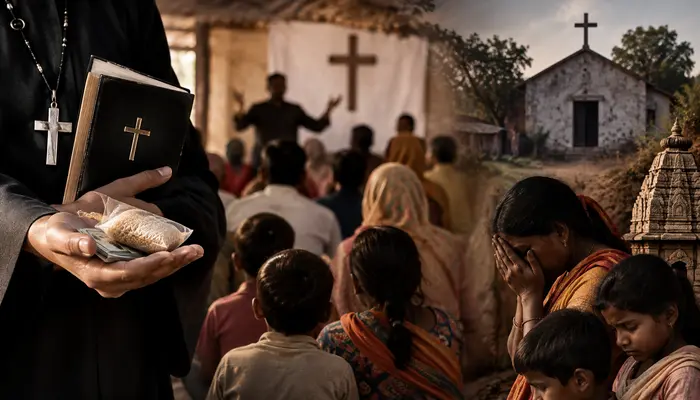
Case Summary
In the Mohanlalganj and Nigohan areas of Lucknow, Uttar Pradesh, Hindus were targeted for Christian conversion through inducements and under the pretext of 'healing' meetings. The conversion network operated across several villages and used these activities to influence Hindus to change their religion. The gang continued operating from different locations even after some of its members were arrested. In Bhola Kheda village of Nigohan, several people were found to have changed their religion. A woman from Mizoram, identified as Naghaki, had spent three years propagating Christianity in the village. She had changed her name from Naghaki to Anjali for this purpose. After the gang involved in the conversion activities was caught, she stopped being seen in the area. Villagers said that she returned to the village twice, but stayed at different places for two or four days before leaving. Malkhan, who was linked to the religious conversion activities, had been sent to jail on charges of religious conversion and was subsequently released on bail. He had been conducting healing meetings from a room constructed in the fields of Baktauri Kheda village. The activities drew opposition from local residents, following which Malkhan changed his location. Malkhan subsequently shifted his activities to Kila village in Ashiyana, where he and his associates held meetings every Sunday. The report stated that large-scale religious conversions had also been carried out in Kila village. Malkhan was also engaged in farming there. The wider conversion network operated from several locations. A church in Bhola Kheda, a hamlet of the Uttarawan gram panchayat in Nigohan, remained locked after the gang was caught. Those involved in the suspicious activities changed their locations, but the gang continued operating in different areas. It continued offering inducements to people to attend Sunday prayer meetings as part of its conversion activities. In Dubbaga, another gang was also influencing people and encouraging them to change their religion, prompting objections from local residents. The activities also came to light in Bhadesuwa village of Mohanlalganj, where a healing meeting was organised. Dharmendra Sharma, the district security chief of Bajrang Dal, conducted a raid with his team. Chandrika Prasad, a resident of Dhodhan Kheda, along with women and children, was found praying at the spot. They were Hindus, and questioning during the raid provided information about the religious conversion activities. Following the incident, Hindu organisations created a ruckus in protest. In Kamalapur, Nagaram, Bajrang Dal also protested after receiving information about the gang and its activities.
Why it is Hate Crime ?
The primary category selected in this case is: Predatory Proselytisation. The subcategory selected is: Conversion/ attempts to convert by inducement. Predatory Proselytisation is not just limited to threat, harassment, force and violence, but it also has contours of stealth. In several cases, the Hindu victim is exploited to convert, with non-Hindus taking advantage of their poverty. In such cases, the Hindu victim who is suffering financially is offered monetary benefits, including lucrative offers for jobs, health treatment, education, etc, to induce the victim into changing his/her religion. In such cases, the religious identity of the victim and the aim to disenfranchise him from his faith form the heart of the crime. Also, taking advantage of and exploiting an individual’s economic vulnerabilities is widely acknowledged as exploitation, forms of which are often penalised by law. Such cases therefore are considered religiously motivated hate crimes since the victim’s religious identity forms the very heart of the crime itself. The other subcategory selected is: Proselytisation by grooming, brainwashing, manipulation or subtle indoctrination. The tertiary categories selected are: Conversion of minor, Pattern of targeting Hindus. Religious brainwashing essentially means the often subtle and forcible indoctrination to induce someone to give up their religious beliefs to accept contrasting regimented ideas. Religious grooming or brainwashing also involves propaganda and manipulation. It involves the systematic effort, driven by religious malice and indoctrination, to persuade “non-believers’ to accept allegiance, command, or doctrine to and of a contrasting faith. Cases of such grooming or brainwashing are far more nuanced than direct threats, coercion, inducement and violence. In such cases, it is often seen that there is repeated, subtle and continual manipulation of the victim to induce disaffection towards their own faith and acceptance of the contrasting faith of the perpetrator. While subtle indoctrination is widely acknowledged as predatory, an element which is often understated in such conversions or the attempts of such conversion is the role of loyalty and trust which might develop between the perpetrator and the victim. Fiduciary relationships are often abused to affect such religious conversion. For example, an educator transmitting religious doctrine of a competing faith to a Hindu student. The Hindu student is likely to accept what the teacher is transmitting owing to the existence of the fiduciary relationship. The exploitation of the fiduciary relationship to religiously indoctrinate victims would also be included in this category. Since the underlying animosity towards the victim’s faith forms the basis of predatory proselytization, such cases are considered religiously motivated hate crimes. This case is a clear example of a religiously driven hate crime because Hindus were specifically targeted for conversion to Christianity through organised proselytisation activities involving inducements, prayer gatherings and so-called healing meetings. The activities were not confined to a single incident or location but were carried out across several villages, with Christian individuals and groups repeatedly conducting religious gatherings and attempting to influence members of the Hindu community to abandon their faith. Such targeted efforts to interfere with the religious identity of Hindus demonstrated hostility towards Hinduism and the Hindu community. The fact that Hindus were singled out and targeted for conversion itself showcased deep-seated hostility towards the Hindu community. A conversion can only be considered genuine and voluntary when it takes place out of a person's own free will, conviction and independent choice. Where persuasion, pressure, manipulation or inducements are used to influence a person to abandon their existing faith, the resulting conversion cannot be regarded as a genuinely willful exercise of religious choice. Rather, such conduct amounts to religious coercion and forced proselytisation. By specifically attempting to make Hindus renounce Hinduism and embrace Christianity through such means, the perpetrators interfered with their victims' religious autonomy and fundamental rights. Such targeted interference with the religious identity of Hindus was rooted in hostility towards Hinduism and the Hindu community, making the conduct a clear instance of religiously motivated hate crime. The use of inducements to draw Hindus into Sunday prayer meetings and conversion activities further demonstrated the coercive nature of the proselytisation. The gang continued operating in different areas and invited people to Sunday prayer meetings by offering inducements, while conversion activities were carried out through the network. Using inducements to influence members of the Hindu community to enter Christian religious settings and move towards conversion exploited their socio-economic vulnerabilities and placed material or other incentives alongside their religious choices. Such conduct effectively amounted to arm-twisting Hindus into moving towards Christianity rather than allowing them to make an entirely free and independent decision regarding their faith. Exploiting vulnerabilities through inducements to facilitate religious conversion was therefore a form of religious coercion rooted in hostility towards Hinduism, making it a clear case of religiously driven hate crime. The use of so-called healing meetings as part of the conversion activities further demonstrated the manipulative nature of the proselytisation. Malkhan had conducted healing meetings from a room constructed in the fields of Baktauri Kheda village, while a healing meeting in Bhadesuwa village ultimately brought the activities to light. Such gatherings created an avenue through which vulnerable people were influenced by the promise or suggestion that participation in Christian religious practices and conversion could provide relief from illness or other problems. Using a person's illness, suffering or hope of recovery to influence their religious affiliation is a deeply manipulative tactic. It exploits victims at a vulnerable point in their lives and interferes with their ability to make an autonomous decision about their faith. Employing claims or expectations of healing as a means of drawing Hindus towards Christianity and conversion is therefore not merely religious outreach, but a coercive form of proselytisation rooted in hostility towards their existing Hindu faith and religious identity. The involvement of minors made the conversion efforts even more concerning. During the raid on the healing meeting in Bhadesuwa, Chandrika Prasad of Dhodhan Kheda, along with women and children, was found praying, and they were identified as Hindus. The presence of children at a gathering connected with religious conversion raised serious concerns because minors, by virtue of their young age and limited maturity, are not in a position to fully comprehend the long-term consequences of abandoning one faith and adopting another. The element of genuine, informed and independent consent is therefore fundamentally compromised when children are subjected to conversion-oriented religious influence. By exposing Hindu children to organised Christian proselytisation and attempting to influence their religious identity at such an impressionable age, the perpetrators exploited their age-related vulnerability and threatened the transmission of Hindu beliefs and traditions from one generation to the next. Such exploitation of minors for religious conversion further demonstrated the religiously motivated nature of the activities and constituted an attack on the religious autonomy and identity of the Hindu community. The fact that such proselytisation activities were repeatedly carried out across different parts of the city demonstrated that these were not isolated incidents, but part of an organised and sustained Christian proselytisation effort. The conversion activities were conducted across multiple locations, with different individuals and groups holding prayer and healing meetings and encouraging Hindus to change their religion. The repeated nature and geographical spread of these activities indicated a coordinated pattern of targeting members of the Hindu community for conversion, further demonstrating the religiously motivated nature of the acts. Given that this case meets the parameters of a hate crime, it is being added to the hate crime database of the tracker. Disclaimer: The Hinduphobia Tracker records perpetrator counts based on confirmed figures available in the source. The source confirms two individually identified perpetrators, Malkhan and Naghaki, who had used the name Anjali while propagating Christianity, alongside Malkhan's unnamed associates. For documentation purposes, a conservative count of 2, comprising the two named perpetrators, has been used as the perpetrator count. This was recorded for documentation purposes only.


Case Status
Case sub-judice


Perpetrators Details
Perpetrators
Christian Extremists
Perpetrators Range
From 2 To 5
Perpetrators Gender
male
 Sources




