Hindu woman and her minor children pressured to convert by Muslim man posing as Hindu; victims forced to offer Qurbani, eat meat and abandon Hindu worship
 Nala Sopara, Maharashtra, India
  9 September, 2023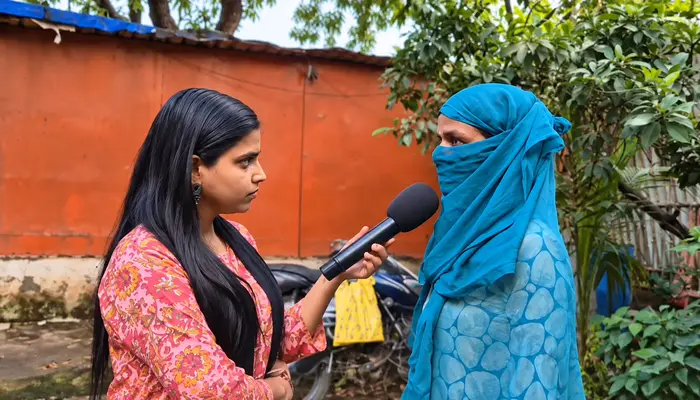
Case Summary
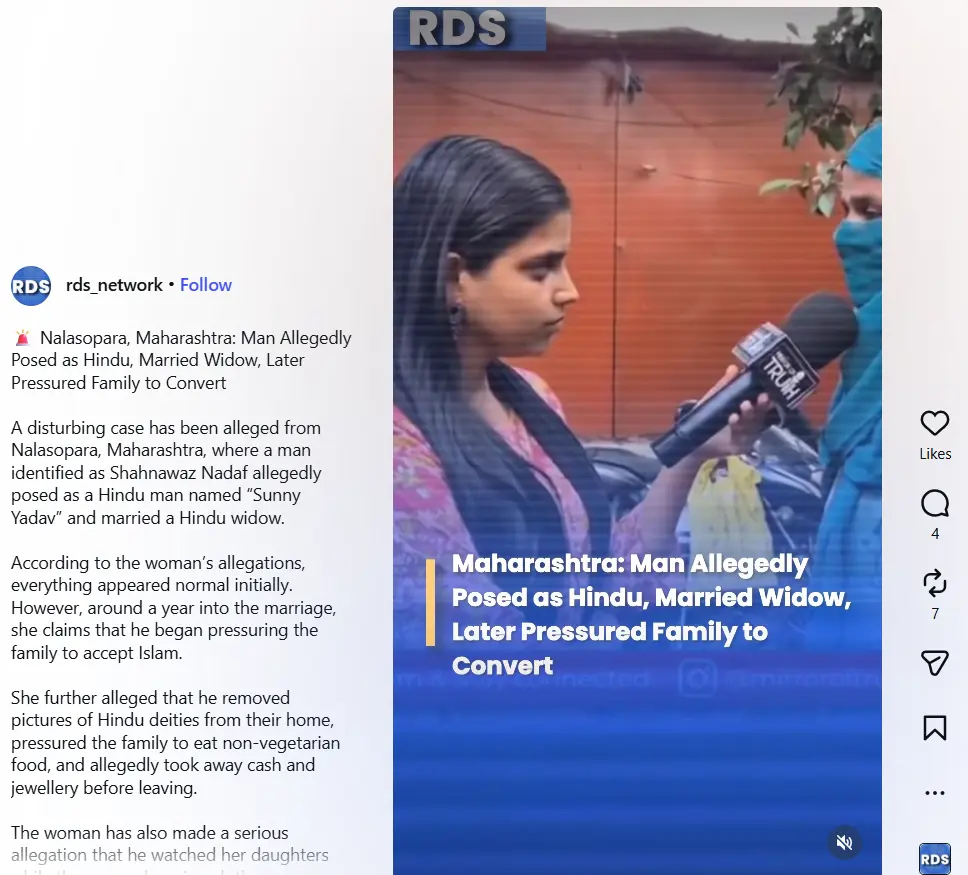
In Nalasopara, Maharashtra, a Hindu woman and her minor children were subjected to religious coercion and pressure to convert to Islam by a Muslim man who posed as a Hindu to enter into a relationship and marriage with her. The accused initially introduced himself as 'Sunny Yadav' but was later identified as Shahnawaz Nadaf. After the marriage, Nadaf pressured the woman and her family, including her minor children, to convert to Islam, objected to their Hindu religious practices, removed pictures of Hindu deities from their home and threw away their household temple when the woman performed Navaratri puja. He also pressured the family to slaughter a goat during Eid (Qurbani) and consume meat, chicken and fish despite their refusal. The woman met Nadaf while they were working at the same company. He introduced himself as Sunny Yadav, after which they began living together in a house and married about a year later. The woman was a Hindu widow with children, including minor daughters. Around two years into the marriage, she discovered his real name and Muslim identity. Over the following year, in 2025, Nadaf increasingly pressured her and her children to convert to Islam and attempted to impose Islamic religious practices on the Hindu family. Nadaf also subjected the woman and her children to physical violence and harassment within the household. He beat the woman and her children with a belt and prevented the children from attending school, telling the woman that he would not allow them to receive an education. He also subjected the woman to unwanted physical contact and watched her while she changed her clothes. He similarly watched her minor daughter while she changed clothes and threatened to kill the girl if she told her mother about his conduct. Around 15 May 2026, Nadaf took ₹3 lakh in cash from the woman, telling her that the money was required to build a house. He subsequently demanded another ₹5 lakh, following which the woman sold all her personal jewellery to meet his demand. On the morning of 16 May 2026, Nadaf took her official files and documents and left the house. When the woman contacted him by telephone, he threatened her and asked what she could do against him. Following this, the woman approached Pelhar Police Station, which falls under the Mira-Bhayandar, Vasai-Virar Police Commissionerate, seeking action against Nadaf for the abuse and coercion faced by her and her children. She said that no legal action was taken and that she did not receive a hearing following her complaint. She subsequently returned to the police station accompanied by a relative's son to pursue a formal complaint and seek action against Nadaf.
Case Images
Why it is Hate Crime ?
The primary category selected in this case is: Crimes against women in relationships and other sexual crimes. The subcategory selected is: Man pretends to be Hindu. The tertiary category selected is: Name Changed. When a non-Hindu man pretends to be a Hindu to deceive a Hindu woman into a relationship, the act is seen as triggered by mala fide intentions. In some cases, the woman eventually accepts the man’s original religious identity and converts after the man’s identity is revealed. These cases could be argued as cases of religious brainwashing and a result of the pressure a woman feels after getting into a relationship with a man. The woman, it can be argued, also changed her religious identity because of the stigma she believes she might face if she chooses to walk out of a deceptive relationship. However, for the purpose of documenting hate crimes, the cases in this subcategory are limited to those where there is explicit violence aimed at religious conversion against the wishes of the victim (force-feeding beef, blackmailing with intimate videos, rape on refusal to convert, etc.), or if the woman herself complains of the man’s religious deception. In such cases, it is established that the deception of the non-Hindu man had a specific aim of religious conversion or targeting of the victim due to her Hindu religious identity, therefore, making it a religiously motivated hate crime. The other subcategory selected is: Forced conversion after marriage. In such cases, a non-Hindu man marries a Hindu woman, and the force/pressure to convert to any Abrahamic faith, like Islam, begins after marriage. In such cases, typically, two patterns emerge. First, when the relationship is consensual and the religious identity of the perpetrator is known to the Hindu woman in the relationship. The marriage could be under the Special Marriages Act, where neither party is required to convert their religion for the marriage to be considered legitimate. While the victim in such cases enters matrimony assuming that religious identity is not a barrier, the non-Hindu man starts to pressure the woman to convert her religion after marriage. The second is when the woman gets into a marriage with the man, pretending to share her faith. Later, when the truth is revealed, the man starts pressuring the woman to convert her religion and give up her religious identity. In both situations, there is an application of force by the perpetrator, including the denial of the woman’s religious rights. Some of the means by which the woman is forced/pressured to convert include force-feeding beef, being forced to read the Kalma, being forced to wear a hijab, being forced to undergo Halala, etc. There are several instances where, after marriage, the woman voluntarily converts to Islam. Such cases are often argued to be a result of religious brainwashing; however, for the purpose of documenting religiously motivated hate crimes, in the absence of the victim complaining of forced conversion, such cases do not form a part of the database. The other subcategory selected is: Desecration of Hindu symbols in relationship. When Hindu women are in a relationship with non-Hindu men, there are cases where the woman faces insult and desecration of her faith (Hinduism) and its symbols because of the inherent disregard for polytheism of the non-Hindu partner. Such relationships may be consensual, with the religious identity of the non-Hindu man known to the victim. Somewhere along the relationship, the non-Hindu man starts desecrating the religious symbols of the Hindu partner out of spite for her faith. Such cases are driven by specific religious motivations and against the religious identity of the victim and are therefore qualified as hate crimes. The other primary category selected is: Predatory Proselytisation. The subcategory selected is: Harassment, threats, coercion for conversion. Harassment covers a wide range of behaviours of an offensive nature. It is commonly understood as behaviour that demeans, humiliates, and intimidates a person, including threats and coercion. Harassment and threats, in this case, find their root on discriminatory grounds which has the effect of nullifying a person’s rights or infringing upon his freedom to exercise his right specifically owing to the victim’s religious identity. Verbal and physical threats and psychological or physical harassment are often used against Hindu victims because they choose to practice their professed religion. Religious harassment also includes forced and involuntary conversions by harassment, threats or coercion. Coercion includes intimidatory tactics like force-feeding a Hindu victim beef to convert to another religion, forceful circumcision etc. In several cases documented, non-Hindu perpetrators or those who harbour specific animosity towards Hinduism, harass victims simply based on their religious identity. Such cases often also include harassment to ensure the Hindu victim abandons his/her professed religion and adopts the religion of the perpetrator. Such cases where Hindu victims are harassed to convert to the perpetrator’s religion are rooted in animosity towards the victim’s religious identity and are therefore documented as religiously motivated hate crimes. The other subcategory selected is: Proselytisation by grooming, brainwashing, manipulation, or subtle indoctrination. The tertiary category selected is: Conversion of minor. Religious brainwashing essentially means the often subtle and forcible indoctrination to induce someone to give up their religious beliefs to accept contrasting regimented ideas. Religious grooming or brainwashing also involves propaganda and manipulation. It involves the systematic effort, driven by religious malice and indoctrination, to persuade “non-believers’ to accept allegiance, command, or doctrine to and of a contrasting faith. Cases of such grooming or brainwashing are far more nuanced than direct threats, coercion, inducement and violence. In such cases, it is often seen that there is repeated, subtle and continual manipulation of the victim to induce disaffection towards their own faith and acceptance of the contrasting faith of the perpetrator. While subtle indoctrination is widely acknowledged as predatory, an element which is often understated in such conversions or the attempts of such conversion is the role of loyalty and trust which might develop between the perpetrator and the victim. Fiduciary relationships are often abused to affect such religious conversion. For example, an educator transmitting religious doctrine of a competing faith to a Hindu student. The Hindu student is likely to accept what the teacher is transmitting owing to existence of the fiduciary relationship. The exploitation of the fiduciary relationship to religiously indoctrinate victims would also be included in this category. Since the underlying animosity towards the victim’s faith forms the basis of predatory proselytization, such cases are considered religiously motivated hate crimes. In this case, the Hindu woman and her minor children were subjected to religious coercion, physical violence and harassment by a Muslim man who posed as a Hindu to enter into a relationship and marriage with her. After concealing his Muslim identity, the perpetrator pressured the woman and her children to convert to Islam, imposed Islamic religious practices on the family, removed pictures of Hindu deities and threw away their household temple, while also forcing them to offer Qurbani and consume meat despite their refusal. Firstly, the perpetrator's act of deception by posing as a Hindu itself demonstrates a clear bias and malicious intent towards the victim’s religion. By hiding his true identity and introducing himself as 'Sunny Yadav', the Muslim man manipulated the Hindu woman’s trust and targeted her under false pretences, indicating a premeditated effort to exploit the woman based on her religious background. Additionally, the marriage legitimised the relationship in the eyes of the woman and the wider Hindu community. This constituted a direct violation of her right to informed consent regarding whom she chooses to marry, as well as an infringement upon her religious beliefs. Thus, the perpetrator’s deliberate decision to hide his religious identity strongly underscored the religious motive behind this crime. In such instances, identity concealment is not just a deceptive tactic for personal reasons but a calculated strategy rooted in religious profiling and targeting. The accused was aware that the victim, being Hindu, would likely refuse his advances if she knew his real identity, and he circumvented this by lying, which directly pointed to a religiously driven intent. This deception reflects a larger pattern where Hindu women are specifically singled out using false identities by Muslim men, often with coercion or conversion in mind. Such targeted victimisation based on religion not only demonstrates a fundamental disregard for Hinduism but also exposes a deeper animosity towards Hindus and their beliefs. Following the marriage, the perpetrator began pressuring the Hindu woman to convert to Islam. Such pressure to change her religion violated her religious autonomy and fundamental right to freely practise and follow her faith. Conversion, when it is not undertaken out of an individual’s own free will and conviction but is instead pursued through force or coercion, amounts to a clear manifestation of religious hostility towards the victim and her Hindu identity. By attempting to compel the woman to abandon her faith, the perpetrator demonstrated deep-seated hostility towards her religious identity, making this a clear case of a religiously driven hate crime. Not only the Hindu woman but even her minor children were pressured to convert to Islam. This made the severity of the case even more pronounced, as the victims being minors meant that their ability to provide mature consent and undergo a genuine change of conscience was missing ab initio. Minors, due to their young age and lack of maturity, are more vulnerable to manipulation and coercion and do not understand the long-term ramifications of discarding their own faith and converting to another. The perpetrator exploited this vulnerability of the minor victims to coerce them into converting to Islam, showcasing deep-seated hostility towards the Hindu victims and their faith identity. Overall, both the Hindu woman and her children were pressured to convert to Islam through coercion. Such coercive proselytisation showcased the perpetrator’s deep-seated disdain for Hinduism and demonstrated that he had no respect for the victims’ right to practise their faith. Rather, he sought to strip away their Hindu identity through force and coercion, making this a clear case of a religiously driven hate crime. Furthermore, the fact that the victims’ Hindu faith was denigrated while they were being pressured to convert to Islam showcased deep-seated religious hostility towards their faith identity. Hindu worship and religious observances are integral expressions of a devotee’s relationship with the divine. Images or murtis of Hindu deities are revered as sacred representations of the deities and are central to household worship. Navaratri is a significant Hindu festival dedicated to the worship of the Divine Goddess Durga in her various forms, with devotees observing puja, prayers and other rituals as an expression of their devotion. A household temple likewise serves as a sacred space where Hindu families perform their daily or periodic worship and maintain a spiritual connection with their faith within their home. Against this religious significance, the perpetrator objected to the woman performing Navaratri puja, removed pictures of Hindu deities from the home and threw away the household temple. These acts directly interfered with the victims’ ability to practise and express their Hindu faith within their own home. The perpetrator’s deliberate restriction of these Hindu religious practices and his treatment of sacred Hindu symbols further demonstrated religious animosity towards the victims. By objecting to the woman’s Navaratri puja, he sought to prevent the family from practising their Hindu faith within their own home. His removal of the images of Hindu deities and the throwing away of the household temple went beyond restricting worship and amounted to the desecration of sacred Hindu symbols that held deep religious significance for the victims. These acts demonstrated a deliberate attempt to suppress the victims’ Hindu religious expression, disrespect objects central to their faith and convey that their Hindu practices and symbols were unacceptable. Such targeted interference with Hindu worship and desecration of sacred symbols, particularly in the context of simultaneous pressure to convert to Islam, showcased deep-seated religious animosity towards Hinduism and the Hindu community, making this a clear case of a religiously driven hate crime. Furthermore, the victims were also pressured to participate in Islamic religious practices, including offering Qurbani during Eid and consuming the meat. Introducing Hindu victims, particularly minor children, to religious observances of another faith and compelling them to participate against their wishes functions as a subtle form of religious indoctrination, gradually introducing Islamic practices into their daily lives while weakening their connection with their own Hindu faith and identity. In this context, the perpetrator’s conduct reflected a deliberate and manipulative method of religious influence, whereby repeated exposure to and participation in Islamic practices was used to distance the victims from their Hindu religious identity. Such coercive tactics, particularly when directed at the vulnerable Hindu woman and minor victims, demonstrated deep-seated hostility towards Hinduism and the Hindu community and further established the religiously driven nature of the crime. The pressure to consume meat also formed part of this broader attempt to impose an Islamic lifestyle upon the Hindu victims. While many Hindus consume meat, a significant number of Hindus observe strict vegetarianism as part of their religious beliefs and regard abstaining from meat as an important aspect of their faith and religious discipline. Therefore, deliberately pressuring Hindu victims who had refused to consume meat, particularly after pressuring them to participate in Qurbani, represented an attempt to interfere with their religiously informed dietary practices. In this context, the imposition of meat consumption functioned as a means of severing the victims from practices associated with their Hindu identity and imposing an alternative religious way of life upon them. Such coercion demonstrated deep-seated hostility towards their Hindu religious beliefs and identity, making this a clear case of a religiously driven hate crime. Taken collectively, the pressure to convert, denigration of Hindu religious practices and symbols, and imposition of Islamic religious observances demonstrated collective hostility towards the Hindu woman and her children’s faith identity. Therefore, this case was added to the Hinduphobia Tracker’s hate crime database. Disclaimer: The Hinduphobia Tracker records incidents based on when an event occurred or when the victim’s ordeal began, rather than when it was reported by the media. It is important to clarify that none of the media sources covering this case specified the exact date when the victim met the accused. However, based on the reported chronology, she met the accused approximately one year before their marriage, discovered his true identity around two years into the marriage, and faced increasing pressure to convert to Islam over the following year, in 2025. The incident first came to light on 10 September 2026. Based on these details, 10 September 2023 has been selected as the indicative incident date for documentation purposes only. This date is indicative and does not represent the exact date when the victim’s ordeal began. The Hinduphobia Tracker records victim counts based on confirmed figures available in the source. The source identified the Hindu woman as a named victim and also referred to her children and family, but did not specify their exact number. For documentation purposes, a conservative count of 2, comprising the named woman and one minor daughter, has been used as the victim count.
Victim Details
Total Victim
2
Deceased
0
Gender
- Male 0
- Female 2
- Third Gender 0
- Unknown 0
Caste
- SC/ST 0
- OBC 0
- General 0
- Unknown 2
Age Group
- Minor 1
- Adult 1
- Senior Citizen 0
- Unknown 0


Case Status
Complaint filed


Perpetrators Details
Perpetrators
Muslim Extremists
Perpetrators Range
One Person
Perpetrators Gender
male
 Sources




