Hindu woman forced to convert, wear burqa and eat cow meat by Muslim man posing as Hindu; her minor children pressured to undergo circumcision
 Deoria, Uttar Pradesh, India
  6 September, 2022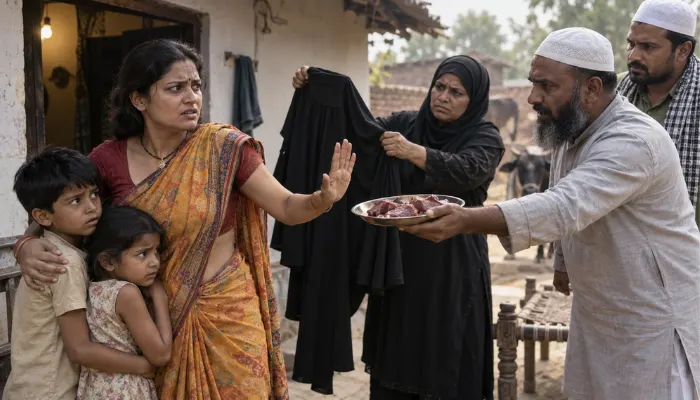
Case Summary
In Tarkulwa, Deoria, Uttar Pradesh, a Hindu woman and her two children were targeted for religious conversion to Islam by a Muslim man and members of his family. The woman was drawn into a relationship by Khushruddin Ansari, who concealed his Muslim identity and posed as a Hindu while building a relationship with her. His brother Noor Mohammad and Noor Mohammad’s wife were also involved in pressuring her to convert. She was forced to wear a burqa and eat cow meat (beef), while her minor children were also pressured to undergo circumcision (khatna), a mandatory religious practice in Islam. According to media reports, the Hindu woman, a mother of two, came into contact with Khushruddin around three to four years before the case surfaced in September 2026. The accounts differed on the circumstances of their first meeting, with one stating that they met while she was coming and going to the market and another placing their first meeting during an examination around three years earlier. They subsequently began communicating over the phone, after which Khushruddin developed a relationship with her while concealing his actual religious identity. At the time, the woman was married and had two children, while her husband lived in Gujarat and worked in a private job. She was from a neighbouring village. During the relationship, Khushruddin took photographs and videos with the woman and showed them to her in-laws. This led to a serious dispute, following which her in-laws expelled her from their home. Khushruddin then took her to Haryana, where she stayed with him for some time, before taking her to Delhi. There, he made her work at a beauty parlour and took all the money she earned. The woman continued to live with him and was financially dependent on him. When the woman later pressed Khushruddin to marry her, he told her that she would first have to convert to Islam. It was at this stage that she discovered his actual religious identity. The demand for conversion therefore emerged after Khushruddin had already established a prolonged relationship with the Hindu woman while concealing his Muslim identity from her. On 7th September 2026, Khushruddin brought the woman to his family home in Kanchanpur village. There, Khushruddin, his brother Noor Mohammad and Noor Mohammad’s wife pressured her to abandon Hinduism and convert to Islam. The family opposed keeping her in the house and told her that she could be allowed to stay only after converting to Islam. She was forcibly made to wear a burqa, while the accused continued pressuring her to change her religion. The dispute over keeping her in the house and the demand for conversion led to repeated arguments and physical altercations between the two sides. The coercion also extended to the woman’s two minor children. The accused pressured her to have both children circumcised and pressured her to eat cow meat. When the woman resisted the demands, the accused locked the doors of the house and assaulted her with hockey sticks and wooden rods. She was also punched and kicked. An attempt was made to kill her with a knife. She managed to escape from the house and approached the police. The police subsequently registered an FIR against Khushruddin Ansari, son of Idrish Ansari; Noor Mohammad, son of Idrish Ansari; and Noor Mohammad’s wife, all residents of Kanchanpur village. Station House Officer Bhupendra Singh confirmed that the case had been registered on the basis of the woman’s complaint and that an investigation was underway. Police were also collecting evidence to verify her complaint. One of the three accused was subsequently arrested, produced before a court and sent to jail, while police conducted raids to trace the two remaining accused.
Why it is Hate Crime ?
This case is being added to the tracker under the first primary category: Crimes against women in relationships and other sexual crimes. The subcategory selected is: Man pretends to be Hindu. When a non-Hindu man pretends to be a Hindu to deceive a Hindu woman into a relationship, the act is seen as triggered by malafide intentions. In some cases, the woman eventually accepts the man’s original religious identity and converts after the man’s identity is revealed. These cases could be argued as cases of religious brainwashing and a result of the pressure a woman feels after getting into a relationship with a man. The woman, it can be argued, also changed her religious identity because of the stigma she believes she might face if she chooses to walk out of a deceptive relationship. However, for the purpose of documenting hate crimes, the cases in this subcategory are limited to those where there is explicit violence aimed at religious conversion against the wishes of the victim (force-feeding beef, blackmailing with intimate videos, rape on refusal to convert, etc), or if the woman herself complains of the man’s religious deception. In such cases, it is established that the deception of the non-Hindu man had a specific aim of religious conversion or targeting of the victim due to her Hindu religious identity, therefore, making it a religiously motivated hate crime. The other subcategory selected is: Forced conversion before marriage. The tertiary categories selected are: Forced to eat beef, Forced to wear hijab. In such cases, a non-Hindu man is in a relationship with a Hindu woman when the pressure to convert her religion begins to manifest. In such cases, typically, two patterns emerge. First, when the relationship is consensual, and the religious identity of the perpetrator is known to the Hindu woman in the relationship, however, at some point during the relationship, the non-Hindu man starts to force the victim to convert her religion and give up her Hindu religious identity. The second is when the woman gets into a marriage with the man pretending to share her faith. Later, when the truth is revealed, the man starts pressuring the woman to convert her religion and give up her religious identity. In both the situations, the methods used to force the victim to convert her religion often revolve around force-feeding beef, forcing her to wear hijab, forcing her to read the Kalma or even pressurizing the victim to do ‘Nikah’, which is marriage under Islamic law, with a prerequisite being conversion to Islam. Cases where a Hindu woman consensually converts to Islam in a relationship will be left out of the hate crime database, even though it could be argued in several cases that the conversion was a result of religious brainwashing. The other subcategory selected is: Assault or threat upon refusal to convert. When Hindu women are in a relationship with non-Hindu men, there are cases where the woman faces threats or assault after she refuses to convert and change her religious identity owing to pressure/force by the non-Hindu man. Such relationships may be consensual with the religious identity of the non-Hindu man known to the victim. Somewhere along the relationship, the non-Hindu man starts pressurizing the Hindu woman to convert to Islam and upon her refusal, assaults or threatens the victim. Such cases are driven by specific religious motivations and against the religious identity of the victim and are therefore qualified as hate crimes. Cases where the Hindu woman converts to Islam and does not file a complaint about the force or threat, are not considered a part of the hate tracker, even though, it may be argued that the woman was brainwashed or threatened to convert to Islam. The second primary category selected is: Predatory Proselytisation. The subcategory selected is: Harassment, threats, coercion for conversion. Harassment covers a wide range of behaviours of an offensive nature. It is commonly understood as behaviour that demeans, humiliates, and intimidates a person, including threats and coercion. Harassment and threats, in this case, find their root on discriminatory grounds which has the effect of nullifying a person’s rights or infringing upon his freedom to exercise his right specifically owing to the victim’s religious identity. Verbal and physical threats and psychological or physical harassment are often used against Hindu victims because they choose to practice their professed religion. Religious harassment also includes forced and involuntary conversions by harassment, threats or coercion. Coercion includes intimidatory tactics like force-feeding a Hindu victim beef to convert to another religion, forceful circumcision etc. In several cases documented, non-Hindu perpetrators or those who harbour specific animosity towards Hinduism, harass victims simply based on their religious identity. Such cases often also include harassment to ensure the Hindu victim abandons his/her professed religion and adopts the religion of the perpetrator. Such cases where Hindu victims are harassed to convert to the perpetrator’s religion are rooted in animosity towards the victim’s religious identity and are therefore documented as religiously motivated hate crimes. The third primary category selected is: Attack not resulting in death. The subcategory selected is: Attacked for refusal to convert. When there is pressure, threat or coercion employed upon the Hindu victim to convert to a different religion, in several cases, the victim refuses to succumb to the pressure/threats. Once the victim refuses, the perpetrator proceeds to attack/assault the victim owing to his/her refusal to convert. In such cases, the pressure/threat/intimidation/coercion/violence itself is driven by animosity towards the victim’s Hindu faith. The violence then is another hate crime driven by the victim’s refusal to abandon his professed faith, Hinduism, and convert to the religion of a non-Hindu perpetrator. Since the victim’s faith is at the heart of the pressure to convert and the ensuing violence towards the victim, such cases are considered religiously motivated hate crimes. This case is a clear example of a religiously driven hate crime because a Hindu woman was deceived into a relationship by a Muslim man, Khushruddin Ansari, who concealed his religious identity and posed as a Hindu. The woman was subsequently pressured to convert to Islam, wear a burqa and eat cow meat, and her children were also pressured to convert and undergo circumcision. Taken together, these details demonstrate that the religious identity of the victims was central to their targeting and the subsequent coercion imposed on them, making the incident a clear example of a religiously motivated hate crime. Firstly, the perpetrator's act of deception by posing as a Hindu itself demonstrates a clear bias and malicious intent towards the victim’s religion. By hiding his true identity, the Muslim man manipulated the Hindu woman’s trust and targeted her under false pretences, indicating a premeditated effort to exploit the woman based on her religious background. Thus, the perpetrator’s deliberate decision to hide his religious identity strongly underscores the religious motive behind this crime. In such instances, identity concealment is not just a deceptive tactic for personal reasons but a calculated strategy rooted in religious profiling and targeting. The accused was aware that the victim, being Hindu, would likely make her decision about pursuing a relationship differently if she knew his real identity, and he circumvented this by lying, which directly points to a religiously driven intent. This deception reflects a larger pattern where Hindu women are specifically singled out using false identities by Muslim men, often with coercion or conversion in mind. Such targeted victimisation based on religion not only demonstrates a fundamental disregard for Hinduism but also exposes a deeper animosity towards Hindus and their beliefs. After deceiving the Hindu woman by concealing his religious identity, the perpetrator then pressured her to convert to Islam as a condition for marriage. This further demonstrates the religiously motivated nature of the targeting. The demand for conversion was not presented to her as a voluntary religious choice but as a condition imposed upon her after the relationship had already been established through deception. When conversion is demanded through external pressure or coercion rather than arising from an individual's free exercise of conscience, it ceases to be a genuinely voluntary change of faith and instead amounts to religious coercion. Such conversion pressure violates the victim's religious autonomy and her fundamental right to determine her own faith and religious identity. The fact that the perpetrator sought to make the abandonment of Hinduism a prerequisite for marriage demonstrates that her Hindu identity was directly at the centre of the coercion imposed upon her. Rather than respecting her religious beliefs, the perpetrators sought to compel her to renounce them in favour of Islam, demonstrating deep-seated religious hostility towards her Hindu identity and making the conversion demand a clear manifestation of religiously motivated targeting. The forced imposition of the burqa further demonstrates the extent of the religious coercion imposed upon the Hindu woman. The burqa was enforced upon her in the context of the demand that she abandon Hinduism and convert to Islam. It therefore represented more than an isolated act of controlling her clothing; it formed part of the broader effort to impose an Islamic religious identity and lifestyle upon her. The perpetrators sought not merely to obtain verbal compliance with a demand for conversion but to make the woman physically conform to religious practices associated with the faith into which she was being coerced. The fact that she was forced to wear the burqa demonstrates the extreme extent to which the perpetrators sought to suppress her existing Hindu identity and impose an alternative religious identity upon her. This coercive imposition of religious practice, in the absence of her free consent, further demonstrates the religious animosity underpinning the targeting of the Hindu woman. The pressure placed on the Hindu woman to consume cow meat further demonstrated the religious hostility involved in the crime. The cow holds profound religious significance in Hinduism and is revered as sacred, with the Vedic tradition using the term Aghnyā, meaning “that which should not be killed”, in reference to the cow. For Hindus, the consumption of cow meat is therefore regarded as a serious religious transgression and a direct violation of deeply held beliefs concerning the sanctity of the cow. The deliberate pressure placed upon a Hindu woman to consume cow meat, while she was simultaneously being coerced to abandon Hinduism, represented an attempt to make her participate in an act that directly conflicted with her religious identity and convictions. It functioned as a means of severing her connection with Hindu religious practice and compelling her to cross a deeply significant religious boundary against her will. Notably, cow meat has also been used as a means of attacking, humiliating or provoking Hindus during historical and communal episodes of religious conflict in the Indian subcontinent, including instances in which cow meat was thrown inside Hindu temples to desecrate sacred places of Hindu worship. There have also been historical accounts of Muslim extremists forcibly feeding cow meat to Hindus as a means of violating their religious beliefs and undermining their Hindu identity. The invocation of the same deeply sensitive religious symbol in this case, through pressure on a Hindu woman to consume cow meat as part of a wider effort to convert her to Islam, therefore demonstrated the deliberate religious hostility underlying the coercion and the attempt to undermine her Hindu identity. The perpetrators' response when the Hindu woman resisted the conversion demands further establishes the religiously coercive nature of the crime. Rather than accepting her refusal to abandon Hinduism, they locked her inside the house and subjected her to physical assault with hockey sticks and wooden rods, as well as punches and kicks. An attempt was also made to kill her with a knife. The use of such extreme violence after she resisted conversion demonstrates that the perpetrators were prepared to enforce their religious demands through physical force and threats to her life. The violence was therefore directly connected to her refusal to submit to the religious coercion imposed upon her. Attacking and attempting to kill a Hindu woman in the course of forcing her to abandon her faith demonstrates a profound disregard for her religious autonomy and establishes that violence was being used as an instrument to impose a religious change against her will. This combination of religious coercion and extreme physical violence demonstrates clear religious animosity and makes the incident a religiously motivated hate crime. The religious coercion in this case extended beyond the Hindu woman to her two minor children, demonstrating the severity and breadth of the perpetrators’ conduct. Given their young age and lack of maturity, the children were particularly vulnerable to manipulation and lacked the capacity to fully understand the long-term implications of abandoning their Hindu faith and adopting another religion. The perpetrators subjected them to the same coercive environment in which their mother was being pressured to abandon Hinduism, seeking to impose a change of faith rather than allowing the children’s religious identity to develop through understanding, personal conviction and free exercise of conscience. Targeting minor children in a forced conversion attempt showed that the perpetrators sought not merely to influence an adult’s personal religious choice but to sever an entire Hindu family from its religious identity. This deliberate targeting of vulnerable children further demonstrated the religious hostility and clear religious motivation underlying the crime. The pressure on the minor Hindu children to undergo circumcision further demonstrates the extent to which the perpetrators sought to impose an Islamic religious identity upon them. Circumcision, or khatna, is an established religious practice in Islam and is traditionally associated with Muslim male identity. Unlike a temporary outward practice, circumcision involves a permanent physical alteration of the body, with lifelong consequences. The fact that the perpetrators sought to have the Hindu woman's minor children undergo such a procedure in the context of coercing them towards Islam demonstrates that the pressure extended beyond a demand for nominal or verbal conversion. It involved an attempt to permanently alter the children's bodies in accordance with the religious identity that the perpetrators sought to impose upon them. Subjecting minor Hindu children to such pressure, while they were simultaneously being targeted for religious conversion, demonstrates the depth of the effort to erase their existing Hindu identity and replace it with an Islamic identity. The attempt to impose a permanent religiously associated bodily alteration upon Hindu minors therefore represents an extreme manifestation of religious coercion and further establishes the religiously motivated nature of the targeting. Taken together, the religious deception, coercive conversion demands, forced imposition of Islamic practices, pressure to consume cow meat, violence for resisting conversion, and targeting of the woman's minor children establish the religiously motivated nature of the incident; therefore, the case is being added to the hate crime database of the Hinduphobia Tracker. Disclaimer: Hinduphobia Tracker records the incident date based on when the crime occurred or, in cases involving an extended ordeal, when the victim’s ordeal began, rather than the date on which the incident was reported by the media. In the present case, the media reports did not specify the exact date on which the victim’s ordeal began. They only stated that she had met the perpetrator approximately three to four years before the matter came to light in September 2026. The earliest specific date mentioned in the reports was 7 September 2026, when the perpetrator took the victim to his village. Therefore, using the reported four-year timeline, 7 September 2022 has been recorded as an indicative incident date. This date has been recorded for documentation purposes only.
Victim Details
Total Victim
3
Deceased
0
Gender
- Male 2
- Female 1
- Third Gender 0
- Unknown 0
Caste
- SC/ST 0
- OBC 0
- General 0
- Unknown 3
Age Group
- Minor 2
- Adult 1
- Senior Citizen 0
- Unknown 0


Case Status
Case sub-judice


Perpetrators Details
Perpetrators
Muslim Extremists
Perpetrators Range
From 2 To 5
Perpetrators Gender
both
 Sources




