Kashmiri Hindu employees targeted through killings, threats, doxxing, intimidation, displacement and forced exodus
 Jammu and Kashmir, India
  10 September, 2026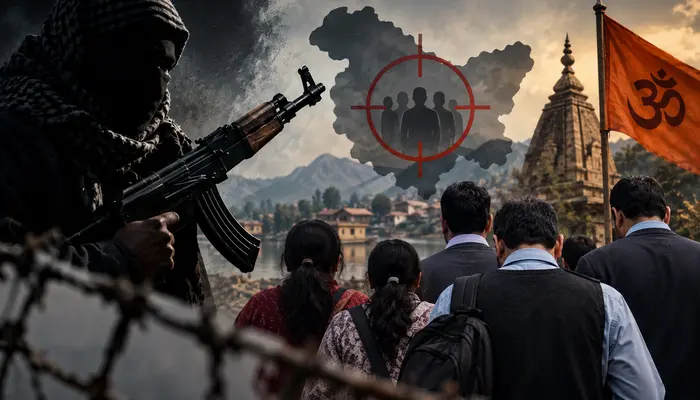
Case Summary
In Jammu and Kashmir, Kashmiri Pandit employees recruited under the Prime Minister’s employment and rehabilitation package were targeted by a fresh threat attributed to the United Liberation Council (ULC), after they staged a protest in Srinagar seeking secure government accommodation. The communication warned against separate settlements for the employees, described such arrangements as an “Israeli model” and a plan to create a “state within a state”, and carried photographs of multiple employees who had participated in the protest. The United Liberation Council (ULC), also referred to as the United Liberation Front (ULF), is a Pakistan-sponsored front linked to Lashkar-e-Taiba (LeT). The organisation operates primarily through digital platforms and uses threat letters, posters and online communications as instruments of terrorist intimidation and psychological warfare. It circulates targeted threats through platforms including Telegram and WhatsApp, while some of its material has appeared on the dark web before wider circulation. The organisation uses the publication of personal information, photographs, locations and other sensitive details to intimidate targeted communities, create fear and exert psychological pressure. Its communications are issued in the name of Ahmed Bilal, who identifies himself as the group’s media coordinator and “soldier of resistance”. Security agencies monitor its online activity and examine its digital trail, sources and possible handlers. The latest threat surfaced on 10 September 2026, a day after Kashmiri Pandit PM Package employees staged a peaceful protest at the Srinagar Press Enclave demanding secure accommodation in the Kashmir Valley. The employees said security at their workplaces was satisfactory but that their safety while living in rented accommodation remained a major concern. They sought allotment of government-built residential accommodation, including 26 buildings that they said were ready for occupation. The fresh communication escalated the intimidation by publishing photographs of protesting employees alongside an image of an AK-47. The communication, signed in the name of Ahmed Bilal, described the protesting PM Package employees in derogatory and threatening terms and accused them of being backed by the Ministry of Home Affairs. It warned against the establishment of separate residential settlements for migrant Pandits and portrayed such settlements as part of a purported plan to establish a separate state within Jammu and Kashmir. The communication further stated that the group possessed details of around 6,000 Kashmiri Pandit employees, including their live locations, telephone numbers, home addresses, family details and daily activities, and warned that it could strike at will. The 10 September 2026 communication was the sixth threat letter in 40 days and featured photographs of protesting staff. Rakesh Handoo, associated with the All PM Package Employees Association in Kashmir Valley, sought immediate security for the employees whose photographs appeared in the communication and called for an investigation into the source of their personal information. The fresh threat followed another communication attributed to the ULC on 5 September 2026, which threatened PM Package employees with fatal consequences and warned them against remaining in the Valley. The communication threatened that bullets and “body bags” would be sent to their native places. On 6 September 2026, Rakesh Handoo approached Prime Minister Narendra Modi, Lieutenant Governor Manoj Sinha and the Jammu and Kashmir Police Cyber Crime Wing, seeking registration of an FIR and an investigation into the threat. Community voice Saba Kaul described the situation as a serious security crisis and called for an investigation into the circulation of employees’ personal information. The threats also involved the circulation of sensitive personal information relating to Kashmiri Pandit employees. Telephone numbers, residential addresses and vehicle-registration details had appeared in the communications. A Srinagar-based senior journalist said the material had first appeared on the dark web before being circulated through WhatsApp and Telegram. The circulation of such information raised concerns over how sensitive details relating to employees had reached those behind the threats. On 1 September 2026, another communication attributed to the ULC emerged amid the series of threats against Kashmiri Pandits. It referred to the possibility of the administration arming migrant Pandit employees with light weapons following a security meeting chaired by Lieutenant Governor Manoj Sinha. The repeated threats increased pressure on the administration to review the security arrangements for the employees and their accommodation. The escalation followed an earlier ULC communication that surfaced on 23 August 2026 and contained personal information relating to several Kashmiri Pandit employees. The communication included their names, residential addresses and vehicle-registration details, including information concerning employees residing in Jammu. The All PM Package Employees Forum, Kashmir, wrote to Chief Secretary Atal Dulloo seeking enhanced security, verification of the threat, security reviews at places of posting and residential accommodation, and protection along transit routes. An earlier communication in August 2026 had named six Kashmiri Pandit employees recruited under the Prime Minister’s Special Package. It disclosed their personal details and warned that their movements were being monitored, including outside the Kashmir Valley, and threatened that they could be targeted even after moving to Jammu. The subsequent communications broadened the intimidation from named individuals to the wider population of PM Package employees in the Valley. The two centrally supported employment initiatives provided for 6,000 posts in total, while the wider population of threatened employees was referred to as nearly 7,000. The latest threat communication itself referred to details of around 6,000 Pandit employees. The Prime Minister’s employment package formed part of the Government of India’s effort to facilitate the return and rehabilitation of Kashmiri migrants. The 2008 return-and-rehabilitation package included 3,000 centrally supported government jobs, while another 3,000 posts were approved under the Prime Minister’s Development Package in November 2015, taking the centrally funded employment target under the two initiatives to 6,000 posts. Government figures indicated that 5,896 appointment orders had been issued against the 6,000 earmarked posts by March 2026. Many of the employees worked in different parts of the Kashmir Valley and lived in rented accommodation. Rakesh Handoo highlighted concerns regarding transit accommodation at Noa on the Chowgam Road in Kulgam, describing the location as isolated and vulnerable, with inadequate roads, drainage, fencing and security. He also sought a security audit of transit colonies and rented accommodation and an investigation into the source of the information appearing in the threat communications. Handoo also referred to 6,042 quarters planned at Zewan in Srinagar, Mattan and Veerinag in Anantnag, and said that only around 800 had been allotted over three years. He sought implementation of a “Right to Return and Rehabilitation” framework covering job security and land rights, alongside immediate protection for employees living in rented accommodation. The security concerns had a wider historical significance because the PM Package was intended to facilitate the return of Kashmiri Pandits to the Valley after the mass displacement that accompanied the rise of armed militancy in the late 1980s and early 1990s. The community had faced targeted killings, threats and intimidation, resulting in the displacement of large numbers of Kashmiri Pandit families from the Valley. The killing of Kashmiri Pandit government employee Rahul Bhat inside a government office in Chadoora in 2022 remained a significant security concern for employees returning to work in Kashmir. The employees subsequently demanded immediate protection and secure residential accommodation. They sought allotment of government-built accommodation, protection for those living in rented houses, an investigation into the source of the leaked information and a comprehensive security assessment of PM Package employees. They also set 30 September 2026 as a deadline for the authorities to address their demands and warned of an indefinite hunger strike from 1 October 2026, along with the possibility of mass resignation or leaving the Valley if their security concerns remained unresolved. The 10 September 2026 communication extended the threat beyond previously named individuals to the wider community of Kashmiri Pandit PM Package employees. The publication of photographs of employees who had participated in a public protest, combined with references to personal information about thousands of employees and a warning that the group could strike at will, intensified concerns about employees' physical security and the possible misuse or leakage of sensitive personal data.
Why it is Hate Crime ?
The primary category selected in this case is: Hate speech against Hindus. The first subcategory selected is: Doxxing and harassment of Hindu for religious reasons. Doxxing is the act of publicly making available an individual's personal, identifiable information with the intention of compromising their safety, security, and privacy. When doxing is done with religious animosity forming the basis of the intention, it often involves severe consequences like loss of employment, physical harm, physical threat, harassment and/or discrimination for the victim’s religious beliefs. Such doxxing also involves projecting the religious beliefs, affiliations, and rituals of the victim, specifically a Hindu, in a manner that can lead to loss of employment, physical harm, physical threat, harassment and/or discrimination. Apart from doxxing, harassment would also include misrepresentation of an individual's views and religious beliefs that would invite abuse, loss of employment, physical harm, physical threat, harassment and/or discrimination owing to religious hate and animosity. There have been several such instances where religious animosity by one section has led to the doxxing and harassment of Hindus. For example, when a Hindu who worked in the UAE commented on the historical persecution of Hindus at the hands of Muslim invaders, his information was leaked online leading to loss of employment, physical harm, physical threat, harassment and/or discrimination. In another case, a Hindu man’s information was leaked online, leading to violent attacks, after he responded with an emoji to a post about Tipu Sultan, the Islamic tyrant who persecuted Hindus. Such cases are born out of intrinsic religious animosity towards Hindus and therefore, would be considered religiously motivated hate speech. The other subcategory selected is: Violent threats. Violent threats, explicit, implicit or implied, is the most dangerous form of hate speech since it goes beyond discriminatory and prejudicial language to express the intent of causing harm to an individual or a group of people based on their religious identity and faith. There could be several different kinds of threats that are issued to Hindus based on religious animosity. An explicit threat would mean the direct threat of violence towards an individual Hindu, a group of Hindus or Hindus at large. Physical violence, death threats, threats of destruction of property belonging to Hindus and threats of genocide would mean explicit threats against Hindus for their religious identity. Implicit threats may not be a direct threat but implied through the use of symbols of actions – for example – in the Nupur Sharma case, other than explicit threats, there were also implicit threats when Islamists took to the streets to burn and beat her effigies. It implies that they want to do the same to Nupur Sharma – thereby is considered an implicit threat. Violent threats can be delivered in person, through letters, phone calls, graffiti, or increasingly through social media and other online platforms. It would be important to understand that a threat – explicit or implicit, online or offline – to an individual who happens to be a Hindu does not qualify as a religiously motivated threat. Such a threat, while vile and dangerous, could be owing to non-religious reasons and/or personal animosity. To qualify as a religiously motivated threat, it would need to exhibit an indication that the individual is being targeted for religious reasons and/or owing to his/her religious identity as a Hindu. This incident constituted a clear instance of religiously motivated hate speech and terrorist intimidation, as the United Liberation Council (ULC) specifically targeted Kashmiri Hindu Pandit employees, identifying them through their religious and community identity while threatening violence, publishing photographs of protesting employees, and opposing their settlement and rehabilitation in the Kashmir Valley. The communication’s characterisation of separate accommodation for migrant Pandits as an “Israeli model” and a plan to create a “state within a state”, together with the warning that the organisation could “strike at will”, demonstrated hostility towards the continued presence, return and secure settlement of Kashmiri Hindus in the Valley and reflected pronounced religious animosity towards the community. Firstly, the identification of Kashmiri Pandits as the specific target established the religious character of the threat. The communication did not merely oppose a government employment scheme or criticise a group of officials. It directed its hostility towards employees because they belonged to the Kashmiri Pandit community, a Hindu community with a distinct religious and historical identity in Kashmir. By repeatedly identifying the targets as migrant Pandits and attaching threatening language to that identity, the communication turned their Hindu community affiliation into a basis for intimidation. The publication of photographs of employees who had participated in the protest further personalised this targeting. The threat therefore operated against Kashmiri Hindus both as identifiable individuals and as members of a particular religious community. Secondly, the opposition to the settlement and rehabilitation of migrant Pandits constituted a direct marker of hostility towards the continued presence of Kashmiri Hindus in the Valley. The employees had sought secure accommodation so that they could continue living and working in Kashmir, but the communication treated their settlement as something that had to be resisted. The use of terms such as “migrant Pandits” and “non-locals” placed the Hindu community outside the legitimate social and territorial identity that the threat sought to enforce. The significance was particularly strong because the employees were part of a government-backed effort intended to enable displaced Kashmiri Pandits to return to and remain in their ancestral homeland. The threat therefore sought not merely to intimidate employees but to discourage the physical return and continued presence of Kashmiri Hindus in Kashmir. Furthermore, the “Israeli model” and “state within a state” framing transformed the presence of Kashmiri Pandits into a supposed demographic and territorial threat. The communication presented separate accommodation for Pandit employees as an organised settlement project rather than as a security measure for vulnerable government workers. By invoking the “Israeli model”, it attached an external and hostile political analogy to the residential security sought by Kashmiri Hindus. The “state within a state” formulation went further by portraying the presence of a Hindu community in protected accommodation as incompatible with the existing social and territorial order. This language therefore delegitimised the establishment of secure housing for Kashmiri Pandits and framed their collective return and settlement as something that threatened the character of the region. Also, the combination of religious identification and a direct threat of violence made the intimidation substantially more serious. The communication identified Kashmiri Pandit employees, displayed photographs of people who had publicly participated in the protest, referred to their personal and family information, and warned that the organisation could “strike at will”. The accompanying AK-47 image reinforced the meaning of the warning by associating the identification of the Hindu employees with the possibility of armed violence. The threat thus did not stop at hostile rhetoric concerning settlement. It placed identifiable Kashmiri Hindu employees within a context of possible physical attack and demonstrated that their public demand for security had itself become a reason for intensified targeting. Moreover, the threat to the rehabilitation of Kashmiri Pandits carried significance because it concerned a displaced Hindu community seeking to re-establish a permanent presence in its ancestral homeland. The employees were not threatened solely in their capacity as workers; their return, employment, and residential presence in the Valley were treated as matters requiring resistance. The communication therefore struck at the underlying objective of enabling Kashmiri Hindus to live and work in Kashmir again. By portraying their secure accommodation as an illegitimate settlement project and coupling that portrayal with threats of violence, the communication sought to create fear around the very act of returning, remaining and building a secure life in the Valley. The religious dimension, therefore, lay in the cumulative treatment of Kashmiri Pandits as an unwanted Hindu presence. The communication connected their identity, residence, rehabilitation and physical security into a single hostile narrative. It opposed their settlement, portrayed their protected accommodation as a demographic threat, singled out individual members of the community for identification and subjected them to a warning of violence. Taken together, these elements demonstrated hostility not merely towards particular employees or a government policy, but towards the continued return, settlement and security of Kashmiri Hindus in the Kashmir Valley. Accordingly, this case has been documented in the Hinduphobia Tracker's Hate Crime Database as an instance of religiously motivated hostility directed against Hinduism and the religious identity of the Hindu community.


Case Status
Unknown


Perpetrators Details
Perpetrators
Muslim Extremists
Perpetrators Range
Unknown
Perpetrators Gender
unknown
 Sources




