Hindu families pressured to convert to Christianity in West Bengal's South 24 Pargana; Hindu women expose conversion drive
 South 24 Parganas district, West Bengal, India
  8 September, 2026
Case Summary
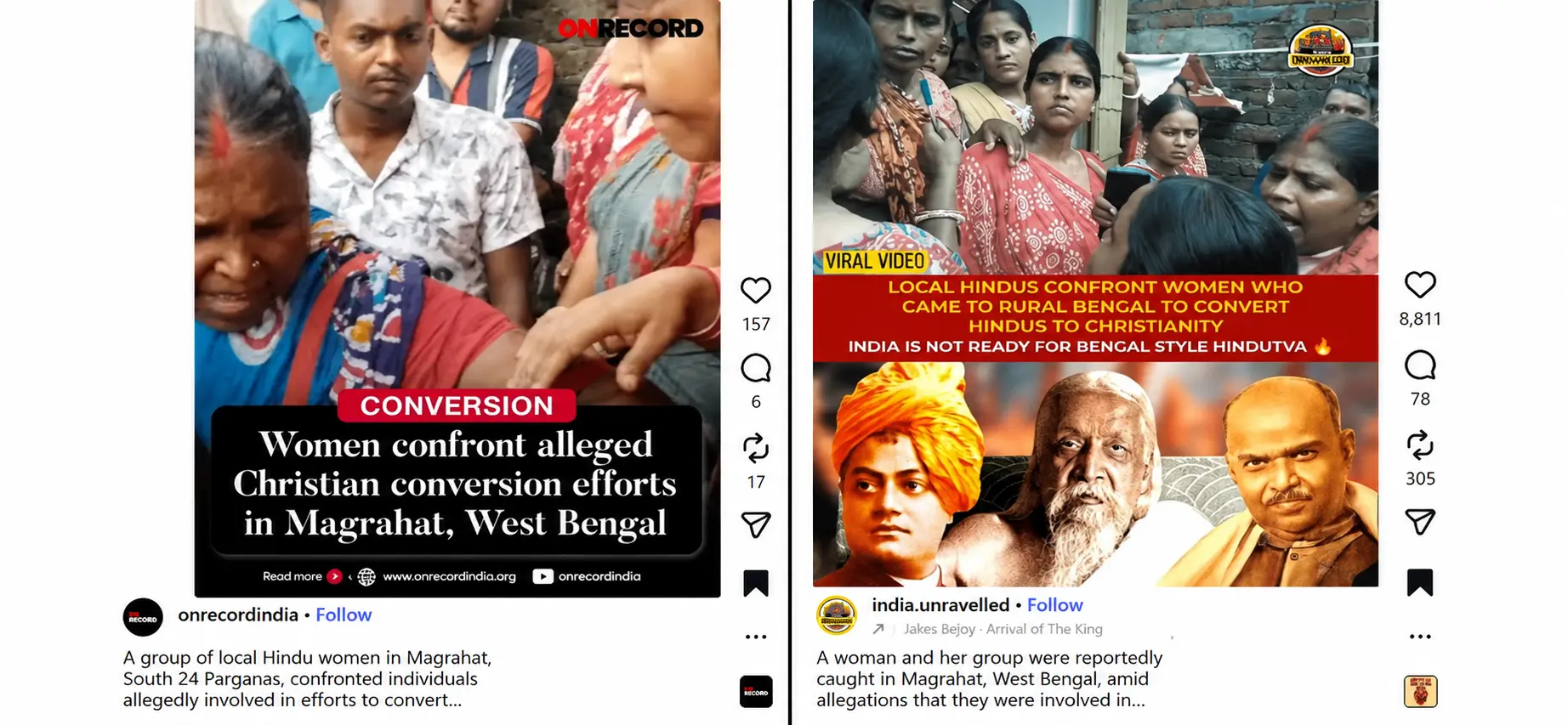
In Magrahat, South 24 Parganas, West Bengal, Hindus were pressured to convert to Christianity. A Christian woman and her group carried out a conversion drive targeting Hindu families in rural areas. Local Hindu women caught and confronted the woman and her group. Video footage circulated on social media showed the women surrounding the group and arguing with its members. During the confrontation, heated arguments broke out as agitated residents opposed the individuals for engaging in wrongful conversion practices. Hindu women in the crowd voiced intense anger and distress, pointing fingers and questioning those involved about items, documents, and books they were carrying or distributing. They called for accountability and demanded that the materials be opened and inspected on the spot, reflecting deep-seated community friction over proselytisation efforts in the region. The local Hindu women subsequently handed the woman and the other members of the group over to the police for questioning. The incident prompted calls for a strict anti-conversion law in West Bengal. While religious freedom is a constitutional right, concerns were also raised over coercive or unlawful religious conversion activities and the need for such cases to be properly investigated.
Case Images
Why it is Hate Crime ?
This case has been added to the tracker under the primary category of: Predatory Proselytisation. Within this, the sub-category selected is: Proselytisation by grooming, brainwashing, manipulation or subtle indoctrination. Religious brainwashing essentially means the often subtle and forcible indoctrination to induce someone to give up their religious beliefs to accept contrasting regimented ideas. Religious grooming or brainwashing also involves propaganda and manipulation. It involves the systematic effort, driven by religious malice and indoctrination, to persuade “non-believers’ to accept allegiance, command, or doctrine to and of a contrasting faith. Cases of such grooming or brainwashing are far more nuanced than direct threats, coercion, inducement and violence. In such cases, repeated, subtle, and continual manipulation often induces disaffection toward the victim's own faith and acceptance of the perpetrator's contrasting faith. While subtle indoctrination is widely acknowledged as predatory, an element which is often understated in such conversions or in the attempts at such conversion is the role of loyalty and trust which might develop between the perpetrator and the victim. Fiduciary relationships are often abused to affect such religious conversion. For example, an educator transmitting religious doctrine of a competing faith to a Hindu student. The Hindu student is likely to accept what the teacher transmits because of the fiduciary relationship. The exploitation of the fiduciary relationship to religiously indoctrinate victims would also be included in this category. Since the underlying animosity towards the victim’s faith forms the basis of predatory proselytisation, such cases are considered religiously motivated hate crimes. The other selected subcategory is: Conversion/ attempts to convert by inducement. Predatory Proselytisation is not just limited to threat, harassment, force and violence, but it also has contours of stealth. In several cases, the Hindu victim is exploited to convert, with non-Hindus taking advantage of their poverty. In such cases, the Hindu victim who is suffering financially is offered monetary benefits, including lucrative offers for jobs, health treatment, education, etc, to induce the victim into changing his/her religion. In such cases, the religious identity of the victim and the aim to disenfranchise him from his faith form the heart of the crime. Also, taking advantage of and exploiting an individual’s economic vulnerabilities is widely acknowledged as exploitation, forms of which are often penalised by law. Such cases therefore are considered religiously motivated hate crimes since the victim’s religious identity forms the very heart of the crime itself. This case has been added to the tracker because the gathering was organised to target Hindus for religious conversion. The accused were reportedly caught red-handed, with proselytisation materials in their possession, providing direct evidence of the conversion-related nature of their activities. What was presented as a religious gathering was, in reality, an effort to persuade Hindus to abandon their faith and convert to Christianity. The group had specifically targeted Hindus to convert them from Hinduism to Christianity. This placed Hindu religious identity at the centre of the activity, as the stated objective was not simply to hold a religious gathering but to persuade members of the Hindu community to leave their existing faith and adopt Christianity. By seeking to change the religious affiliation of Hindus, the activity had directly undermined the continuation of their Hindu faith and identity. People in rural areas, particularly those facing financial hardship, can be especially vulnerable to inducements and promises of assistance. Using inducements is a common tactic to influence or manipulate vulnerable people into changing their faith. This approach can target economically disadvantaged groups by offering material benefits such as food, money, livestock, or other forms of assistance in connection with conversion. Such practices can create dependency and place individuals in a position where they may feel compelled to convert not out of genuine religious conviction, but because of immediate needs or financial hardship. The Christian evangelists in this case appear to have adopted a similar approach, exploiting the vulnerability of Hindu families to advance their conversion efforts. Such practices are particularly concerning because proselytisation is central to Christian missionary activities. The Christian faith, by its very theological foundations, places a strong emphasis on proselytisation. In pursuit of conversion objectives, Christian evangelists often employ unethical means, ranging from psychological pressure and misinformation to inducements such as money or jobs. In such cases, Christian missionary groups often target and brainwash socially and economically vulnerable Hindus to further their agenda of religious conversions. Since exploiting vulnerabilities for the explicit purpose of conversion is purely based on animosity towards the victim's faith, this case has been categorised as a religiously motivated hate crime. Disclaimer: The Hinduphobia Tracker records incidents based on when an event occurred or when the victim's ordeal began. None of the media sources covering this case has specified the exact date the incident occurred. Therefore, for documentation purposes, we recorded the date as when the incident was reported in the media: 9th September 2026.


Case Status
Unknown


Perpetrators Details
Perpetrators
Christian Extremists
Perpetrators Range
Unknown
Perpetrators Gender
unknown
 Sources




