Hindu minor girl students forced to take part in Christian prayers and convert to Christianity by school seniors; Bibles recovered during inspection
 Sangareddi, Telangana, India
  1 September, 2026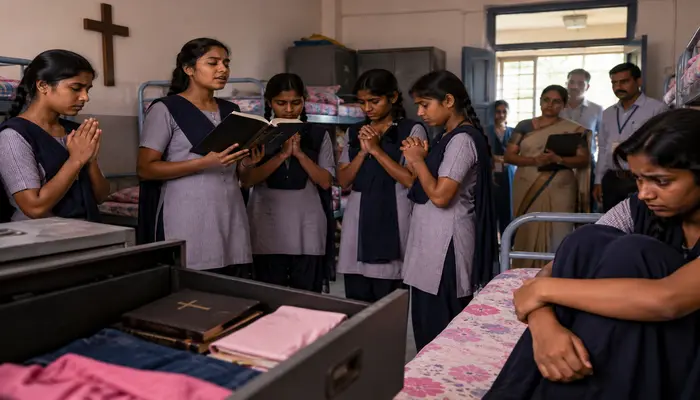
Case Summary
Minor Hindu girls at a residential school in Telangana were forced by senior students to convert to Christianity and participate in Christian prayers. The incident occurred at Chitkul Social Welfare Residential Girls’ Gurukul, where, during a surprise inspection, the students were found being indoctrinated with Bible teachings. The coercive religious practices surfaced on 2 September 2026, when Member of Legislative Council (MLC) Dr Chinnamail Anjireddy conducted a surprise inspection of the state-run institution in Sangareddy district. During the visit, junior students approached the legislator and described forced religious activities by their seniors. While inspecting the dormitories, the team found Bibles on female students' beds. Dr Chinnamail questioned the teachers and administrative staff regarding how sectarian religious texts reached minor students inside a government educational institution. Following the inspection, the legislator alerted Sangareddy District Collector Prateek Jain and senior officials of the Social Welfare Department. The District Collector immediately ordered a thorough investigation into the incident, directing authorities to examine the conduct of the students and school administration and initiate action against those responsible. Subsequently, the non-governmental organisation Legal Rights Protection Forum submitted a formal complaint to the National Human Rights Commission (NHRC). The complaint sought an independent investigation into the school’s principal, warden, teachers, and senior students to determine whether external missionary organisations or individuals were granted access to supply religious materials. The forum also petitioned the commission to mandate inspections of all hostels under the Telangana Social Welfare Residential Educational Institutions Society, record minor students' statements confidentially without institutional interference, and review compliance under the Foreign Contribution (Regulation) Act (FCRA) for any external entities involved.
Why it is Hate Crime ?
The primary category selected is- Predatory Proselytisation. The subcategory selected is- Proselytisation by grooming, brainwashing, manipulation or subtle indoctrination. The tertiary categories selected are- Conversion of minor, Family claims grooming. Religious brainwashing essentially means the often subtle and forcible indoctrination to induce someone to give up their religious beliefs to accept contrasting regimented ideas. Religious grooming or brainwashing also involves propaganda and manipulation. It involves the systematic effort, driven by religious malice and indoctrination, to persuade “non-believers’ to accept allegiance, command, or doctrine to and of a contrasting faith. Cases of such grooming or brainwashing are far more nuanced than direct threats, coercion, inducement and violence. In such cases, it is often seen that there is repeated, subtle and continual manipulation of the victim to induce disaffection towards their own faith and acceptance of the contrasting faith of the perpetrator. While subtle indoctrination is widely acknowledged as predatory, an element which is often understated in such conversions or the attempts of such conversion is the role of loyalty and trust which might develop between the perpetrator and the victim. Fiduciary relationships are often abused to affect such religious conversion. For example, an educator transmitting religious doctrine of a competing faith to a Hindu student. The Hindu student is likely to accept what the teacher is transmitting owing to the existence of the fiduciary relationship. The exploitation of the fiduciary relationship to religiously indoctrinate victims would also be included in this category. Since the underlying animosity towards the victim’s faith forms the basis of predatory proselytisation, such cases are considered religiously motivated hate crimes. The incident has been added to the database as the imposition of Christian prayers on the Hindu students served as a calculated method of subtle brainwashing. By forcing the minor students to participate in religious rituals foreign to their own faith, the perpetrators aimed to normalise Christian practices while simultaneously devaluing the students' Hindu heritage. This forced participation functioned not as an educational exercise, but as a coercive tactic designed to induce disaffection towards Hinduism and enforce allegiance to a contrasting religious doctrine. Furthermore, the strategic placement of Bibles on the beds of the Hindu girls represented a direct encroachment on their personal space and freedom of conscience. The distribution of these sectarian texts within a secular, government-administered dormitory operated as a deliberate tool for continuous religious manipulation. This act demonstrated a premeditated agenda to saturate the students' living environment with Christian propaganda, ensuring that the religious indoctrination extended beyond the forced prayer sessions. The perpetrators weaponised the established hierarchy of the residential school to execute this proselytisation. By exploiting their superiority, the senior students abused the natural trust and authority inherent in the senior-junior dynamic. The younger Hindu girls, who relied on their seniors for guidance in a boarding environment, were instead subjected to intimidation and control. This exploitation of a hierarchical relationship made it exceedingly difficult for the younger students to resist the religious coercion without fear of retaliation. Ultimately, the conduct was driven by an underlying animosity towards the victims' Hindu identity. The combination of forced prayers, the distribution of contrasting religious texts, and the abuse of institutional hierarchy amounted to a systematic campaign of predatory proselytisation. Because the psychological manipulation and grooming were specifically designed to erase the students' Hindu faith against their will, the incident firmly qualified as a targeted, religiously motivated hate crime. It was crucial that the victims in this incident were Hindu minors, which meant the element of consent and genuine change of conscience was missing ab initio. Because minors, due to their young age and lack of maturity, were particularly vulnerable to manipulation and coercion, they lacked the ability to fully understand the implications of converting to another religion. The perpetrators purposely targeted and exploited this vulnerability. Because this case exemplified the use of coercion and manipulation to achieve religious conversion, it stood as a blatant act of religious hate, which is why it qualified for documentation. Disclaimer: The exact date on which the forced prayers and religious indoctrination began was not specified in the available sources. The matter came to light during a surprise inspection conducted on 2nd September 2026. The tracker records incident dates based on when the incident occurred, not when it was reported or investigated. So 2nd September has been recorded as the indicative incident date for documentation purposes.


Case Status
Complaint filed


Perpetrators Details
Perpetrators
Christian Extremists
Perpetrators Range
Unknown
Perpetrators Gender
unknown
 Sources




