Hindu family terrorised and forced into migration as Muslim attackers vandalise home and demolish temple
 Sirajganj District, Bangladesh
  7 September, 2026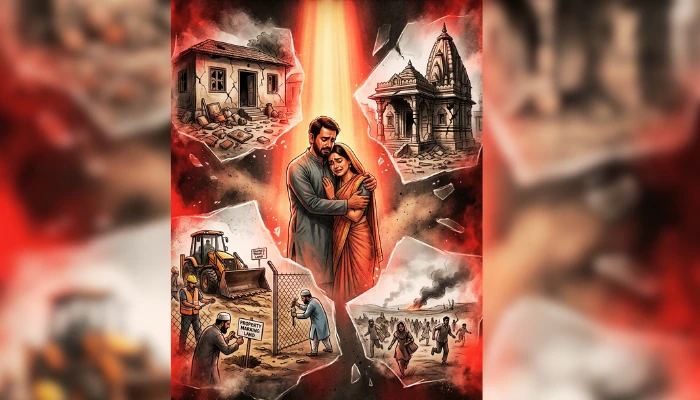
Case Summary
In Ullapara, Sirajganj district, Bangladesh, a Hindu family was attacked, tortured and threatened with eviction from their ancestral land by a group of Muslim men, who vandalised their house and smashed their small family temple while demanding that they sell the property and leave. The incident came to light after the X account @HinduVoice_in shared a video on social media, which subsequently went viral. The video featured local news footage from Ullaparanews24 showing damaged temple-like structures, broken platforms, destruction inside the house, and emotional interviews with an elderly woman and a male family member describing the incident. According to the victims, their family had occupied the land for around 40 years after their forefathers purchased it. They stated that a group of Muslim men, including the secretary’s brothers-in-law and several unidentified individuals, came to their house at night and attacked them. The attackers vandalised the house, broke the concrete platform of their small family temple, and assaulted and tortured family members. The elderly woman also stated that money was stolen from the house during the attack. The victims identified some of the attackers, including individuals named Alom and Hathem/Hadem, while the identities of others remained unknown. They further stated that the perpetrators continued to demand money and pressured them to sell their land and leave the locality. In the video, the elderly woman said, “They came at night and attacked our house… They broke the temple and vandalised the house. They beat us. They want our land... They are pressuring us to sell the land. We don’t want to sell. Where will we go? No one is helping us.” Further, the other victim stated in the video, “They are trying to force us to sell our ancestral land and leave. We went to the police, but they took no action. We are a minority family; no one listens to us. We want justice, and we will not sell the land.” They complained that the police visited the site, but took no action. They expressed that they were scared that attackers would return and assault them again, and appealed for protection and justice, saying no help came despite their complaints. This incident occurred against the backdrop of the historical persecution faced by Hindus in Bangladesh. While the Hindu minority has endured discrimination, targeted violence, and religious hostility over decades, such persecution has intensified in distinct spurts during periods of political and social instability. The latest major escalation began after the ouster of Sheikh Hasina’s government in August 2024, continued after the death of Sharif Osman Bin Hadi in December 2025, and resurfaced in the immediate aftermath of the 13th National Parliamentary Election in 2026. Following the ouster of Sheikh Hasina, multiple incidents involving attacks on Hindu homes, temples and religious institutions were documented, alongside intimidation, arson and mob violence targeting Hindu localities. The Hinduphobia Tracker recorded 336 incidents involving the Hindu minority during this period, reflecting the scale of the escalation and the continuing vulnerability of Hindus in Bangladesh. A further spurt of violence followed the death of Sharif Osman Bin Hadi, a Muslim political activist and student leader known for his anti-Hindu and anti-India rhetoric, in December 2025. In the aftermath, Hindu communities were subjected to retaliatory violence, with Hindu homes and properties selectively attacked and several families forced to flee. Among the victims was Dipu Chandra Das, who was lynched and whose body was subsequently set ablaze by a Muslim mob over false blasphemy allegations. The Hinduphobia Tracker documented 51 incidents of anti-Hindu violence in the period following Hadi’s death alone, further illustrating how existing hostility towards the Hindu minority intensified during moments of communal mobilisation. During the same period, posters and written material calling for the extermination of Hindus were also displayed in public spaces. Such rhetoric, when viewed alongside incidents of arson, vandalism, assault and targeted intimidation, reflected an environment in which hostility towards Hindus was not merely episodic but repeatedly resurfaced in more intense forms during periods of unrest. The most recent escalation followed the 13th National Parliamentary Election in 2026. In the immediate aftermath of the election results, Hindu families in districts including Noakhali, Rangpur, Nilphamari, Sylhet, Thakurgaon and Dinajpur faced attacks involving arson, looting, assault and vandalism of Hindu homes and temples. In several instances, Hindu properties were selectively targeted, and families were threatened with displacement.
Why it is Hate Crime ?
The primary category selected for this case is: Attack not resulting in death. The subcategory selected for this case is: Attacked for Hindu identity. In several cases, Hindus are attacked merely for their Hindu identity without any perceived provocation. A classic example of this category of religiously motivated hate crime is a murder in 2016. 7 ISIS terrorists were convicted for shooting a school principal in Kanpur because they got ‘triggered’ seeing the Kalava on his wrist and the tilak that he had put. In this, the Hindu victim had offered no provocation except for his Hindu religious identity. The motivation for the murder was purely religious, driven by religious supremacy. Such cases where Hindus are targeted merely for their religious identity would be documented as a hate crime under this category. The other sub-category selected here is - Attacked to induce migration from non-Hindu-dominated area. There have been cases where Hindus living in an area, often with a majority dwelling belonging to non-Hindus or those harbouring animosity towards the Hindu faith, the Hindu residents experience threats and violence. The violence is employed to make the Hindus leave the area and relocate, so the area could be turned into an exclusive ghetto for adherents of the non-Hindu faith or those who harbour animosity towards the Hindu faith. In several cases, the aim of exodus is explicit. However, in several cases, the demand for the exodus of Hindu residents is not explicit; violence by non-Hindu residents leaves the Hindu residents no option but to leave the area, thereby turning the area into an exclusive ghetto of non-Hindu residents. In such cases, there are instances of violence against the Hindu residents. For example, in the Hauz Qazi case of 2019, the Muslim residents claimed that mob violence against the Hindu residents had been triggered by a parking dispute. However, the violence did turn religious, with a temple being desecrated, and was directed specifically against the Hindu residents. The Hindu residents of the area were clear that the violence was religiously motivated, and one of the motives was to affect an exodus of the Hindu residents. In such cases, even though the perpetrators have not explicitly expressed the aim of affecting an exodus, the given circumstances, violence and precedent point to the intention of exodus and therefore would be categorised as a religiously motivated hate crime. Under this category, cases where the attack led to the death of the Hindu victim/s would be documented. This case qualified as a religiously motivated hate crime because a Hindu family was attacked by a group of Muslim men in the course of an attempt to drive them from their ancestral land. The attackers did not merely assault the family or damage their property. They vandalised their home, demolished their small family temple and threatened them with eviction while demanding that they sell the land and leave the locality. The destruction of the temple gave the attack a clear religious dimension. The manner of the attack demonstrated hostility towards the family’s Hindu identity. The perpetrators did not limit their conduct to taking valuables. They tortured the family, vandalised their home and deliberately demolished their family temple. Targeting a place of worship had no apparent connection to robbery and showed that the attack extended to the family’s religious life. The violence also served a coercive purpose. The perpetrators attacked the family at night and subjected them to such intimidation that remaining in the locality became unsafe, while simultaneously demanding that they sell their ancestral land and leave. The assault, destruction of the home and temple, and demand to vacate were therefore interconnected acts designed to frighten the family into abandoning their property. The incident thus reflected a deliberate attempt to displace the family rather than a conventional criminal act motivated solely by financial gain. The targeting of the temple, in particular, demonstrated that their Hindu identity formed part of what was being attacked. In the broader context of persecution faced by Hindus in Bangladesh, the use of violence and intimidation to force a Hindu family from its ancestral home reflected a serious form of religiously motivated coercion. The incident also took place against the broader context of persecution and insecurity faced by Hindus in Bangladesh, where Hindu families and religious sites have faced violence, intimidation, attacks and pressure over their property and continued presence. Within this wider context, the targeting of a Hindu family's home and temple, coupled with demands that they surrender their ancestral land and leave, assumed a significance beyond an isolated property dispute. It reflected a pattern in which religious identity, property and physical security became intertwined. Taken together, the targeted attack on a Hindu family, the destruction of their family temple and the coercive demand that they abandon their ancestral land demonstrated hostility towards both their Hindu identity and their continued presence at the site. The incident therefore constituted more than an ordinary dispute over property; it involved the deliberate disruption of Hindu religious practice and the destruction of a sacred space integral to the family's faith and traditions. It warranted inclusion in the Hinduphobia Tracker. Disclaimer: The Hinduphobia Tracker records an incident based on the date it occurred, rather than when it was reported. In this case, the exact date on which the attack on the Hindu family and demolition of the family temple began could not be conclusively established. Therefore, 8th September 2026, the date on which the incident was reported in the media, was recorded as the indicative incident date for documentation purposes only. In this case, the perpetrator count was recorded as two (2) since the victims named two perpetrators. This is for documentation purposes only, and the actual number of perpetrators in the case could be higher.
Victim Details
Total Victim
2
Deceased
0
Gender
- Male 1
- Female 1
- Third Gender 0
- Unknown 0
Caste
- SC/ST 0
- OBC 0
- General 0
- Unknown 2
Age Group
- Minor 0
- Adult 2
- Senior Citizen 0
- Unknown 0


Case Status
Unknown


Perpetrators Details
Perpetrators
Muslim Extremists
Perpetrators Range
From 2 To 5
Perpetrators Gender
male
 Sources




