Hindu woman abducted and married to Muslim man in Bangladesh; Jamaat-e-Islami leader forcibly converts her to Islam on Facebook Live
 Bangladesh
  2 September, 2026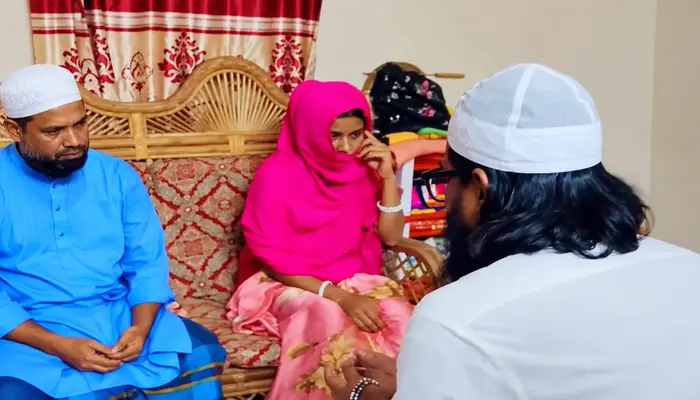
Case Summary
In Bangladesh, a 21-year-old Hindu woman was abducted, forcibly converted to Islam and married to a Muslim man named Arif. The conversion was carried out by Muslim leaders linked to Jamaat-e-Islami, a Muslim extremist organisation infamous for its involvement in communal violence against Hindus, attacks on temples, targeting of Hindu women and terror attacks. The victim was identified as Mukta Rani. She was a married Hindu woman and a housewife. Wasim Billah, a Muslim leader of Jamaat-e-Islami, was named in connection with her abduction, forced conversion and marriage. According to reports, following her abduction, Mukta Rani was subjected to a Facebook Live broadcast during which she was forcibly made to recite the Kalma (Islamic declaration of faith) and declare that she had converted to Islam. After the declaration, she was forcibly married to Arif according to Islamic rites. A video of the incident subsequently circulated on social media on 3 September 2026, causing outrage among members of the Hindu community. Notably, Bangladesh Jamaat-e-Islami was officially designated and banned as a “militant and terrorist” organisation by the Sheikh Hasina government in August 2024. However, the designation was revoked later that same month by the country’s subsequent interim administration, with the intent of appeasing Muslim extremists. Jamaat-e-Islami also has a longstanding history of anti-Hindu violence, extending beyond its role in the atrocities committed during the 1971 Bangladesh Liberation War. Following independence, Jamaat and its affiliated organisations were involved in communal violence targeting Hindus, including attacks on Hindu homes, businesses and places of worship, destruction of property, forced displacement and intimidation. Jamaat-linked groups were also involved in major episodes of anti-Hindu violence in Bangladesh, particularly during periods of political and communal unrest following Sheikh Hasina's ouster in 5 August 2024. This incident occurred against the broader backdrop of the historical persecution faced by Hindus in Bangladesh. While the Hindu minority has endured discrimination, targeted violence, and religious hostility over decades, such persecution has intensified in distinct spurts during periods of political and social instability. The latest major escalation began after the ouster of Sheikh Hasina’s government in August 2024, continued after the death of Sharif Osman Bin Hadi in December 2025, and resurfaced in the immediate aftermath of the 13th National Parliamentary Election in 2026. Following the ouster of Sheikh Hasina, multiple incidents involving attacks on Hindu homes, temples and religious institutions were documented, alongside intimidation, arson and mob violence targeting Hindu localities. The Hinduphobia Tracker recorded 336 incidents involving the Hindu minority during this period, reflecting the scale of the escalation and the continuing vulnerability of Hindus in Bangladesh. A further spurt of violence followed the death of Sharif Osman Bin Hadi, a Muslim political activist and student leader known for his anti-Hindu and anti-India rhetoric, in December 2025. In the aftermath, Hindu communities were subjected to retaliatory violence, with Hindu homes and properties selectively attacked and several families forced to flee. Among the victims was Dipu Chandra Das, who was lynched and whose body was subsequently set ablaze by a Muslim mob over false blasphemy allegations. The Hinduphobia Tracker documented 51 incidents of anti-Hindu violence in the period following Hadi’s death alone, further illustrating how existing hostility towards the Hindu minority intensified during moments of communal mobilisation. During the same period, posters and written material calling for the extermination of Hindus were also displayed in public spaces. Such rhetoric, when viewed alongside incidents of arson, vandalism, assault and targeted intimidation, reflected an environment in which hostility towards Hindus was not merely episodic but repeatedly resurfaced in more intense forms during periods of unrest. The most recent escalation followed the 13th National Parliamentary Election in 2026. In the immediate aftermath of the election results, Hindu families in districts including Noakhali, Rangpur, Nilphamari, Sylhet, Thakurgaon and Dinajpur faced attacks involving arson, looting, assault and vandalism of Hindu homes and temples. In several instances, Hindu properties were selectively targeted, and families were threatened with displacement. The present incident therefore occurred within a much longer history of persecution of Hindus in Bangladesh, where hostility towards the community has persisted over time and intensified in repeated spurts. The latest cycle began after Sheikh Hasina's ouster. It continued through subsequent periods of political and communal upheaval, leaving the Hindu minority increasingly vulnerable to targeted violence, intimidation and religious hostility.
Why it is Hate Crime ?
The primary category selected in this case is: Predatory Proselytisation. Within this, the subcategory selected is: Harassment, threats, coercion for conversion. Harassment covers a wide range of behaviours of an offensive nature. It is commonly understood as behaviour that demeans, humiliates, and intimidates a person, including threats and coercion. Harassment and threats, in this case, find their root in discriminatory grounds, which have the effect of nullifying a person’s rights or infringing upon his freedom to exercise his rights specifically owing to the victim’s religious identity. Verbal and physical threats and psychological or physical harassment are often used against Hindu victims because they choose to practice their professed religion. Religious harassment also includes forced and involuntary conversions by harassment, threats or coercion. Coercion includes intimidatory tactics like force-feeding a Hindu victim beef to convert to another religion, forceful circumcision, etc. In several documented cases, non-Hindu perpetrators or those who harbour specific animosity towards Hinduism harass victims simply based on their religious identity. Such cases often also include harassment to ensure the Hindu victim abandons his/her professed religion and adopts the religion of the perpetrator. Such cases where Hindu victims are harassed to convert to the perpetrator’s religion are rooted in animosity towards the victim’s religious identity and are therefore documented as religiously motivated hate crimes. This case has been included in the Hinduphobia Tracker’s Hate Crime Database because Mukta Rani, a Hindu woman, was abducted, forcibly converted to Islam and subsequently married to a Muslim man. The abduction itself was significant because it formed the starting point of the coercive process that culminated in her conversion and marriage. Mukta Rani was abducted before she was subjected to religious conversion, indicating that her removal from her existing circumstances preceded and enabled the subsequent acts imposed upon her. The progression from abduction to conversion and then marriage demonstrated the predatory nature of the incident from the outset, as physical control over the victim was followed by an attempt to alter her religious identity and place her within a Muslim marital arrangement. Her Hindu identity was therefore not merely disregarded during the offence; it became an aspect of her personhood that the perpetrators sought to overcome through a sustained process of coercion. Following her abduction, the Hindu victim was pressured to abandon Hinduism and was made to recite the Kalma and declare that she had converted to Islam during a Facebook Live broadcast. A conversion undertaken without the individual’s free and voluntary consent, but instead through coercion, pressure or force, cannot be regarded as a genuine exercise of religious choice; rather, the circumstances demonstrated the coercive process and harassment through which the change in religious affiliation was imposed. The compelled recitation of the Kalma and public declaration of conversion therefore directly violated the Hindu victim’s religious autonomy and fundamental right to retain her faith. By compelling her to renounce Hinduism and publicly profess another religion, the perpetrators treated her existing faith as something that could be forcibly discarded and replaced, reflecting animosity and disdain towards Hinduism and denying the Hindu victim the freedom to determine her own religious identity and beliefs. Her subsequent marriage to Arif further institutionalised the forced conversion. Under Islamic jurisprudence, a Muslim man cannot marry a Hindu woman unless she is regarded as having converted to Islam, making the preceding conversion integral to the validity of the marriage within that religious framework. In this context, the forced conversion was followed by marriage in a manner that reinforced and formalised the religious identity that had been imposed upon her. The marriage therefore did not constitute an isolated act following the conversion; it served to consolidate the conversion and place her within a Muslim marital structure after her Hindu identity had been forcibly discarded. Marriage was consequently used as an additional mechanism of control over the victim, transforming the coerced religious change into an institutionalised relationship and further restricting her ability to retain her original faith and religious identity. The involvement of Wasim Billah, who was identified as a leader of Jamaat-e-Islami, further heightened the seriousness of the case. The involvement of a person associated with an organisation known for its Muslim extremist ideology indicated that the incident extended beyond the actions of individuals, as a person identified as an organisational leader was connected to the abduction of a Hindu woman, her forced conversion to Islam, her compelled recitation of the Kalma and her subsequent marriage to a Muslim man. The association with Jamaat-e-Islami was particularly significant given the organisation’s history of anti-Hindu violence and its involvement in communal violence targeting Hindus in Bangladesh. The connection therefore raised the gravity of the incident, as the coercion of the Hindu victim’s religious identity occurred in the context of the involvement of an organisation with an established history of hostility towards Hindus, making the forced conversion and marriage a serious manifestation of religiously motivated hostility and an attack on her freedom to retain her Hindu faith. The incident occurred against the wider backdrop of heightened persecution and violence targeting Hindus in Bangladesh following Sheikh Hasina’s ouster and political exile in August 2024, during which Hindu homes, temples, businesses and other religious institutions faced repeated attacks. Within this environment, the abduction, forced conversion and marriage of a Hindu woman represented another manifestation of hostility directed at Hindu religious identity. Overall, since this case meets the parameters of a religiously driven offence, it is being added to the hate crime database of the Hinduphobia Tracker. Disclaimer: The Hinduphobia Tracker records incidents based on when an event occurred or when the victim's ordeal began. It is important to clarify that none of the media sources covering this case has specified the exact date when the incident occurred. Therefore, for documentation purposes, we have recorded the date based on when the incident first went viral on social media, 3rd September 2026.
Victim Details
Total Victim
1
Deceased
0
Gender
- Male 0
- Female 1
- Third Gender 0
- Unknown 0
Caste
- SC/ST 0
- OBC 0
- General 0
- Unknown 1
Age Group
- Minor 0
- Adult 1
- Senior Citizen 0
- Unknown 0


Case Status
Unknown


Perpetrators Details
Perpetrators
Muslim Extremists
Perpetrators Range
From 2 To 5
Perpetrators Gender
male
 Sources




