Hindu community forced to suspend century-old Durga Puja after Muslim man encroaches on sacred idol-immersion ghat in Naogaon, Bangladesh
 Naogaon District, Bangladesh
  6 September, 2026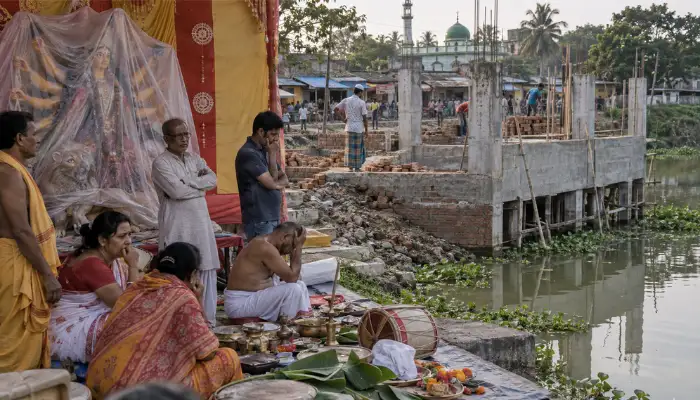
Case Summary
In Mainam Bazar, Manda Upazila, Naogaon, Bangladesh, the Hindu community decided to suspend the upcoming Sharadiya Durga Puja after a Muslim man, Aurangzeb Kantu, encroached upon the designated idol-immersion ghat used by local Hindu temples. The ghat formed part of the khash pond adjoining Mainam Bazar and had long been used by the Hindu community for the religious ritual of Durga idol immersion. The Mainam Bazar Sarbajanin Durga Temple had been organising Durga Puja for nearly 100 years, and the same immersion ghat had historically been used by around 8 to 10 local temples for the visarjan of Durga idols. The Hindu community continued to perform the immersion ritual at the site as recently as last year. Temple committee general secretary Ranjit Chandra Kabiraj stated that Aurangzeb Kantu, a Muslim man and former president of the Mainam Union BNP, was constructing a permanent concrete structure by occupying the khash land of the immersion ghat. The construction reduced the space required for carrying out the idol-immersion ritual and created a direct obstacle to the continuation of the Hindu community’s long-standing religious practice. With the designated ghat rendered difficult to use and no alternative arrangement available, members of the local Hindu community decided during a general meeting to suspend the upcoming Durga Puja celebrations. The encroachment therefore affected not only access to the immersion site but also the community’s ability to observe an almost century-old Hindu religious festival in accordance with its established customs and rituals. Temple committee president Milan Kamal Das said the permanent construction on the ghat would make celebrating Durga Puja difficult and stressed that recovering the site was necessary to preserve the community’s religious rites and long-standing tradition. The Mainam Bazar Sarbajanin Durga Temple Committee subsequently submitted a written application to Upazila Nirbahi Officer Akhtar Jahan Sathi, seeking removal of the encroachment and restoration of the immersion ghat. The UNO confirmed receipt of the complaint and directed the concerned land officer to investigate the matter, after which further administrative action would be taken. This incident occurred against the broader backdrop of the historical persecution faced by Hindus in Bangladesh. While the Hindu minority has endured discrimination, targeted violence, and religious hostility over decades, such persecution has intensified in distinct spurts during periods of political and social instability. The latest major escalation began after the ouster of Sheikh Hasina’s government in August 2024, continued after the death of Sharif Osman Bin Hadi in December 2025, and resurfaced in the immediate aftermath of the 13th National Parliamentary Election in 2026. Following the ouster of Sheikh Hasina, multiple incidents involving attacks on Hindu homes, temples and religious institutions were documented, alongside intimidation, arson and mob violence targeting Hindu localities. The Hinduphobia Tracker recorded 336 incidents involving the Hindu minority during this period, reflecting the scale of the escalation and the continuing vulnerability of Hindus in Bangladesh. A further spurt of violence followed the death of Sharif Osman Bin Hadi, a Muslim political activist and student leader known for his anti-Hindu and anti-India rhetoric, in December 2025. In the aftermath, Hindu communities were subjected to retaliatory violence, with Hindu homes and properties selectively attacked and several families forced to flee. Among the victims was Dipu Chandra Das, who was lynched and whose body was subsequently set ablaze by a Muslim mob over false blasphemy allegations. The Hinduphobia Tracker documented 51 incidents of anti-Hindu violence in the period following Hadi’s death alone, further illustrating how existing hostility towards the Hindu minority intensified during moments of communal mobilisation. During the same period, posters and written material calling for the extermination of Hindus were also displayed in public spaces. Such rhetoric, when viewed alongside incidents of arson, vandalism, assault and targeted intimidation, reflected an environment in which hostility towards Hindus was not merely episodic but repeatedly resurfaced in more intense forms during periods of unrest. The most recent escalation followed the 13th National Parliamentary Election in 2026. In the immediate aftermath of the election results, Hindu families in districts including Noakhali, Rangpur, Nilphamari, Sylhet, Thakurgaon and Dinajpur faced attacks involving arson, looting, assault and vandalism of Hindu homes and temples. In several instances, Hindu properties were selectively targeted, and families were threatened with displacement. The present incident therefore occurred within a much longer history of persecution of Hindus in Bangladesh, where hostility towards the community has persisted over time and intensified in repeated spurts. The latest cycle began after the ouster of Sheikh Hasina and continued through subsequent periods of political and communal upheaval, leaving the Hindu minority increasingly vulnerable to targeted violence, intimidation and religious hostility.
Why it is Hate Crime ?
The primary category selected in this case is: Attack on Hindu religious representations. The subcategory selected is: Encroachment or illicit takeover of temple land/ land near temple. In Hinduism, a temple is the abode of the Deity. The Deity in the Temple is consecrated, thereby making it a real, breathing entity. Hindus believe that not just the Deity but the temple premises themselves are sacred to Hindus since Hindus hold the faith that the entire Temple space is an amalgamation of the divine energy of the deity. Not only the Temple but the Temple premises in their entirety are considered sacred by Hindus. In several cases, the premises of the Temple and/or religious centre are illicitly taken over by institutions belonging to other faiths – like the Waqf board or the Church. Other times, the temple property, land or the property of religious centres are illicitly encroached upon by non-Hindu groups. Any illicit takeover or encroachment is a crime ab initio; however, when non-Hindu groups illicitly take over or encroach upon the sacred land of Hindus, it is an affront to the Hindu community and is therefore classified as a religiously motivated hate crime under this category. The other subcategory selected is: Breaking rules of place of worship. Sanatan Dharma is not a religion of one book, which is to say that while it has religious scriptures that form the central tenets of the faith, there are several traditions followed through thousands of years, mostly passed from generation to generation orally. One of these oral traditions or written traditions is the rules of specific temples. Certain temples have rules which are traditional, dependent on the worship of the presiding deities. These rules and traditions have been followed for thousands of years, whether they find scriptural mention or not. Such traditions are based on the nature and rules of worship of the presiding deity of that temple. Any non-compliance with these traditions owing to animosity towards the faith or for the sake of activism stems not only from a lack of faith in the presiding deity but also from disregard for the faith of the devotees of that deity/temple and implicit bias against the faith, the tradition and the deity itself. Since these specific traditions are central to the faith of the devotees of that specific temple and presiding deity, any non-compliance with these traditional rules would be considered a religiously motivated hate crime. This case qualified as a religiously motivated hate crime because a Muslim man, Aurangzeb Kantu, encroached upon the designated immersion ghat used by the Mainam Bazar Sarbajanin Durga Temple and several other Hindu temples. The ghat was not an ordinary piece of land; it was a long-established religious site used by the Hindu community for Durga idol immersion. By constructing a permanent structure on the ghat, the encroachment directly obstructed a space essential to Hindu worship and disrupted the community’s ability to observe its religious tradition. The immersion of the Durga idol is an important concluding rite of Durga Puja. After the period of worship, the consecrated idol is ceremonially immersed in water as part of the completion of the festival. The ghat where this ritual is traditionally performed therefore has direct religious significance for devotees. Blocking or occupying such a site interferes with the ability of Hindus to complete the festival according to established custom and effectively obstructs a sacred religious practice. The seriousness of the encroachment was evident from its impact on the local Hindu community. The ghat had been used for nearly a century and served idols from multiple temples, yet the permanent construction left insufficient space for immersion. With no suitable alternative available, the Hindu community decided to suspend Sharadiya Durga Puja, showing that the encroachment had gone beyond a land dispute and had directly impaired the continuation of Hindu religious observance. Taken together, the encroachment of a long-used Hindu immersion ghat by a Muslim man, obstruction of a sacred Durga Puja ritual, and resulting disruption of an almost century-old religious tradition constituted a direct attack on a space integral to Hindu worship. The incident therefore reflected disregard for Hindu religious practice and the continuity of temple traditions, warranting its inclusion in the Hinduphobia Tracker. Disclaimer: The Hinduphobia Tracker records an incident based on the date it occurred, rather than the date it was subsequently discussed or circulated. In this case, the exact date on which the encroachment of the Hindu immersion ghat began could not be conclusively established. Therefore, 7th September 2026, the date Hindu News reported the incident, has been recorded as the indicative incident date for documentation purposes only.


Case Status
Complaint filed


Perpetrators Details
Perpetrators
Muslim Extremists
Perpetrators Range
One Person
Perpetrators Gender
male
 Sources




