Hindu Pran Pratishtha and idol worship mocked as ‘delusion’ and ‘looting’ by Ambedkarite; repeated attacks on Hindu scriptures, deities and festivals surface
 Fatehpur, Uttar Pradesh, India
  5 September, 2026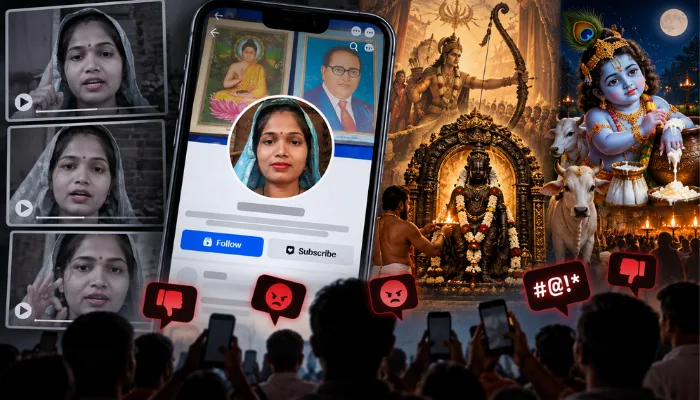
Case Summary
In Khaga Naka village, an Ambedkarite woman and self-identified Facebook digital creator, Sushma Jatav, made derogatory remarks targeting Brahmins and Pran Pratishtha, a central Hindu ritual through which a deity is consecrated in a murti. The Hinduphobia Tracker traced her Facebook account, which uses the name Sushma Gautam and has around 656,000 followers. Her remarks circulated on social media and drew objections from members of the Hindu community, who sought action over what they described as her repeated derogatory content targeting Hindu beliefs and religious traditions. In the latest instance, Sushma Jatav mocked Brahmins and ridiculed the practice of Pran Pratishtha. She stated, “A Brahmin cannot bring his dead father back to life, but he will put life into a stone idol and make it alive. He is looting the world by spreading this delusion, and you expect me to believe him? Mind your own understanding. Jai Bheem.” She compared the death of a Brahmin's father with the consecration of a Hindu murti and portrayed the religious practice as a deliberate deception used to mislead people. The post prompted calls for police action on social media. One such appeal stated that Sushma Jatav of Khaga Naka village had been making objectionable remarks against Hindu deities and that her posts were hurting the religious sentiments of the Hindu community, while urging users to continue amplifying the matter until action was taken. These remarks were not an isolated incident. While reviewing her public Facebook content, the Hinduphobia Tracker found multiple posts and videos in which Sushma Jatav ridiculed Hinduism, Hindu scriptures, religious traditions, festivals, and associated beliefs. The Tracker had also previously documented a separate case involving her remarks against the Hindu festival of Holi. In another post, she mocked an episode from the Ramayana involving the bow that Lord Ram lifted during Sita's swayamvar. She questioned whether Lord Ram was the only person capable of lifting the bow and who had brought it to the assembly in the first place. She accompanied the remarks with a laughing emoji, challenged believers to answer her questions, and stated that “there is a limit even to superstition and jokes.” In a separate remark, she contrasted Islam and Hinduism, stating that Muslims had neither treated “us” as untouchables nor prevented “us” from walking on roads or accessing water. She then claimed that the religion worshipped day and night by those who had subjected them to such restrictions was itself responsible for their oppression, thereby attributing historical caste discrimination to the Hindu religion. Sushma Jatav also made derogatory remarks about Janmashtami and the worship of Lord Krishna. Referring to the Hindu practice of observing Krishna's birth at midnight, she questioned how anyone could know that Krishna was born at “12 o'clock” 5,000 years ago when clocks had not yet been invented. She described the midnight observance as “showing off” and criticised devotees for pouring milk and butter down drains while hungry children remained without food, concluding that “this is not devotion but hypocrisy.”
Case Images

Why it is Hate Crime ?
This case is being added to the tracker under the primary category: Hate speech against Hindus. The subcategory selected is: Anti-Hindu slurs, mocking faith. Anti-Hindu slurs and the deliberate mocking of the Hindu faith owing to religious animosity involve the use of derogatory terms, stereotypes, or offensive references to religious practices, symbols, or figures. One of the common anti-Hindu slurs used against Hindus is “cow-worshipper” and “cow piss drinker”. The intention of using these terms is to demean and mock Hindus as a group and their religious beliefs, since Hindus consider the cow holy. Additionally, some symbols and the slurs attached to them have a historical context that exacerbates the insult, hate, stereotyping, dehumanisation and oppression against Hindus. Cow worship has been used for centuries to denigrate Hindus, insult their faith and oppress Hindus specifically as a religious group. There has been overwhelming documentation about how cow slaughter has been used to persecute Hindus, with cow meat being thrown in temples and places of worship. There has also been overwhelming documentation that cow meat (beef) has been force-fed to Hindus to either forcefully convert them to Islam or denigrate their faith. Apart from cow worship, the Swastika – which holds deep religious significance for the Hindus – has also been misinterpreted and distorted to be used as a slur against Hindus. Similarly, the worship of the Shivling has been used by supremacist ideologies and religions to denigrate Hindus owing to religious animosity. Such slurs and denigration stem from inherent animosity and hate towards Hindus and their faith; therefore, it is categorised as hate speech targeted at Hindus specifically owing to their religious identity. The other selected subcategory is: Subversion of scriptures. Subverting the religious scriptures of Hindus has particularly devastating consequences. Subversion of the scriptures of Hindus is often done to justify or promote hatred, discrimination, or violence against specific individuals or groups of Hindus. Religious scriptures are often nuanced and those who harbour religious animosity towards Hindus often misquote or misrepresent the scripture to legitimise their animosity and hate towards the faith and its adherents. Any such misquoting of scriptures or subversion to justify hate, violence and discrimination against Hindus owing to religious animosity is hate speech and is categorised as such. This incident was recorded as religiously motivated hate speech because the Ambedkarite digital creator repeatedly used her social-media platform to ridicule, distort and denigrate Hindu religious beliefs, scriptures, deities, festivals and modes of worship. Rather than engaging with the religious significance of Pran Pratishtha, the remark recast the Hindu doctrine of consecration in deliberately derogatory terms, portraying the murti as nothing more than a stone and accusing Brahmins of deceiving people by claiming to imbue it with divine presence for monetary gain. Understanding the religious significance of Pran Pratishtha helps explain why that representation was distasteful. In Hindu temple theology, Pran Pratishtha is a consecratory rite through which a murti is ritually established as a locus of divine presence through prescribed mantra, purification, invocation and worship. The Hindu understanding is therefore not equivalent to a Brahmin claiming to resurrect biologically dead matter in the same sense that a deceased human being could be revived. Temple-consecration procedures are particularly developed in the Agamas, Pancharatra and other ritual traditions, as well as Puranic ritual literature, and Vedic mantras are incorporated into consecration ceremonies. It would consequently be imprecise to describe the entire ritual simply as a literal claim that a priest can make an ordinary stone biologically alive. By deliberately collapsing this theological distinction and juxtaposing Pran Pratishtha with the death of a Brahmin’s father, Jatav converted a sacred Hindu concept into a crude supposed contradiction and then used that distortion to accuse its practitioners of spreading “delusion” and exploiting the world. The same method of religious subversion through selective caricature was visible in her treatment of the Ramayana. Jatav mocked the account of Lord Ram and Shiva’s bow by asking that, if no one other than Ram could lift the bow, then who had brought it into the assembly, followed by a laughing emoji and the assertion that there was a limit to “superstition and jokes”. However, the Valmiki Ramayana, Bala Kanda, Sarga 67, explicitly answers the question she presented as an inherent absurdity. King Janaka ordered the bow to be brought; it was contained in an eight-wheeled coffer, which the text says was drawn with great difficulty by five thousand strong men. Lord Ram subsequently handled and strung the bow himself with extraordinary ease. Her formulation therefore omitted the very textual detail that answered her rhetorical question and used that omission to present the Ramayana narrative as irrational. This was significant under anti-Hindu subversion and prejudice, because a Hindu scripture was not being seriously examined on its own terms; an incomplete version of the narrative was presented, and the resulting manufactured contradiction was then used to ridicule Hindu belief. A further religious marker appeared in her attack on Janmashtami and the midnight celebration of Lord Krishna’s birth. Jatav questioned how devotees could celebrate Krishna’s birth at exactly midnight when mechanical clocks did not exist 5,000 years ago and portrayed the midnight observance as modern “showing off”. This again confused the existence of a modern clock with the ancient human ability to identify divisions of the night. More importantly, the midnight association is not a modern invention created after mechanical clocks. Srimad Bhagavatam 10.3.8 describes Janardana’s manifestation using the term niśīthe, meaning late at night or midnight, when darkness had arisen. The Vishnu Purana tradition likewise places Krishna’s birth on Krishna Paksha Ashtami at midnight, while the Harivamsha tradition preserves the association of the birth with Ashtami, Rohini and midnight. This scriptural basis explains why devotees await Nishita Kaal and commemorate Krishna Janma at midnight. The practice therefore does not depend upon the existence of a modern clock face; modern clocks merely provide a contemporary means of measuring a time of night already embedded in the religious tradition. Her further description of offerings of milk and butter as waste being “poured down the drain”, followed by the assertion that such devotion was “hypocrisy”, continued the same reductionist framing. Milk, curd and butter possess a specific devotional association with Krishna through Hindu narratives and ritual traditions surrounding his childhood and are used as offerings within worship. A person may legitimately debate the social use of resources, but presenting devotional offerings themselves as evidence that Hindu worship is fraudulent or hypocritical turns a social argument into a vehicle for disparaging the religious practice. In her formulation, education, compassion or rationality were repeatedly placed on one side and Hindu observance on the other, producing a prejudicial binary in which adherence to Hindu tradition was represented as evidence of superstition or moral deficiency. Another post extended this hostility from particular rituals to Hinduism as a whole. Jatav stated that Muslims had neither treated “us” as untouchables nor stopped “us” from using roads or water, while asserting that the religion worshipped day and night was itself responsible for such restrictions. This was a sweeping historical and religious generalisation. It is important to distinguish criticism of caste discrimination—which is a legitimate subject of historical and social debate—from attributing an entire history of social exclusion uniformly to Hindu religion while simultaneously making an absolute exculpatory claim about another religious community. No Vedic or Puranic citation contained in her formulation established those broad historical propositions. Her post instead used caste grievance to construct Hinduism itself as the singular religious antagonist, reinforcing the recurring portrayal of Hindu faith as inherently oppressive rather than engaging with the complexity of texts, practices, social history and reform traditions. The cumulative context matters because these were not isolated remarks in a single debate. The Hinduphobia Tracker’s examination of Sushma Jatav’s Facebook account found numerous posts and videos in which Hindu deities, scriptures, festivals, rituals and religious traditions were repeatedly subjected to derision. The Tracker records three such antecedent instances in this case to demonstrate the recurring pattern, while noting that additional similar material was present on her account. The Hinduphobia Tracker had also previously documented a separate case involving Jatav’s denigration of the Hindu festival Holi. The present Pran Pratishtha remark therefore occurred against a documented background of repeated hostile commentary directed at different and unrelated components of Hindu religious life. The sustained pattern therefore went beyond disagreement with a single custom and reflected innate animosity for Hindus and their faith, warranting the case’s inclusion in the Hinduphobia Tracker’s hate-crime database. It is also important to mention here that the accused was a member of the Bhim Army. While the Bhim Army presents itself as a champion of Dalit rights, its actions and affiliations often contradict this claim. Dalits are very much Hindus, yet the Bhim Army frequently targets Hindu symbols, festivals, and practices, including those held sacred by Dalits themselves. This pattern suggests that the organisation’s agenda is less about genuine Dalit upliftment and more aligned with broader anti-Hindu narratives that seek to divide and weaken Hindu society from within. This becomes particularly apparent when the Bhim Army aligns with leftist and Islamist platforms, where identity politics is weaponised against Hindus. In such spaces, the micro identities of caste, region, and language are secondary; what matters most is religious identity. It is the Hindu identity, regardless of caste, that often becomes the target of animosity. As seen in cases where Dalit families were attacked for displaying Hindu symbols or worshipping deities, the hostility stems not from caste differences, but from a disdain for Hindu religiosity. For example, on May 19, 2020, reports emerged in which a Dalit family in Bihar’s Kishanganj district accused the local Bhim Army unit of attacking them for their beliefs, desecrating a temple as they objected to their reverence for Hindu deities and saffron flags. Moreover, Bhim Army chief Chandrashekhar Azad has repeatedly made statements and taken positions that reflect his anti-Hindu stance. For instance, he has publicly endorsed conversion as a political weapon, invoking B.R. Ambedkar’s decision to leave Hinduism, and has actively supported movements that call for a rejection of Hindu festivals and practices. In fact, Chandrashekhar Azad's political trajectory has strongly focused on building a Dalit-Muslim alliance, a strategy that became particularly evident during his active participation in the anti-CAA (Citizenship Amendment Act) protests, which culminated in the Delhi anti-Hindu Riots of 2020. His brand of politics, under the banner of Dalit-Muslim unity, has contributed to narratives that vilify Hindu traditions and exacerbate targeted attacks against Hindus. Thus, by attacking Hindu symbols and aligning with forces hostile to Hinduism at large, the Bhim Army effectively turns against the cultural and spiritual traditions of the Dalit community itself. In doing so, it reinforces the very forces of division and religious antagonism that marginalise Dalits, not as a caste, but as Hindus. This contradiction reveals that, despite its stated mission, the Bhim Army’s trajectory increasingly serves an anti-Hindu, rather than a pro-Dalit, agenda. Disclaimer: The Hinduphobia Tracker records the incident date based on when the incident occurred, rather than the date it was subsequently circulated or discussed. In this case, the exact date on which Sushma Jatav originally made and uploaded the objectionable video could not be conclusively identified. Bajrang Dal Uttar Pradesh brought the matter to public attention through a post on X (Twitter) on 6th September 2026. Therefore, 6th September 2026 has been recorded as the indicative incident date for documentation purposes only.


Case Status
Complaint filed


Perpetrators Details
Perpetrators
Others
Perpetrators Range
One Person
Perpetrators Gender
female
 Sources




