Revered Hindu deity Lord Krishna subjected to obscene and derogatory remarks by Ambedkarite man on sacred occasion of Janmashtami
 Ambedkar Nagar, Uttar Pradesh, India
  3 September, 2026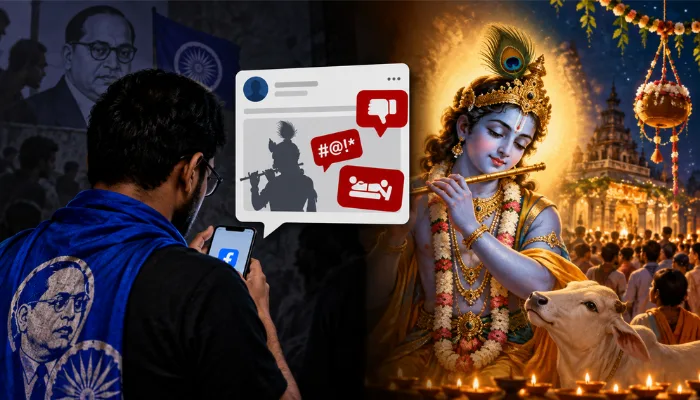
Case Summary
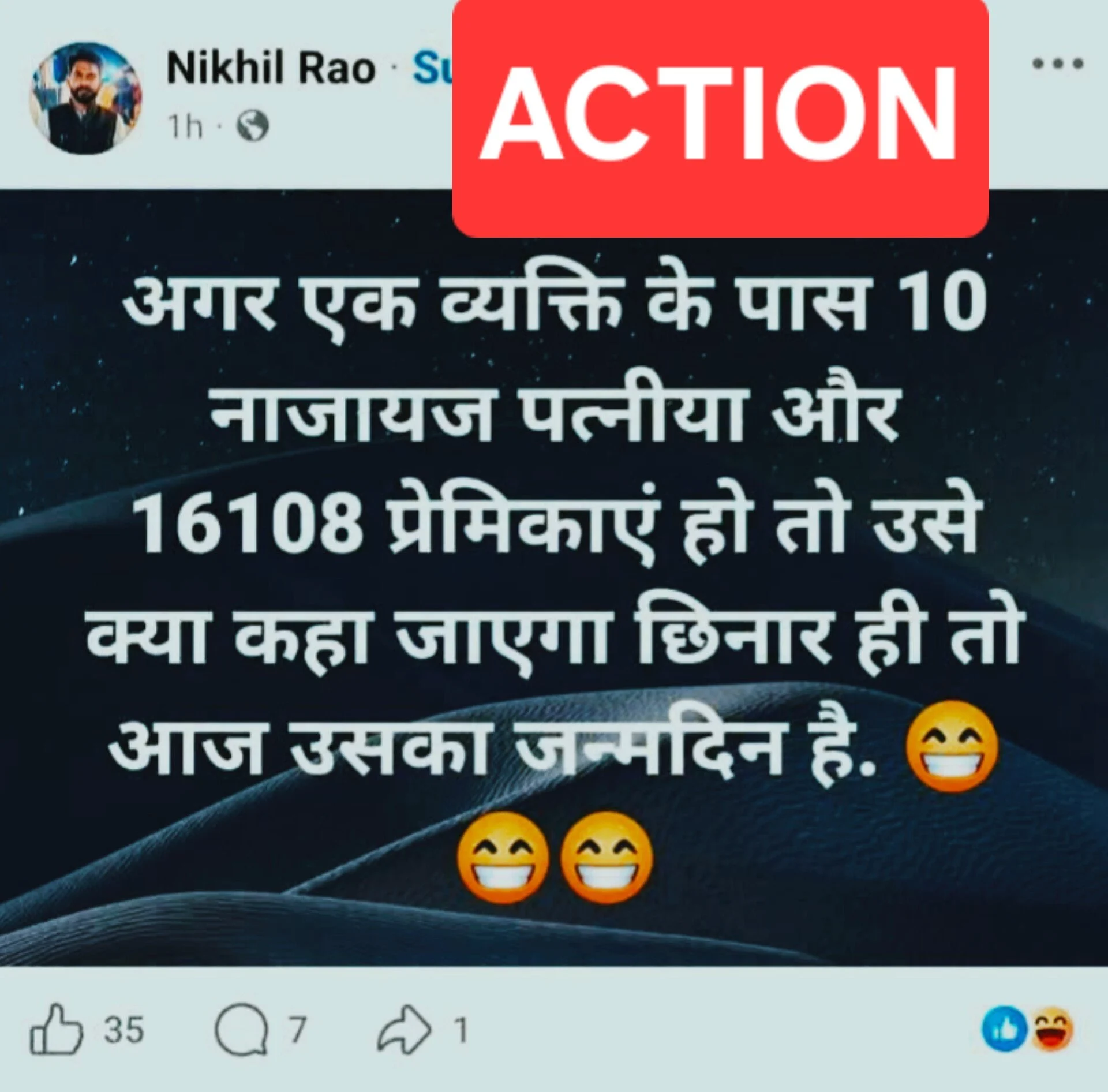
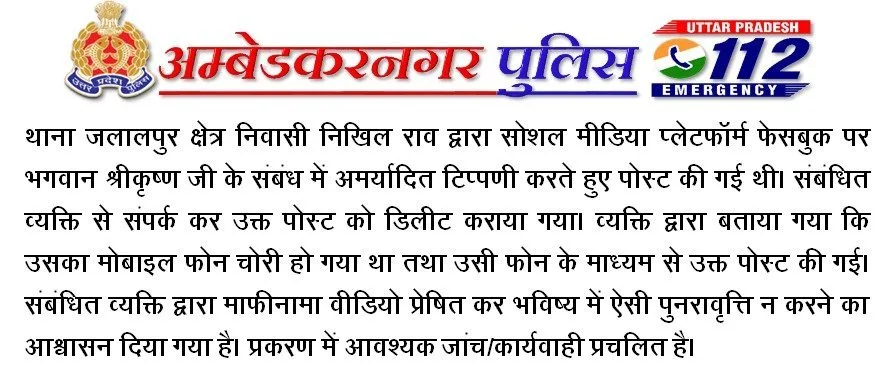
In Jalalpur, Ambedkar Nagar, Uttar Pradesh, revered Hindu deity Lord Shri Krishna was denigrated on the sacred occasion of Janmashtami through an objectionable Facebook post linked to an Ambedkarite man identified as Nikhil Rao. The remarks triggered outrage among members of the Hindu community. The incident came to light after the Facebook post circulated on social media. Posted on Janmashtami, the content used obscene and derogatory language to target Lord Shri Krishna and made a sexually suggestive reference to the women whom he is traditionally described as having accepted and protected. In the post, it was stated that if a man had “10 illegitimate wives and 16,108 girlfriends,” he would be called a “womaniser”. The post then added that “today is the birthday of the same womaniser,” clearly referring to Lord Shri Krishna and thereby using the sacred occasion of Janmashtami itself to mock and insult the revered Hindu deity. Following the post's circulation, members of the Hindu community raised objections on social media and demanded action from the Ambedkar Nagar Police. Dr Neha Das also highlighted the matter and thanked the police for taking cognisance of the derogatory remarks against Lord Shri Krishna. Ambedkar Nagar Police subsequently identified the person concerned as Nikhil Rao, a resident of the Jalalpur police station area. In its official response, the police stated that an objectionable Facebook post regarding Lord Shri Krishna had been made from his account; the person was contacted, and the post was deleted. Nikhil Rao recorded an apology video with the salutation "Jai Bheem" and then claimed that his mobile phone had been stolen and that the objectionable post had been made using the stolen phone, thereby deceiving others. He also sent an apology video and assured the police that such an incident would not occur again. The police stated that the necessary investigation and further action in the matter were ongoing.
Case Images
Why it is Hate Crime ?
The primary category selected for this case is: Hate speech against Hindus. The subcategory selected for this case is: Anti-Hindu slurs/mocking faith. Anti-Hindu slurs and the deliberate mocking of the Hindu faith owing to religious animosity involve the usage of derogatory terms, stereotypes, or offensive references to religious practices, symbols, or figures. One of the common anti-Hindu slurs used against Hindus is “cow-worshipper” and “cow piss drinker”. The intention of using these terms is to demean and mock Hindus as a group and their religious beliefs, since Hindus consider the cow holy. Additionally, some symbols and the slurs attached to them have a historical context that exacerbates the insult, hate, stereotyping, dehumanisation and oppression against Hindus. Cow worship has been used for centuries to denigrate Hindus, insult their faith and oppress Hindus specifically as a religious group. There has been overwhelming documentation about how cow slaughter has been used to persecute Hindus, with cow meat being thrown in temples and places of worship. There has also been overwhelming documentation that cow meat (beef) has been force-fed to Hindus to either forcefully convert them to Islam or denigrate their faith. Apart from cow worship, the Swastika – which holds deep religious significance for the Hindus – has also been misinterpreted and distorted to be used as a slur against Hindus. Similarly, the worship of the Shivling has been used by supremacist ideologies and religions to denigrate Hindus owing to religious animosity. Such slurs and denigration stem from inherent animosity and hate towards Hindus and their faith; therefore, it is categorised as hate speech targeted at Hindus specifically owing to their religious identity. The other selected subcategory is: Subversion of scriptures. Subverting the religious scriptures of Hindus has particularly devastating consequences. Subversion of the scriptures of Hindus is often done to justify or promote hatred, discrimination, or violence against specific individuals or groups of Hindus. Religious scriptures are often nuanced and those who harbour religious animosity towards Hindus often misquote or misrepresent the scripture to legitimise their animosity and hate towards the faith and its adherents. Any such misquoting of scriptures or subversion to justify hate, violence and discrimination against Hindus owing to religious animosity is hate speech and is categorised as such. This case is a clear example of religiously driven hate speech, as a Facebook post linked to Nikhil Rao used obscene, derogatory and sexually demeaning language against the revered Hindu deity Lord Shri Krishna. Lord Krishna holds immense religious, spiritual and cultural significance for Hindus and is worshipped as an incarnation of Lord Vishnu. He occupies a central place in Hindu religious traditions through texts such as the Bhagavad Gita and the Mahabharata. Devotees revere him as a divine figure associated with dharma, devotion, wisdom and righteousness. Janmashtami, which commemorates his birth, is one of the most important Hindu festivals and is observed through fasting, prayers, devotional singing, temple rituals, scripture recitation and other forms of worship. The nature of the post makes the religious targeting explicit. It described Shri Krishna as a “womaniser” and referred to him as having “10 illegitimate wives and 16,108 girlfriends.” The post did not seek to question or engage with Hindu scripture. It deliberately twisted a sacred Puranic narrative and recast it in crude, sexually derogatory terms to portray Lord Shri Krishna as a “womaniser.” The reference to 16,108 women is particularly significant because it distorted a recognised Puranic tradition. Hindu scriptures describe Shri Krishna as rescuing 16,108 women who had been held captive by Narakasura and accepting them so that they would not be subjected to social rejection because of their captivity. The post stripped this context entirely and recast the women as “girlfriends” and “illegitimate wives” in order to attach a degrading sexual characterisation to Shri Krishna. The insult therefore depended on misrepresenting a Hindu religious narrative and turning it into material for sexual ridicule. The timing further reinforces the religious nature of the offence. The post was circulated on Janmashtami itself, the sacred occasion when Hindus commemorate Shri Krishna's birth and worship and celebrate him. Using this specific day to publish a sexually derogatory portrayal of the deity added a deliberate element of provocation and contempt towards Hindu worship and the community observing the festival. The incident also bears resemblance to an earlier case documented by the Hinduphobia Tracker, in which another man identified as an Ambedkarite, Indresh Baudh, made similarly derogatory remarks about Shri Krishna on Janmashtami. The recurrence of similar targeting of the same revered Hindu deity on the same sacred occasion is significant in assessing the present incident. Taken together, the obscene sexualisation of Shri Krishna, deliberate distortion of a Puranic narrative, and timing of the insult on Janmashtami demonstrate that the post was not merely criticism or commentary on Hindu scripture. It was a direct act of denigration aimed at a revered Hindu deity and, by extension, the faith and devotees who worship him. It reflected clear animosity and contempt towards Hinduism and its forms of worship, thereby meeting the parameters of a religiously motivated hate crime against Hindus. For this reason, the case warrants inclusion in the tracker. It is also important to mention here that the accused was a member of the Bhim Army. While the Bhim Army presents itself as a champion of Dalit rights, its actions and affiliations often contradict this claim. Dalits are very much Hindus, yet the Bhim Army frequently targets Hindu symbols, festivals, and practices, including those held sacred by Dalits themselves. This pattern suggests that the organisation’s agenda is less about genuine Dalit upliftment and more aligned with broader anti-Hindu narratives that seek to divide and weaken Hindu society from within. This becomes particularly apparent when the Bhim Army aligns with leftist and Islamist platforms, where identity politics is weaponised against Hindus. In such spaces, the micro identities of caste, region, and language are secondary; what matters most is religious identity. It is the Hindu identity, regardless of caste, that often becomes the target of animosity. As seen in cases where Dalit families were attacked for displaying Hindu symbols or worshipping deities, the hostility stems not from caste differences, but from a disdain for Hindu religiosity. For example, on May 19, 2020, reports emerged in which a Dalit family in Bihar’s Kishanganj district accused the local Bhim Army unit of attacking them for their beliefs, desecrating a temple as they objected to their reverence for Hindu deities and saffron flags. Moreover, Bhim Army chief Chandrashekhar Azad has repeatedly made statements and taken positions that reflect his anti-Hindu stance. For instance, he has publicly endorsed conversion as a political weapon, invoking B.R. Ambedkar’s decision to leave Hinduism, and has actively supported movements that call for a rejection of Hindu festivals and practices. In fact, Chandrashekhar Azad's political trajectory has strongly focused on building a Dalit-Muslim alliance, a strategy that became particularly evident during his active participation in the anti-CAA (Citizenship Amendment Act) protests, which culminated in the Delhi anti-Hindu Riots of 2020. His brand of politics, under the banner of Dalit-Muslim unity, has contributed to narratives that vilify Hindu traditions and exacerbate targeted attacks against Hindus. Thus, by attacking Hindu symbols and aligning with forces hostile to Hinduism at large, the Bhim Army effectively turns against the cultural and spiritual traditions of the Dalit community itself. In doing so, it reinforces the very forces of division and religious antagonism that marginalise Dalits, not as a caste, but as Hindus. This contradiction reveals that, despite its stated mission, the Bhim Army’s trajectory increasingly serves an anti-Hindu, rather than a pro-Dalit, agenda. Similar cases involving Sanghmitra Baudh’s continuing pattern of denigrating and ridiculing Hinduism, Hindu deities, scriptures, religious beliefs and practices have also been documented by the Hinduphobia Tracker.


Case Status
Perpatrator released by Police


Perpetrators Details
Perpetrators
Others
Perpetrators Range
One Person
Perpetrators Gender
male
 Sources




