Hindu man branded 'kafir' and assaulted after mosque instigates Muslim mob to demolish and loot his shop in Buxar, Bihar
 Buxar, Bihar, India
  3 September, 2026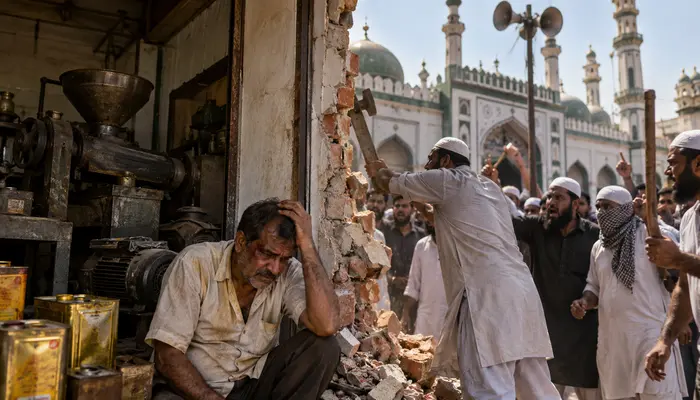
Case Summary
In Thatheri Bazaar, Buxar, Bihar, a Hindu family’s oil mill, which had been operating from the same location within the Jama Masjid complex for over six decades, was vandalised and looted by a Muslim mob after Jumma (Friday) prayers on 4 September 2026. The Hindu shopkeeper was subjected to anti-Hindu abuse, including being called a “Kafir”, and was threatened with death and told to leave the area or face the consequences. The mob mobilised and attacked the shop after an announcement was made over the mosque loudspeaker calling on Muslims to demolish it. Following the announcement, a mob of more than 30 to 40 Muslims, including women and children associated with the mosque, arrived at the shop. Some members of the mob were carrying sticks and rods and proceeded to demolish the shop’s wall. The Hindu shopkeeper was also assaulted and threatened with being bombed, along with his family members. Rakesh Sharma, son of Suresh Sharma, a resident of Thatheri Bazaar, operated the shop. On the day of the violence, the Muslim mob broke the wall of the shop, following which they entered the oil mill and looted cash, machinery, mustard oil and other articles. According to Rakesh Sharma’s complaint, Jama Masjid Committee Joint Secretary Shabbir Ahmad looted ₹10,000 from the cash drawer. Fasih Alam, Dunnu Hashmi, Zulfiqar Hashmi and Sagir Farooqui took two 4-horsepower Crompton motors and old machine parts, while Saif Ansari, along with unidentified persons, took four tins of mustard oil and other valuables. Rakesh Sharma was also assaulted by the Muslim mob during the incident. After locals gathered at the scene on hearing the commotion, the named accused, who were leading the mob, left with the looted goods. As they fled, they threatened to bomb Rakesh Sharma, his entire family, their house and the shop if he approached the police or filed a complaint. Rakesh Sharma subsequently approached Nagar Police Station, where a First Information Report was registered against seven named accused and 30–40 unidentified Muslim persons. The police took the matter seriously as the incident involved members of two communities and heightened tension in the area. Police increased vigilance and deployed personnel near the Big Mosque as a precautionary measure. Police arrested one of the named accused and continued raids at possible hideouts to apprehend the remaining accused. Sadar Deputy Superintendent of Police Gaurav Pandey said they were identifying those involved and would take further action based on evidence gathered during the investigation. Shahabad Deputy Inspector General Satyaprakash also took cognisance of the incident and spoke with Buxar Superintendent of Police Shubham Arya regarding the case. The Deputy Inspector General directed the police to identify the perpetrators and arrest them immediately. He also sought to speak with the Buxar Superintendent of Police regarding a complaint that the Superintendent of Police had not been answering his phone. Police appealed to Hindu and Muslim communities to maintain peace and communal harmony and warned that they would take legal action against anyone who tried to disturb the atmosphere by circulating videos of the vandalism or dispute on social media. The police also appealed to the public to ignore rumours. Notably, the incident took place against the backdrop of an older dispute between the two sides. According to Rakesh Sharma’s written complaint, in 2024, members of the mosque committee had attempted to fill an ancient government well located on the premises with soil and level it. Sharma and his family objected, saying it amounted to destroying government property. Sharma stated that this dispute subsequently led to an ongoing rivalry between the two sides. Separately, police stated that there had also been a dispute concerning the shop being set up or operated outside the designated area and the storage or placement of shop goods outside the designated area. Police had previously called both parties together and attempted to resolve the dispute amicably. The matter was pending before the court and remained sub judice at the time of writing this report. Sadar Deputy Superintendent of Police Gaurav Pandey stated that both sides should respect the law and the judicial process until the court delivered its decision. On 6 September 2026, Nagar Police arrested Shabbir Ahmad, Joint Secretary of the Jama Masjid Committee and the main named accused in the case. Subsequently, Nagar Police Station Station House Officer Manoj Kumar Singh reached Jama Masjid Katra in Thatheri Bazaar with a substantial police deployment. In the police's presence, masons rebuilt the demolished wall of the oil mill, while police personnel remained deployed at the site. The administration subsequently sealed the entire disputed plot and restored the status quo. Station House Officer Manoj Kumar Singh said the disputed plot would remain sealed until the final court decision and that the administration was monitoring the situation to prevent further disputes. He warned that strict legal action would be taken against anyone from either side who tried to disturb peace or create trouble, and he appealed to all parties to maintain peace and harmony.
Why it is Hate Crime ?
The primary category selected in this case is: Attack not resulting in death. The subcategory selected is: Attacked for Hindu identity. In several cases, Hindus are attacked merely for their Hindu identity without any perceived provocation. A classic example of this category of religiously motivated hate crime is a murder in 2016. 7 ISIS terrorists were convicted for shooting a school principal in Kanpur because they got ‘triggered’ seeing the Kalava on his wrist and the tilak that he had put. In this, the Hindu victim had offered no provocation except for his Hindu religious identity. The motivation for the murder was purely religious, driven by religious supremacy. Such cases where Hindus are targeted merely for their religious identity would be documented as a hate crime under this category. The other primary category selected is: Hate speech against Hindus. The subcategory selected is: Violent threats. Violent threats, explicit, implicit or implied, are the most dangerous form of hate speech since it goes beyond discriminatory and prejudicial language to express the intent of causing harm to an individual or a group of people based on their religious identity and faith. There could be several different kinds of threats that are issued to Hindus based on religious animosity. An explicit threat would mean a direct threat of violence towards an individual Hindu, a group of Hindus or Hindus at large. Physical violence, death threats, threats of destruction of property belonging to Hindus and threats of genocide would mean explicit threats against Hindus for their religious identity. Implicit threats may not be a direct threat but implied through the use of symbols or actions – for example – in the Nupur Sharma case, other than explicit threats, there were also implicit threats when Islamists took to the streets to burn and beat her effigies. It implies that they want to do the same to Nupur Sharma – thereby is considered an implicit threat. Violent threats can be delivered in person, through letters, phone calls, graffiti, or increasingly through social media and other online platforms. It would be important to understand that a threat – explicit or implicit, online or offline – to an individual who happens to be a Hindu does not qualify as a religiously motivated threat. Such a threat, while vile and dangerous, could be owing to non-religious reasons and/or personal animosity. To qualify as a religiously motivated threat, it would need to exhibit an indication that the individual is being targeted for religious reasons and/or owing to his/her religious identity as a Hindu. The other selected subcategory is: Anti-Hindu slurs, mocking faith. Anti-Hindu slurs and the deliberate mocking of the Hindu faith owing to religious animosity involve the usage of derogatory terms, stereotypes, or offensive references to religious practices, symbols, or figures. One of the common anti-Hindu slurs used against Hindus is “cow-worshipper” and “cow piss drinker”. The intention of using this term is to demean and mock Hindus as a group and their religious beliefs since Hindus consider the cow holy. Additionally, some symbols and the slurs attached to them have a historical context that exacerbates the insult, hate, stereotyping, dehumanisation and oppression against Hindus. Cow worship has been used for centuries to denigrate Hindus, insult their faith and oppress Hindus specifically as a religious group. There has been overwhelming documentation about how cow slaughter has been used to persecute Hindus with cow meat being thrown in temples and places of worship. There has also been overwhelming documentation where cow meat (beef) has been force-fed to Hindus to either forcefully convert them to Islam or denigrate their faith. Apart from cow worship, the Swastika – which holds deep religious significance for the Hindus – has also been misinterpreted and distorted to use as a slur against Hindus. Similarly, the worship of the Shivling has been used by supremacist ideologies and religions to denigrate Hindus owing to religious animosity. Such slurs and denigration stem out of inherent animosity and hate towards Hindus and their faith, therefore, it is categorised as hate speech targeted at Hindus specifically owing to their religious identity. This case was a clear example of a religiously driven hate crime because a Hindu man was assaulted, and his shop was specifically targeted and demolished by a Muslim mob following an announcement from the mosque after Jumma prayers. The mosque announcement was particularly significant in establishing the incident's religious character. A mosque is a religious institution, and announcements made through its loudspeakers, particularly around Jumma, reach a Muslim congregation gathered for the important weekly Friday prayer and carry a religious and communal significance. In this case, the announcement did not remain a mere statement; it was followed by the mobilisation of 30–40 Muslims who arrived at the Hindu man’s shop, some armed with sticks and rods, and proceeded to demolish its wall, enter the premises and loot the property. The direct sequence between the mosque announcement and the subsequent collective action demonstrated that the religious institution had played a central role in mobilising the mob against the Hindu shopkeeper. Mosque announcements have also historically played a significant role in episodes of communal mobilisation and violence against Hindus, including during the Kashmiri Hindu genocide and other instances of mass communal violence. They therefore cannot be dismissed as random or inconsequential pronouncements when they are followed by instances of organised collective violence against Hindus. The fact that the attack occurred following such an announcement and immediately after Jumma prayers further underscored the religious and communal character of the mobilisation. There was no justification for the Muslim mob to take the law into its own hands on the pretext of the earlier disputes concerning the government well or the separate issue relating to the location of the shop and placement of its goods. The latter matter was already sub judice before the court, and both sides were required to respect the judicial process and await the court’s decision. Moreover, the oil mill had operated from the Jama Masjid complex for 68 years, with Rakesh Sharma stating that he had run it there with his father for decades. This established that the shop was not a recent or random encroachment that had suddenly appeared on the premises, but a longstanding Hindu-owned establishment whose presence had existed for generations. Instead, a large Muslim group was mobilised following the mosque announcement and proceeded to demolish the Hindu man’s property. The fact that a longstanding dispute was already pending before the court did not provide any basis for collective violence, nor did it justify attacking a person belonging to the Hindu community. The targeting and demolition of the only Hindu shop within the mosque complex, despite its longstanding presence, demonstrated that the objective went beyond resolving a property dispute and amounted to an attempt to erase the only Hindu presence from the premises and target the shopkeeper because of his Hindu identity. The use of a religious setting to mobilise a group against him therefore transformed what might otherwise have remained a legal or property dispute into a clear case of communal intimidation and religiously driven hate crime. The subsequent physical assault, religious abuse and violent threats against the victim further demonstrated the severity and nature of the hostility directed at him. The victim was assaulted by the Muslim mob and was subjected to religious abuse, including being called a “Kafir”. He was also threatened with being bombed, along with his entire family, their house and the shop, if he approached the police or filed a complaint. The use of the term “Kafir” was particularly significant because it explicitly framed the victim’s Hindu identity as the basis of the hostility directed against him. Such religiously charged abuse, combined with threats of extreme violence, amounted to an attempt to terrorise the victim. Muslim perpetrators due to indoctrination by the Islamic theology, which advocates that all non-Muslims (referred to as kafirs) are inferior and subject to subjugation unless they convert to Islam or live under Islamic rule (dhimmitude). These ideas are not mere abstractions; they manifest in actions where non-Muslims, especially Hindus in India, are seen as targets for religious domination, coercion, or humiliation. This theological framework fosters an "us versus them" mindset, in which any assertion of Hindu identity or religious freedom is seen not only as undesirable but as a threat to Islamic supremacy. As a result, perpetrators who are shaped by such teachings feel justified, even morally obligated, to harass, suppress, or violently attack Hindus, particularly when Hindus assert their religious rights. Such acts, therefore, are not isolated but driven by a broader ideological hostility towards Hindus as non-believers and reflect an attempt to impose religious dominance. The attack therefore carried a clear anti-Hindu character, particularly given that the targeted premises belonged to the only Hindu shopkeeper within the mosque complex. This incident also reflected the wider problem of territorial control and communal dominance around religious institutions such as mosques, dargahs and madarsas and in areas where the Muslim community constitutes a majority. Such spaces are often treated as ‘Muslim areas’, where the presence and activities of non-Muslims, particularly Hindus, become subject to restrictions or conditions imposed by members of the Muslim community. This reflects a form of Islamic supremacist assertion in which members of the Muslim community sought to determine who can operate, reside or maintain a presence around spaces under their perceived communal control. In the present case, the targeting of the only Hindu shopkeeper within the mosque complex through collective Muslim mobilisation demonstrated how such communal dominance translates into direct intimidation and violence against a Hindu individual. The manner in which the Muslim mob was assembled also demonstrated that the incident was not simply a spontaneous fit of rage arising from an old dispute. The rapid mobilisation of 30–40 Muslims, the presence of sticks and rods, the demolition of the shop’s wall, the subsequent looting, the assault on the victim and the threats against his family reflected a coordinated escalation. The targeting of the only Hindu shop within the Jama Masjid complex, following an announcement from the mosque, further demonstrated the communal dimension of the attack. It sought to intimidate the Hindu shopkeeper and remove his presence from a space in which the Muslim community exercised overwhelming social and religious influence. Taken together, the mosque announcement, its immediate connection with the subsequent mobilisation of a Muslim mob, the targeting and demolition of the Hindu man’s shop, the religiously charged abuses, physical assault and the threats to bomb the victim, his family, their house and the shop established a clear pattern of religious hostility. Therefore, this case is being added to the tracker's hate crime database.
Victim Details
Total Victim
1
Deceased
0
Gender
- Male 1
- Female 0
- Third Gender 0
- Unknown 0
Caste
- SC/ST 0
- OBC 0
- General 1
- Unknown 0
Age Group
- Minor 0
- Adult 1
- Senior Citizen 0
- Unknown 0


Case Status
Case sub-judice


Perpetrators Details
Perpetrators
Muslim Extremists
Perpetrators Range
From 10 to 100
Perpetrators Gender
male
 Sources




