Hindus lured to convert to Christianity through ‘healing’ meetings in Dhamtari, Chhattisgarh
 Dhamtari, Chhattisgarh, India
  5 September, 2026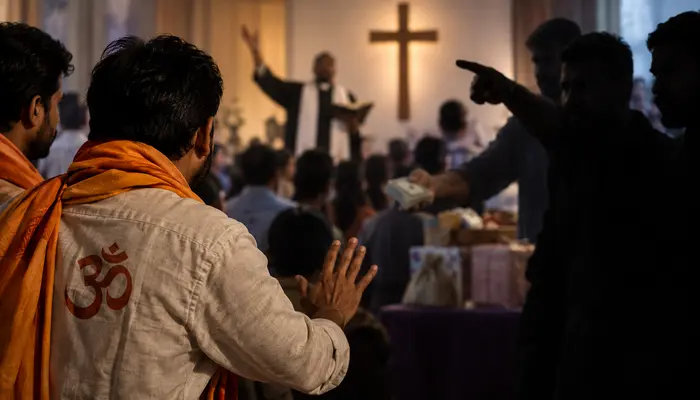
Case Summary
In Dhamtari, Chhattisgarh, Hindus were targeted for religious conversion to Christianity by Christian missionaries. The conversion activity was carried out under the pretext of ‘healing’ meetings (Changai Sabha), where Hindus were brought on the promise of curing their diseases and were subsequently sought to be converted to Christianity. The meeting was organised in a rented house in the Tikrapara area under Kotwali Police Station. On 6 September 2026, after receiving information about the gathering, members and activists of the Hindu Jagran Manch reached the rented house and began protesting. Pratik Soni, a member of the Hindu Jagran Manch, said that a meeting involving around 100 to 150 Hindus was taking place nearby. The Hindu Jagran Manch also stated that around 35 to 40 people had been brought from outside for the gathering. The organisation said that Hindu villagers had been brought to the meeting under the pretext of curing their diseases through a healing prayer meeting (Changai Sabha), where they were being encouraged to convert to Christianity. When the Hindu activists arrived to protest, the Christian individuals involved in the conversion activity threatened to kill them and warned that they would call another 100 to 150 people to intimidate them. The situation became tense as the Christians present inside the rented house also came outside, bringing both sides face-to-face. Members of both sides raised slogans, and the increasing crowd further heightened the tension. Chitresh Sahu, a co-coordinator of the Hindu Jagran Manch, said that the organisation would continue its protest and warned that such activities would no longer be tolerated. Takeshwar Sahu, another co-coordinator of the organisation, demanded strict action against illegal religious gatherings and those carrying out religious conversions through inducements or under the guise of healing meetings. He demanded that such assemblies be shut down immediately. The Hindu Jagran Manch also demanded an impartial investigation and said that those responsible should face legal action. The organisation warned that it would launch an agitation in the coming days if such conversion activities were not stopped. Police personnel reached the spot after receiving information about the commotion, with Additional Superintendent of Police D. C. Patel leading the Kotwali police team. The police attempted to calm the people gathered at the location and questioned those present to ascertain the purpose of the meeting and the activities taking place there. During the intervention, a heated argument broke out between the police and Hindu Jagran Manch activists, who stated that the police had failed to take immediate action. The activists remained firm on their demand for action. D. C. Patel stated that all those present would be questioned and that their statements and the facts of the incident would be examined before deciding on further action. He also stated that information had been received that, apart from those expected to attend the Christian healing prayer meeting (Changai Sabha), several outsiders had been called for religious conversion. The police investigated the activities conducted at the meeting, its purpose and whether permission had been obtained for the gathering. D. C. Patel said that appropriate legal action would be taken in this matter. After considerable efforts, the police brought the situation under control, following which the Hindu Jagran Manch members returned to their respective places.
Why it is Hate Crime ?
The primary category selected in this case is: Predatory Proselytisation. The subcategory selected is: Conversion/attempts to convert by inducement. Predatory Proselytisation is not limited to threat, harassment, force and violence, but it also has contours of stealth. In several cases, the Hindu victim is exploited to convert, with non-Hindus taking advantage of their poverty. In such cases, the Hindu victim who is suffering financially is offered monetary benefits, including lucrative offers for jobs, health treatment, education, etc, to induce the victim to change his/her religion. In such cases, the religious identity of the victim and the aim to disenfranchise him from his faith form the heart of the crime. Also, taking advantage of and exploiting an individual’s economic vulnerabilities is widely acknowledged as exploitation, forms of which are often penalised by law. Such cases therefore are considered religiously motivated hate crimes since the victim’s religious identity forms the very heart of the crime itself. The other subcategory selected is: Proselytisation by grooming, brainwashing, manipulation or subtle indoctrination. Religious brainwashing essentially means the often subtle and forcible indoctrination to induce someone to give up their religious beliefs to accept contrasting regimented ideas. Religious grooming or brainwashing also involves propaganda and manipulation. It involves the systematic effort, driven by religious malice and indoctrination, to persuade “non-believers’ to accept allegiance, command, or doctrine to and of a contrasting faith. Cases of such grooming or brainwashing are far more nuanced than direct threats, coercion, inducement and violence. In such cases, it is often seen that there is repeated, subtle and continual manipulation of the victim to induce disaffection towards their own faith and acceptance of the contrasting faith of the perpetrator. While subtle indoctrination is widely acknowledged as predatory, an element which is often understated in such conversions or the attempts of such conversion is the role of loyalty and trust which might develop between the perpetrator and the victim. Fiduciary relationships are often abused to affect such religious conversion. For example, an educator transmitting religious doctrine of a competing faith to a Hindu student. The Hindu student is likely to accept what the teacher is transmitting owing to existence of the fiduciary relationship. The exploitation of the fiduciary relationship to religiously indoctrinate victims would also be included in this category. Since the underlying animosity towards the victim’s faith forms the basis of predatory proselytization, such cases are considered religiously motivated hate crimes. This case was a clear example of a religiously driven hate crime, as Hindus were targeted for conversion to Christianity under the pretext of curing diseases through a healing meeting. The meeting used the promise of healing and relief from illnesses to draw Hindus towards Christianity, thereby exploiting their health concerns to influence their religious choices. Targeting members of the Hindu community through such a method demonstrated hostility towards their faith and religious identity. Changai Sabhas, or healing meetings, served as an inducement when the promise of curing diseases was tied to conversion to Christianity. Hindus were lured to such meetings with the assurance that their illnesses would be cured and that they would receive healing upon attending the prayers and embracing Christianity. This was not an act of genuine welfare, as the promise of recovery was used to influence the religious decisions of individuals by exploiting their health vulnerabilities and socio-economic circumstances. A conversion secured through such inducement was therefore not an exercise of free will or genuine consent, but a coercive form of proselytisation that exploited personal vulnerabilities to bring about a change of faith. The use of healing as a means of securing conversion was also a manipulative tactic that undermined the religious autonomy of the targeted Hindus. By presenting conversion to Christianity as a means of obtaining relief from illness, the perpetrators sought to make adherence to Christianity appear necessary for recovery while placing the victims' existing Hindu faith in opposition to their perceived need for healing. Such manipulation treated the victims' religious identity as something to be abandoned in exchange for promised benefits and therefore reflected hostility towards their faith. Conversion achieved through such coercive manipulation constituted a clear manifestation of religious animosity towards Hinduism and the Hindu community. The scale of the gathering further demonstrated that the incident was not limited to an isolated individual. Around 100 to 150 Hindus were present at the meeting, while the Hindu Jagran Manch stated that around 35 to 40 people had been brought from outside for the gathering. The targeting of such a large group indicated an organised effort to influence Hindus and facilitate conversions to Christianity on a wider scale. The attempt to alter the religious identity of a sizeable section of the local Hindu community therefore reflected a broader pattern of religious targeting rather than an individual or incidental act. The hostility behind the conversion activity was further evident when Hindu activists who intervened to oppose the proselytisation and protect other Hindus were themselves threatened with violence. When the activists confronted those involved in the conversion activity, they were threatened with death and warned that additional people would be called to intimidate them. Targeting Hindu activists merely for resisting the conversion of members of their community demonstrated that the hostility extended beyond attempts to change individual religious identities and was also directed at those seeking to protect and preserve Hindu religious identity. The use of threats and intimidation to silence opposition to the conversion effort reflected deep-seated religious animosity towards Hinduism and the Hindu community, as those attempting to prevent coercive proselytisation were themselves subjected to threats of violence. These instances of targeted proselytisation activities stem from inherent hostility towards the victims' professed faith, since Abrahamic faiths believe that any non-adherent to their faith is subject to being dehumanised till they convert, making it a religiously motivated crime against Hindus. Therefore, this case is being added to the hate crime database of the Hinduphobia Tracker. Disclaimer: The report stated that around 100 to 150 Hindus were present at the meeting, while around 35 to 40 people had been brought from outside for the gathering. Therefore, the upper limit of both figures was considered, and the two figures were added to arrive at an indicative victim count. Accordingly, the victim count was recorded as 150 + 40, totalling 190 Hindu victims.
Victim Details
Total Victim
190
Deceased
0
Gender
- Male 0
- Female 0
- Third Gender 0
- Unknown 190
Caste
- SC/ST 0
- OBC 0
- General 0
- Unknown 190
Age Group
- Minor 0
- Adult 0
- Senior Citizen 0
- Unknown 190


Case Status
Complaint filed


Perpetrators Details
Perpetrators
Christian Extremists
Perpetrators Range
Unknown
Perpetrators Gender
unknown
 Sources




