Hindus targeted for conversion to Christianity through prayer and healing gathering in Tikrapara, Dhamtari, Chhattisgarh
 Dhamtari, Chhattisgarh, India
  5 September, 2026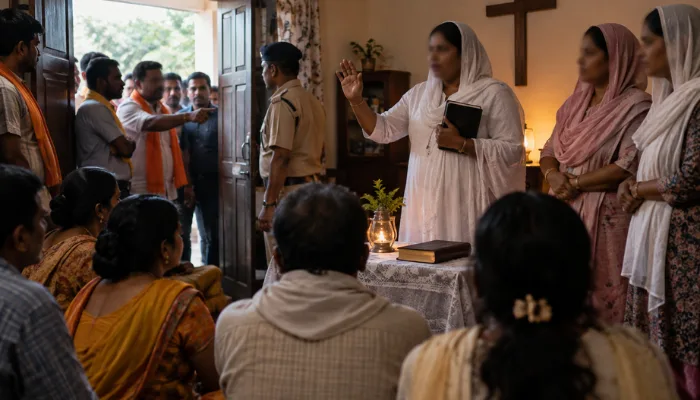
Case Summary
In the Tikrapara area of Dhamtari, Chhattisgarh, Hindus were targeted for religious conversion by a Christian missionary through a Christian prayer and were offered inducements to attend the healing meeting organised inside a rented house. Around 35 to 40 people had gathered at the premises, with some accounts stating that more than 40 people were present. Hindu activists stated that the gathering was being conducted in the name of a prayer meeting or Changaai Sabha, while those attending were being encouraged to move away from Hinduism and adopt Christianity. According to the accounts, members and office-bearers of the Hindu Jagran Manch reached the house after receiving information about the gathering. The organisation objected to the meeting and stated that the prayer and healing programme was being used as a means to influence Hindus towards religious conversion. The arrival of the Hindu organisation led to a confrontation at the spot, after which people from both sides came outside, and sloganeering began. Hindu Jagran Manch members stated that Hindus had been brought to the gathering and were being encouraged to change their religion under the cover of prayer and healing activities. The organisation demanded that the administration investigate whether people were being influenced through deception, inducement, pressure or other unlawful means. However, in the material relating specifically to this Tikrapara incident, no particular inducement, such as money, employment, free education, or medical treatment, was established. As the confrontation intensified, police personnel reached the location under the supervision of Additional Superintendent of Police D.C. Patel and brought the situation under control. A heated argument also broke out between Hindu Jagran Manch members and the police, with the organisation accusing the authorities of failing to take immediate action against the organisers of the gathering. Both sides subsequently submitted complaints to the police. ASP D.C. Patel stated that everyone present at the gathering would be questioned and that the police would examine the purpose of the meeting, the activities conducted there, the role of the organisers and the circumstances in which people had been brought to the premises. Police stated that further legal action would be taken based on the investigation's findings. The incident came amid a series of similar conversion-related disputes in Dhamtari and other parts of Chhattisgarh. On 19 August 2026, Hindu Jagran Manch had protested a prayer meeting in Risaipara, Dhamtari. On 9 August 2026, the organisation had objected to another prayer meeting in Vandana Vihar Colony, Dhamtari, over concerns that conversion activities were being conducted under its cover. A similar dispute had also occurred in Tikrapara on 30 June 2025. Other incidents were recorded in Bharanda village, Narayanpur, on 30 June 2026; in the Teregaon area of Kawardha on 9 June 2026, where a Baiga family stated that they had been brought to a healing meeting through deception; and in Gurur, Balod, on 5 February 2026, where concerns were raised that poor residents were being influenced towards conversion through inducements.
Why it is Hate Crime ?
The primary category selected for this case is: Predatory proselytisation. The subcategory selected is: Conversion/attempts to convert by inducements. Predatory Proselytisation is not limited to threats, harassment, force and violence, but it also has contours of stealth. In several cases, the Hindu victim is exploited to convert, with non-Hindus taking advantage of their poverty. In such cases, the Hindu victim who is suffering financially is offered monetary benefits, including lucrative offers for jobs, health treatment, education, etc, to induce the victim to change his/her religion. In such cases, the religious identity of the victim and the aim to disenfranchise him from his faith form the heart of the crime. Also, taking advantage of and exploiting an individual’s economic vulnerabilities is widely acknowledged as exploitation, forms of which are often penalised by law. Such cases therefore are considered religiously motivated hate crimes since the victim’s religious identity forms the very heart of the crime itself. The other subcategory selected is: Proselytisation by grooming, brainwashing, manipulation or subtle indoctrination. The tertiary category selected is: Pattern of targeting Hindus. Religious brainwashing essentially means the often subtle and forcible indoctrination to induce someone to give up their religious beliefs to accept contrasting regimented ideas. Religious grooming or brainwashing also involves propaganda and manipulation. It involves the systematic effort, driven by religious malice and indoctrination, to persuade “non-believers’ to accept allegiance, command, or doctrine to and of a contrasting faith. Cases of such grooming or brainwashing are far more nuanced than direct threats, coercion, inducement and violence. In such cases, it is often seen that there is repeated, subtle and continual manipulation of the victim to induce disaffection towards their own faith and acceptance of the contrasting faith of the perpetrator. While subtle indoctrination is widely acknowledged as predatory, an element which is often understated in such conversions or in the attempts at such conversion is the role of loyalty and trust which might develop between the perpetrator and the victim. Fiduciary relationships are often abused to affect such religious conversion. For example, an educator transmitting religious doctrine of a competing faith to a Hindu student. The Hindu student is likely to accept what the teacher is transmitting owing to the existence of the fiduciary relationship. The exploitation of the fiduciary relationship to religiously indoctrinate victims would also be included in this category. Since the underlying animosity towards the victim’s faith forms the basis of predatory proselytisation, such cases are considered religiously motivated hate crimes. This case qualified as a religiously motivated hate crime because Hindu residents were specifically targeted through a prayer and healing gathering that Hindu Jagran Manch stated was being used to influence them away from Hinduism and towards Christianity. The religious identity of the attendees was central to the concern: the objection was not merely to the holding of a prayer meeting, but to the use of that gathering as a vehicle through which Hindus were being encouraged to abandon their existing faith. When a religious programme is directed at adherents of another faith to alter their religious identity, the attempted conversion itself becomes the core of the offence. The case strongly reflected predatory proselytisation through grooming, manipulation and subtle indoctrination. The gathering was outwardly presented as a prayer or Changai Sabha, creating an atmosphere of spiritual support and religious trust. Such a setting can be used to gradually expose Hindu attendees to a competing religious doctrine and create disaffection towards their own faith. The concern raised in this case was precisely that an apparently devotional or healing gathering was functioning as a channel for conversion. This element of concealment gave the conversion effort a deceptive character, because the religious objective was embedded within an activity presented as prayer and healing rather than openly declared as a conversion campaign. The incident was also significant because it formed part of a continuing sequence of similar conversion-related controversies in Dhamtari and other parts of Chhattisgarh. Similar objections had been raised in Vandana Vihar Colony, Dhamtari, on 9 August 2026, in Risaipara on 19 August 2026, and earlier in Tikrapara on 30 June 2025, while other disputes involving healing meetings and conversion concerns had also surfaced in Kawardha, Balod and Narayanpur. The recurrence of prayer or healing gatherings repeatedly drawing complaints of conversion activity strengthened the concern that the Tikrapara incident was not being viewed in isolation, but within a broader pattern of sustained proselytisation activity targeting Hindu communities. The incident also highlights a growing pattern in organised conversion networks, where individuals who have embraced Christianity continue to retain their Hindu names while practising Christianity. This allows these crypto Christians to seamlessly integrate into Hindu communities, gain the confidence of unsuspecting families, and carry out conversion activities without immediately revealing their religious identity. It illustrates how the continued use of a Hindu identity can facilitate access to communities that might otherwise be wary of conversion efforts Taken together, the targeting of Hindu attendees, use of a prayer/healing gathering as the medium of influence, the concealed conversion objective alleged by Hindu activists, and the recurring pattern of similar incidents in the region established the religious character of the case. The activity was directed towards separating Hindu individuals from their professed faith and bringing them into another religious fold, which placed the Hindu religious identity of the victims at the heart of the incident. For these reasons, the case fell within Predatory Proselytisation, particularly proselytisation through grooming, manipulation and subtle indoctrination. Disclaimer: The Hinduphobia Tracker records the incident date based on when the incident or the victimisation occurred, rather than the date on which it was subsequently discussed or circulated. In this case, the exact date on which the prayer and healing gathering was organised, and the suspected conversion activity began, was not independently specified in the material. Therefore, 6th September 2026, the date on which the media source reported the incident, has been recorded as the indicative incident date for documentation purposes only.
Victim Details
Total Victim
40
Deceased
0
Gender
- Male 0
- Female 0
- Third Gender 0
- Unknown 40
Caste
- SC/ST 0
- OBC 0
- General 0
- Unknown 40
Age Group
- Minor 0
- Adult 0
- Senior Citizen 0
- Unknown 40


Case Status
Complaint filed


Perpetrators Details
Perpetrators
Christian Extremists
Perpetrators Range
Unknown
Perpetrators Gender
unknown
 Sources




