Hindu family, including children, subjected to intense pressure and offered inducements for Christian conversion in Chhatrapati Sambhajinagar
 Aurangabad, Maharashtra, India
  7 September, 2026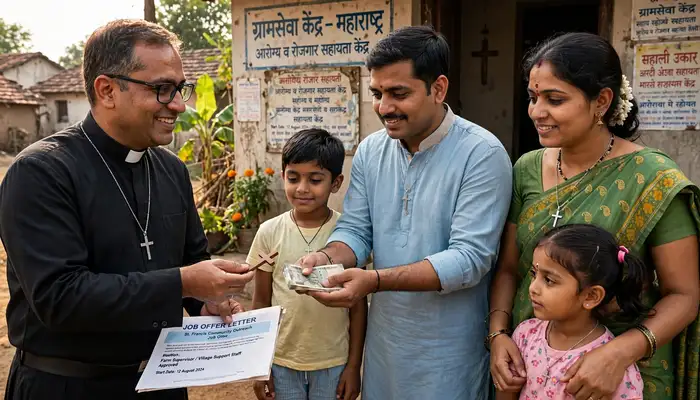
Case Summary
In Chhatrapati Sambhajinagar (Aurangabad), Maharashtra, a Hindu family, including two minor Hindu children, was targeted for Christian conversion through inducements and coercion by Christian missionaries. The victims were identified as Balasaheb Appasaheb Sathe and his wife, Pooja. The couple was working on a contractual basis at Shanti Sadan Primary School in Borsar, where they were paid ₹5,000 each towards travel expenses. Subsequently, the couple was promised permanent teaching jobs at the school on the condition that they convert to Christianity. They were also asked to pay ₹5 lakh if they wished to secure their jobs. In the hope of securing permanent employment, Balasaheb and Pooja borrowed money from their friends. Of the demanded amount, ₹4.80 lakh was paid at the residence of a man named Sanjay Rupekar, while the remaining ₹20,000 was deposited at the office of St Francis Society at Seven Hills. Thereafter, Balasaheb and Pooja were forcibly converted to Christianity by Father Ashish Mhaske at a church in Mali Ghogargaon. Following their conversion, the accused exerted intense pressure on the couple to convert their two minor children to Christianity as well. Pooja objected to the pressure and categorically refused to allow her children to be converted. She subsequently resigned from her job. After Pooja refused to permit the conversion of her children, the institution denied the couple employment and appointed another person in their place. Balasaheb Sathe stated that the entire episode caused the Hindu family mental distress and financial exploitation. Troubled by this, the victims approached the local police station and filed a complaint. The police registered a First Information Report (FIR), naming Father Ashish Mhaske, Sudam Ubale, Father Gerald Rebelo, Sanjay Rupekar and Vinod Shelke as accused. The case was registered by Veergaon Police in Vaijapur taluka.
Why it is Hate Crime ?
This case has been added to the tracker under the primary category: Predatory Proselytisation. The subcategory selected is: Conversion/attempts to convert by inducement. Predatory Proselytisation is not just limited to threat, harassment, force and violence, but it also has contours of stealth. In several cases, the Hindu victim is exploited to convert, with non-Hindus taking advantage of their poverty. In such cases, the Hindu victim who is suffering financially is offered monetary benefits, including lucrative offers for jobs, health treatment, education, etc, to induce the victim into changing his/her religion. In such cases, the religious identity of the victim and the aim to disenfranchise him from his faith form the heart of the crime. Also, taking advantage of and exploiting an individual’s economic vulnerabilities is widely acknowledged as exploitation, forms of which are often penalised by law. Such cases therefore are considered religiously motivated hate crimes since the victim’s religious identity forms the very heart of the crime itself. The other subcategory selected is: Harassment, threats, coercion for conversion. Harassment covers a wide range of behaviours of an offensive nature. It is commonly understood as behaviour that demeans, humiliates, and intimidates a person, including threats and coercion. Harassment and threats, in this case, find their root on discriminatory grounds which has the effect of nullifying a person’s rights or infringing upon his freedom to exercise his right specifically owing to the victim’s religious identity. Verbal and physical threats and psychological or physical harassment are often used against Hindu victims because they choose to practice their professed religion. Religious harassment also includes forced and involuntary conversions by harassment, threats or coercion. Coercion includes intimidatory tactics like force-feeding a Hindu victim beef to convert to another religion, forceful circumcision etc. In several cases documented, non-Hindu perpetrators or those who harbour specific animosity towards Hinduism, harass victims simply based on their religious identity. Such cases often also include harassment to ensure the Hindu victim abandons his/her professed religion and adopts the religion of the perpetrator. Such cases where Hindu victims are harassed to convert to the perpetrator’s religion are rooted in animosity towards the victim’s religious identity and are therefore documented as religiously motivated hate crimes. This case is a clear example of a hate crime, as a Hindu family, including minor children, was subjected to pressure for religious conversion by Christian missionaries. The family was targeted on account of their religious identity with the intent of converting them to Christianity through external pressure and coercion. Religious conversion is not an expression of genuine religious conviction when it is secured through force, pressure or manipulation rather than an individual's free and informed choice. In such circumstances, the targeting of a Hindu family specifically to sever them from their faith reflects deep-seated religious hostility towards the Hindu community. The use of coercive means to alter the religious identity of Hindu victims therefore makes this incident a clear case of a religiously driven hate crime. The involvement of the couple's minor children further heightened the severity of the incident. The children were themselves subjected to pressure to abandon their Hindu faith and embrace Christianity, despite being minors. At such a young age, children lack the maturity and capacity to fully comprehend the long-term ramifications of a fundamental change in religious identity. Their vulnerability to manipulation and coercion makes the imposition of religious conversion particularly serious. In this case, the perpetrators exploited the vulnerability of the children as well as that of their parents to pursue conversion, demonstrating that the process was not founded on genuine consent or a voluntary change of conscience. The targeting of minors for religious conversion through pressure therefore constituted a particularly grave manifestation of religious hostility. The use of inducements, particularly the promise of permanent employment, further demonstrated the coercive nature of the conversion effort. The promise of secure employment was presented to the Hindu couple in connection with their conversion, while they were also required to pay ₹5 lakh. Such inducements are not acts of kindness when they are tied to a person's religious identity; rather, they exploit socio-economic vulnerabilities to exert pressure for religious conversion. By attaching the prospect of permanent employment to conversion, the perpetrators effectively used the victims' need for economic security as leverage to influence their religious choices. This amounted to arm-twisting the victims by exploiting their socio-economic circumstances in exchange for abandoning their faith. Such a process is fundamentally different from a voluntary conversion based on personal conviction and instead reflects hostility towards the religious identity of the Hindu victims, making the incident a religiously driven hate crime. The fact that the victims' minor children were also subjected to continued pressure for conversion further demonstrated the extent of the coercion. The use of harassment, pressure and coercive tactics to target not only the Hindu couple but also their children constituted an attack on the family's religious autonomy. Every individual has the fundamental right to practise and sustain their faith without being subjected to coercion aimed at forcing them to abandon it. By extending the conversion effort to the children after their parents had resisted, the perpetrators disregarded the family's religious autonomy and sought to interfere directly with the transmission of their Hindu faith to the next generation. Such conduct demonstrated deep-seated hostility towards Hinduism and the Hindu community and therefore constituted a clear case of a religiously driven hate crime. This incident was not an isolated case of predatory proselytisation. The Hinduphobia Tracker has documented nearly 1931 incidents of forcible religious conversion between 1 January 2023 and 7 September 2026. The scale of these documented incidents demonstrates a broader pattern in which Hindu individuals and families are subjected to coercive or exploitative methods aimed at altering their religious identity. Viewed within this wider pattern of predatory proselytisation, the targeting of this Hindu family was not merely an individual dispute but formed part of a larger phenomenon involving the exploitation of vulnerable Hindu victims for religious conversion, making it a clear case of a religiously driven hate crime. Predatory proselytisation of this nature is rooted in hostility towards Hinduism and the Hindu community, particularly when conversion efforts involve coercion, socio-economic inducements and the targeting of vulnerable family members. The deliberate attempt to sever a Hindu family from its faith, extend that pressure to minor children and exploit their socio-economic vulnerabilities constitutes religiously motivated hostility. Therefore, this incident is being added to the hate crime database of the Hinduphobia Tracker. Disclaimer: The Hinduphobia Tracker records incident dates based on when the crime occurred rather than when it was reported by the media. However, in the present case, media reports did not specify the exact date on which the crime occurred, nor did they state when the victims' ordeal first began. Therefore, 7 September 2026, the date on which the incident was reported in the media, has been selected as the indicative incident date. This date has been recorded solely for documentation purposes.
Victim Details
Total Victim
4
Deceased
0
Gender
- Male 1
- Female 1
- Third Gender 0
- Unknown 2
Caste
- SC/ST 0
- OBC 0
- General 0
- Unknown 4
Age Group
- Minor 2
- Adult 2
- Senior Citizen 0
- Unknown 0


Case Status
Complaint registered


Perpetrators Details
Perpetrators
Christian Extremists
Perpetrators Range
From 2 To 5
Perpetrators Gender
male
 Sources




