Hindu woman abandoned after refusing to convert to Islam following marriage to Muslim man in Odisha
 Jajpur, Odisha, India
  5 September, 2022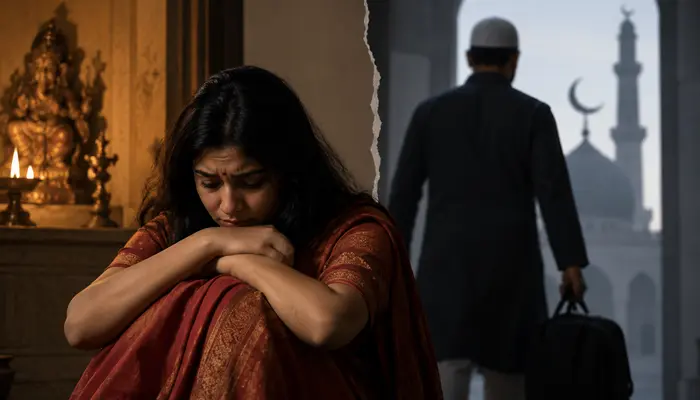
Case Summary
In Jajpur, Odisha, a Hindu woman was pressured to convert to Islam after marrying a Muslim man and was abandoned after refusing to give up her Hindu religion. The woman was a widow from the Bharatpur police station area of Bhubaneswar and had two children. In 2022, she came into contact with a Muslim man, Sadiq Khan, a resident of Sayedpur in the Binjharpur police station area of Jajpur district, through Instagram. Their relationship gradually grew closer, and they began living together. After around one and a half years, the two married through a notary. The woman then stayed with Sadiq wherever he worked and also lived with him in Jharkhand for some time. They lived together for around four years. After the marriage, Sadiq took around ₹2 lakh from the woman, along with an expensive mobile phone and a scooter. One day, he told her he had a festival to attend and would return after celebrating it, but he did not. He also changed his mobile telephone number, making it difficult for her to contact him. After repeatedly failing to contact Sadiq, the woman telephoned his parents and asked them to put her in contact with their son. His family told her that they had no information about Sadiq. The woman subsequently went to Binjharpur police station with social worker Svayambhara Sahu, who worked for women's rights, and lodged a complaint against Sadiq and some members of his family. The complaint concerned fraud, taking away her belongings and money, and pressure over religious conversion. An attempt was subsequently made to speak with Sadiq and his family. A meeting between the two sides took place at the house of a maulana in Mughal Mohalla, Jajpur. Sadiq's maternal uncle, Kalam Mirza, told the woman that she was Hindu while their family was Muslim and that she was older than Sadiq, and said that the family could not accept her in those circumstances. The woman told them that she had made it clear from the beginning of her relationship with Sadiq that she would not change her religion under any circumstances, and that Sadiq could remain Muslim while she remained Hindu. She was also told to leave her two children if she wanted to remain in the family, but she refused, saying that she would neither leave her religion nor her children. Svayambhara Sahu, who accompanied the woman to the police station, said that the two had been living together for around four years and had married through a notary. She explained that a marriage conducted only through a notary did not, by itself, constitute proof of a legally valid marriage, but that the two had lived together as husband and wife for a long period. Sahu also said that Sadiq had known from the beginning that the woman was Hindu, a widow and the mother of two children. She questioned the religious conversion as a condition to stay with the Hindu woman when Sadiq had already known about the woman's religion and family circumstances. She said she would pursue the matter further to secure justice for the woman, and that if she did not receive justice at the police station level, she would approach the Superintendent of Police and, if necessary, raise the matter before the Chief Minister.
Why it is Hate Crime ?
The primary category selected in this case is: Crime against women in relationships and other sexual crimes. Within this, the first subcategory selected is: Forced conversion after marriage. In such cases, a non-Hindu man marries a Hindu woman, and the force/pressure to convert to any Abrahamic faith, like Islam, begins after marriage. In such cases, typically, two patterns emerge. First, when the relationship is consensual, and the religious identity of the perpetrator is known to the Hindu woman in the relationship. The marriage could be under the Special Marriages Act, where neither party is required to convert their religion for the marriage to be considered legitimate. While the victim in such cases enters matrimony assuming that religious identity is not a barrier, the non-Hindu man starts to pressure the woman to convert her religion after marriage. The second is when the woman gets into a marriage with the man, pretending to share her faith. Later, when the truth is revealed, the man starts pressuring the woman to convert her religion and give up her religious identity. In both situations, there is application of force by the perpetrator, including the denial of the woman’s religious rights. Some of the means by which the woman is forced/pressured to convert include force-feeding beef, being forced to read the Kalma, being forced to wear a hijab, being forced to undergo Halala, etc. There are several instances where, after marriage, the woman voluntarily converts to Islam. Such cases are often argued to be a result of religious brainwashing; however, for the purpose of documenting religiously motivated hate crimes, in the absence of the victim complaining of forced conversion, such cases do not form a part of the database. The other subcategory selected is: Leaves Hindu partner upon refusal to convert. When Hindu women are in a relationship with non-Hindu men, there are cases where the woman faces pressure/threats/violence to convert and change her religious identity by the non-Hindu man. However, when the Hindu woman refuses to convert, the non-Hindu man ends the relationship or divorces the woman, as the case might be. Such relationships may be consensual, with the religious identity of the non-Hindu man known to the victim. Somewhere along the relationship, the non-Hindu man starts pressuring the Hindu woman to change her religious identity and, upon her refusal, ends the relationship. Cases where the Hindu woman converts to Islam and does not file a complaint about the force or threat after she refuses to convert to Islam are not considered part of the hate tracker. The incident qualified as a hate crime because the Hindu woman was targeted on account of her religious identity, with the Muslim man subsequently pressuring her to convert to Islam after their relationship and marriage, and leaving her upon her refusal to convert. Firstly, the pressure to convert came after the Hindu woman had already married the Muslim man and had lived with him for a considerable period while maintaining her Hindu faith. She had made her position clear from the outset: she would follow her own religion, while he could continue following Islam. Despite that understanding, she was later told that her being Hindu stood in the way of her acceptance by his Muslim family and that she would have to abandon Hinduism and embrace Islam. This made her Hindu identity the very condition she was expected to surrender to continue her married life. It was wrong against her Hindu identity because it treated her adherence to Hindu faith as something that had to be erased rather than respected, and sought to make the continuation of her relationship dependent on her giving up her religious identity. Her clear decision to remain Hindu had already established that she had no intention of abandoning her faith, yet pressure was subsequently brought upon her to do exactly that. The demand therefore struck directly at her right to preserve her Hindu identity, practise her own faith and remain Hindu without being made to choose between her religion and her family life. Also, the woman was left after she refused to convert to Islam. Her refusal to surrender her Hindu identity was followed by the breakdown of the relationship and her abandonment. This made her religious identity the decisive factor in the treatment she received. She had been willing to remain in the relationship while respecting both religions, but was not allowed to retain her Hindu faith on the same terms. The abandonment therefore followed her decision to preserve her Hindu identity rather than renounce it. This was wrong because her continued adherence to the faith was effectively treated as unacceptable within the relationship, despite her having made her position clear from the beginning. She had not sought to impose Hinduism on the Muslim man or prevent him from practising Islam. She had simply sought to remain Hindu herself. Instead, she was faced with the loss of her relationship for refusing to give up that identity. This placed a direct burden on her for being Hindu and turned her refusal to abandon her faith into the reason for her rejection, undermining her dignity as a Hindu woman and her ability to preserve her religious identity on her own terms. Altogether, the treatment of the Hindu woman had made her religious identity a condition for retaining her relationship, while her decision to remain Hindu had ultimately resulted in her being abandoned. The conduct had therefore placed a direct burden on her for remaining faithful to Hinduism and had treated her refusal to renounce her faith as grounds for rejecting her. For the Hindu woman, being forced to choose between her faith and her married life had amounted to an attack on her religious dignity, autonomy and identity as a Hindu. Accordingly, this case has been documented in the Hinduphobia Tracker's Hate Crime Database as an instance of religiously motivated hostility directed against Hinduism and the religious identity of the Hindu community. Disclaimer: The exact date of when the Hindu woman and the Muslim perpetrator first came into contact was not specified in the available sources. However, the year of initial contact was indicated as 2022. The tracker records incident dates based on when the crime occurred rather than when it was reported or published. In this case, 6th September 2022 has been used as the indicative incident date, derived by aligning the known year of initial contact with the article publication date of 6th September 2026. This date has been recorded for documentation purposes only.
Victim Details
Total Victim
1
Deceased
0
Gender
- Male 0
- Female 1
- Third Gender 0
- Unknown 0
Caste
- SC/ST 0
- OBC 0
- General 0
- Unknown 1
Age Group
- Minor 0
- Adult 1
- Senior Citizen 0
- Unknown 0


Case Status
Complaint filed


Perpetrators Details
Perpetrators
Muslim Extremists
Perpetrators Range
One Person
Perpetrators Gender
male
 Sources




