Hindu woman molested and assaulted after being religiously profiled; subjected to anti-Hindu abuse by Muslim men in Kasganj
 Kasganj, Uttar Pradesh, India
  4 September, 2026
Case Summary
In Kasganj, Uttar Pradesh, a 30-year-old Hindu woman named Manisha was religiously profiled, molested and assaulted by Muslim men. She was also subjected to anti-Hindu communal slurs by the perpetrators during the incident. The incident occurred near the Shiva temple in the Hulka locality in broad daylight. Police received information that the woman had been misbehaved with and immediately reached the spot. The incident took place when Manisha was returning home from work at Shivam Garments. At that time, the accused, Mohammad Sohail (32), son of Balisher and a resident of Mohalla Hulka, was already standing near the Shiva temple. As the victim passed by, he began molesting Manisha. When she protested against his behaviour, Sohail struck her on the chest and abused her. He also made a vulgar and derogatory remark about the Hindu community and their festivals, saying, “Pata nahi in Hinduon ke kaun kaun se tyohar bante rahte hain... behen ke l*nd kabhi khatm hi nahi hote!” (“I do not know which festivals these Hindus keep celebrating... they never seem to end!”). Sohail’s associate, Ashu Saifi (38), son of Shamshuddin Saifi and a resident of Dhanmeel Road in Kasganj, then arrived at the spot. Ashu also abused Manisha and threatened her. The incident thus involved harassment, physical assault, religiously driven abuse and threats against the woman near the Shiva temple. Reports revealed that Manisha had been married around 11 years earlier and had a 9-year-old son named Aryan. She lived separately from her husband, who had remarried. Manisha and her son resided with her cousin, Jogendra, son of Ramchandra, at her maternal home. Following the incident, Inspector Jagdish Chandra Rajput took a written complaint from Manisha. A video of the incident went viral on social media, in which Manisha was heard narrating how she had been targeted, molested, assaulted and subjected to anti-Hindu slurs by the Muslim perpetrators. Further legal action was initiated on the basis of her complaint. Kasganj Police, through its official X handle, also revealed that a case had been registered against the two accused and that they had been produced before the court. On 6 September 2026, the police tweeted, “In connection with the case, an FIR has been registered at Kasganj Police Station under the relevant sections, and both accused persons have been taken into police custody and produced before the Hon’ble Court.” At the time of writing this report, the situation at the spot remained calm and normal after the incident. As a precautionary measure, police deployed a picket in the area.
Case Images
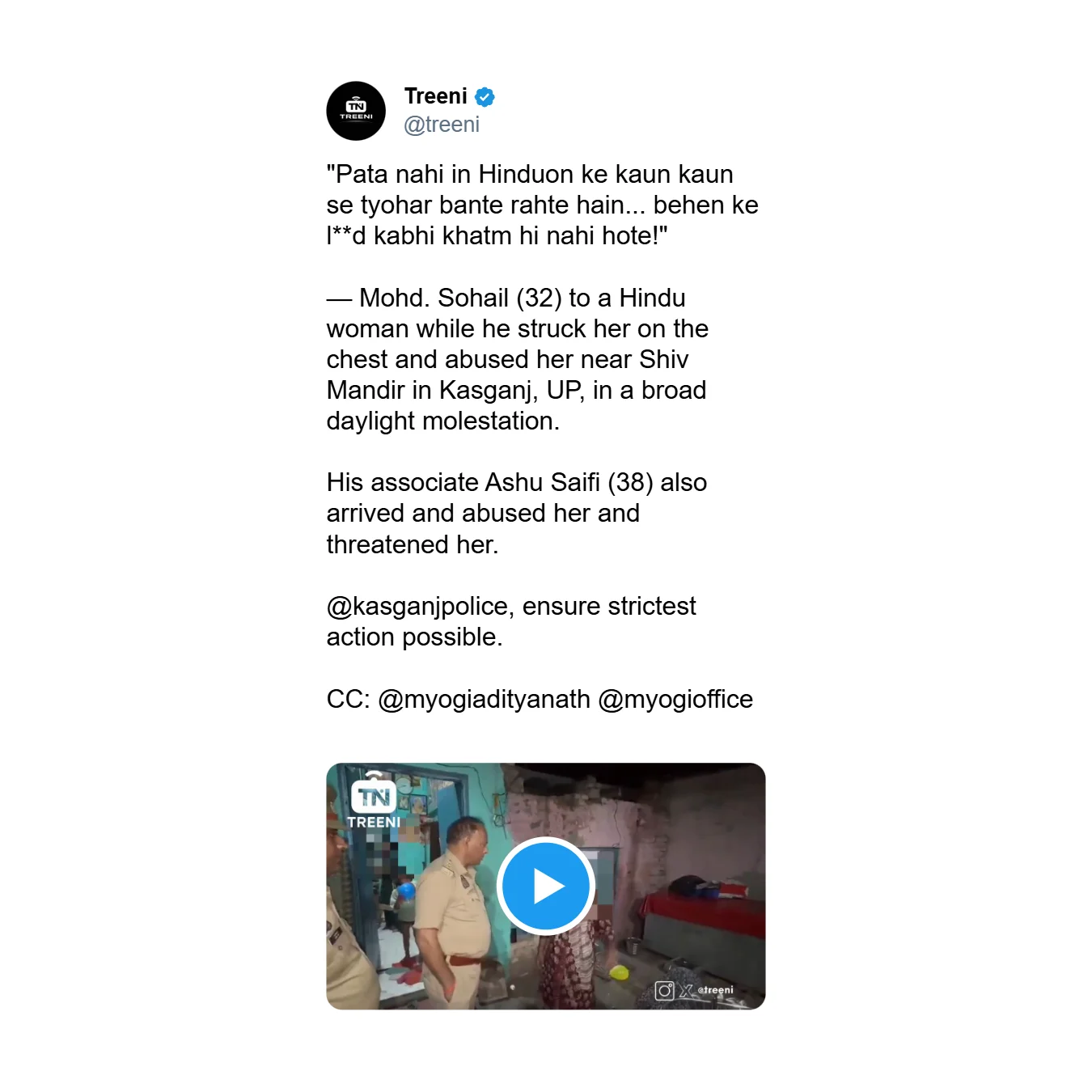
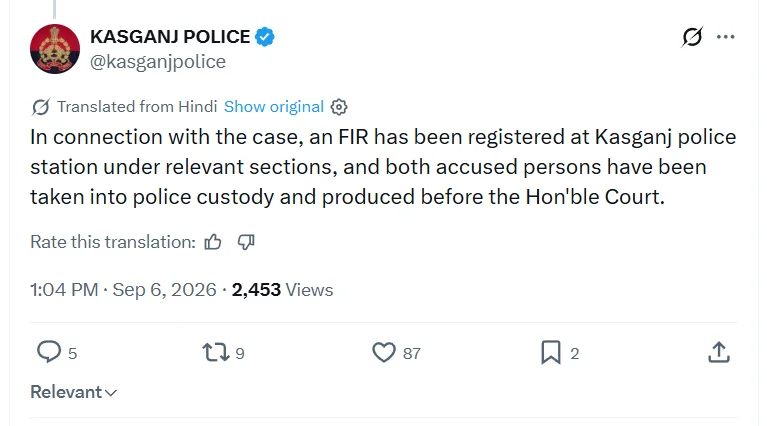
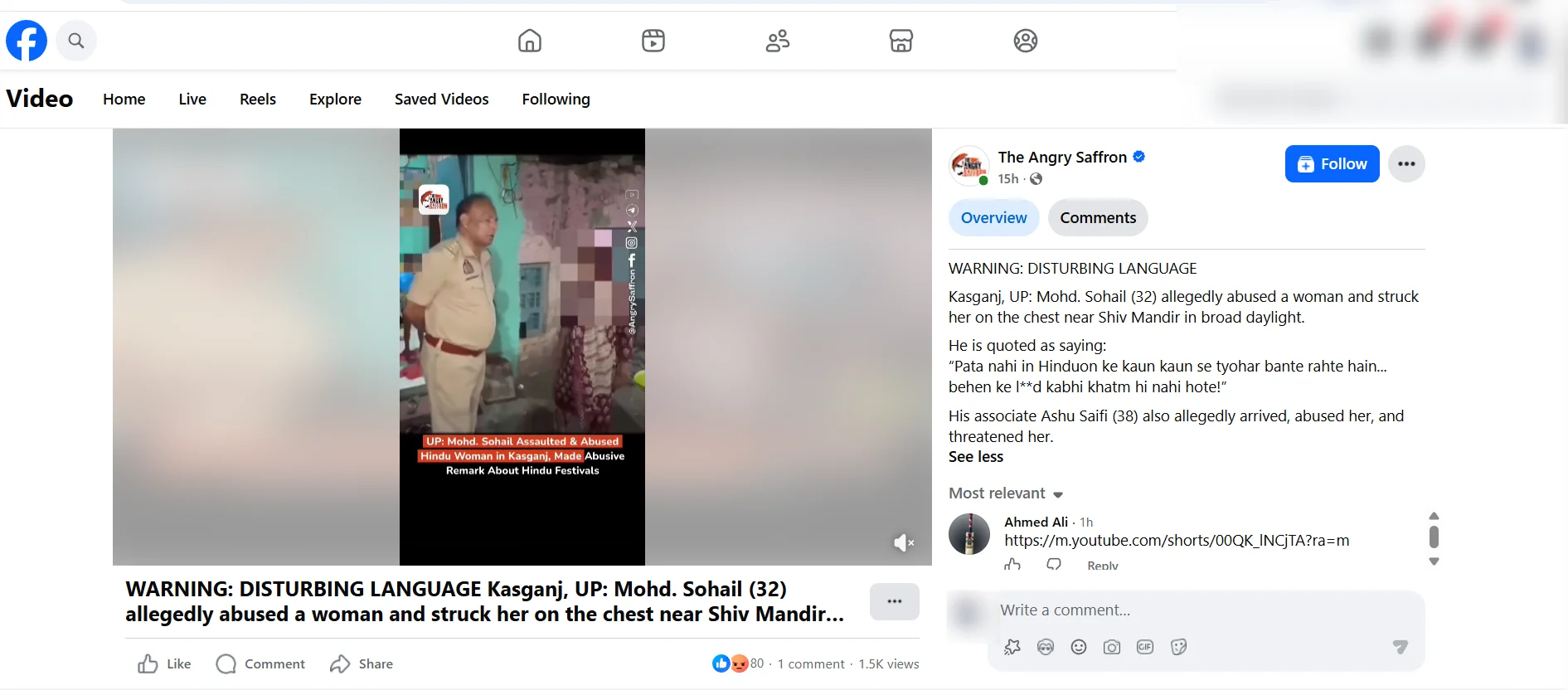
Why it is Hate Crime ?
The primary category selected in this case is: Attack not resulting in death. The subcategory selected is: Attacked for Hindu identity. In several cases, Hindus are attacked merely for their Hindu identity without any perceived provocation. A classic example of this category of religiously motivated hate crime is a murder in 2016. 7 ISIS terrorists were convicted for shooting a school principal in Kanpur because they got ‘triggered’ seeing the Kalava on his wrist and tilak that he had put. In this, the Hindu victim had offered no provocation except for his Hindu religious identity. The motivation for the murder was purely religious, driven by religious supremacy. Such cases where Hindus are targeted merely for their religious identity would be documented as a hate crime under this category. The other primary category selected is: Hate Speech against Hindus. The subcategory selected is: Anti-Hindu slurs, mocking faith. Anti-Hindu slurs and the deliberate mocking of the Hindu faith owing to religious animosity involve the usage of derogatory terms, stereotypes, or offensive references to religious practices, symbols, or figures. One of the common anti-Hindu slurs used against Hindus is “cow-worshipper” and “cow piss drinker”. The intention of using this term is to demean and mock Hindus as a group and their religious beliefs since Hindus consider the cow holy. Additionally, some symbols and the slurs attached to them have a historical context that exacerbates the insult, hate, stereotyping, dehumanisation and oppression against Hindus. Cow worship has been used for centuries to denigrate Hindus, insult their faith and oppress Hindus specifically as a religious group. There has been overwhelming documentation about how cow slaughter has been used to persecute Hindus with cow meat being thrown in temples and places of worship. There has also been overwhelming documentation where cow meat (beef) has been force-fed to Hindus to either forcefully convert them to Islam or denigrate their faith. Apart from cow worship, the Swastika – which holds deep religious significance for the Hindus – has also been misinterpreted and distorted to use as a slur against Hindus. Similarly, the worship of the Shivling has been used by supremacist ideologies and religions to denigrate Hindus owing to religious animosity. Such slurs and denigration stem out of inherent animosity and hate towards Hindus and their faith, therefore, it is categorised as hate speech targeted at Hindus specifically owing to their religious identity. This case was a clear example of a hate crime as a Hindu woman was religiously profiled, targeted for molestation and assault, and simultaneously subjected to anti-Hindu abuse by the Muslim perpetrators. The combination of her Hindu identity, the manner in which she was targeted, and the anti-Hindu abuse directed at her during the incident demonstrated that the crime had a religious dimension beyond the underlying physical and sexual violence. The most significant religious marker in this case was the fact that the victim was subjected to anti-Hindu slurs while she was being molested and assaulted by the perpetrators. When a Hindu person is subjected to assault, molestation or abuse while their faith is simultaneously derided, mocked, or their festivals are demeaned, it indicates more than a random act of violence or molestation driven solely by sexual gratification. Rather, it demonstrates religiously profiled targeting, as the perpetrator made his hostility towards the victim’s Hindu identity and the Hindu community explicit through his words. The fact that the anti-Hindu abuse occurred simultaneously with the molestation and assault further demonstrated that the violence was accompanied by animosity towards her Hindu identity. This made the attack an assault on the victim not merely as an individual, but in the context of her religious identity, making the crime religiously driven and rooted in hostility towards Hinduism. The use of profanities and derogatory remarks against the Hindu community and its festivals further made the religiously driven nature of the incident explicit. Hindu festivals hold profound religious and cultural significance, commemorating sacred events, deities, traditions and spiritual beliefs that form an integral part of Hindu religious life. Therefore, using vulgar and contemptuous language to demean Hindu festivals and the Hindu community is not merely an ordinary personal insult; it denigrates practices and traditions that hold deep religious significance for Hindus. Such remarks demonstrate contempt towards Hinduism and the Hindu community, while their use in the course of the assault reinforces the religious dimension of the crime. The combination of anti-Hindu abuse with the molestation and physical assault therefore made the religiously driven nature of the incident particularly clear, amounting to an anti-Hindu hate crime. Since this case meets the parameters of a religiously driven hate crime, it is being added to the hate crime database of the Hinduphobia Tracker. Disclaimer: The Hinduphobia Tracker records incident dates based on when a crime occurs, rather than when it is first reported by the media. In this case, however, the available media reports did not specify the exact date on which the incident occurred. As the incident was first reported in the media on 5 September 2026, that date has been recorded as the indicative incident date for documentation purposes only and should not be construed as the confirmed date of occurrence.
Victim Details
Total Victim
1
Deceased
0
Gender
- Male 0
- Female 1
- Third Gender 0
- Unknown 0
Caste
- SC/ST 0
- OBC 0
- General 0
- Unknown 1
Age Group
- Minor 0
- Adult 1
- Senior Citizen 0
- Unknown 0


Case Status
Arrested


Perpetrators Details
Perpetrators
Muslim Extremists
Perpetrators Range
From 2 To 5
Perpetrators Gender
male
 Sources




