Hindu devotees attacked for reciting Hanuman Chalisa in Uttar Pradesh's Loni; Hindu cab driver beaten for wearing Kalava
 Ghaziabad, Uttar Pradesh, India
  5 September, 2026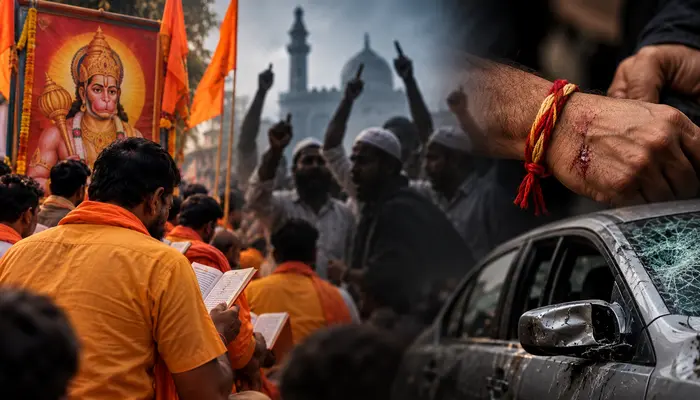
Case Summary
In Loni, Ghaziabad, the recitation of the Hanuman Chalisa by Hindu devotees was opposed and disrupted by a Muslim crowd chanting “Nara-e-Takbeer” and “Allahu Akbar.” The crowd also attempted to attack those reciting the Hanuman Chalisa. A Hindu cab driver present at the spot was beaten after the group noticed the kalava, a sacred Hindu thread, on his wrist. His cab was also vandalised. On September 6, 2026 (Sunday), Hindu Raksha Dal workers gathered near Rashid Ali Gate on the Delhi–Saharanpur Road for the announced recitation of Hanuman Chalisa. Police barricaded the route and stopped them about 50 metres from the gate, near Salam Hotel. The workers sat on the road and recited the Hanuman Chalisa twice, while police remained deployed at the site. As a precaution, police had already cordoned off the surrounding area and closed nearby markets. Personnel from six police stations, the Provincial Armed Constabulary and Quick Reaction Teams were deployed, while drones were used for surveillance to prevent a confrontation between the two sides. During the recitation, people from the Muslim community made several attempts to approach and attack the participants while chanting “Nara-e-Takbeer” and “Allahu Akbar”. Police drove them away and intervened to keep the groups apart as several confrontational situations arose. The Hindu Raksha Dal workers then completed the recitation without proceeding to Rashid Ali Gate. During the same period, Hindu cab driver Mohar Singh, who had travelled from Bisrakh/Greater Noida towards Loni after dropping a passenger, stopped near Rashid Ali Gate. After a Muslim group noticed the kalava on his hand, he was beaten, and his cab was damaged, with its glass broken. Mohar Singh sustained injuries, and nearby police personnel intervened, rescued him and drove the attackers away. The Hindu Raksha Dal subsequently announced that it would no longer refer to Rashid Ali Gate by that name and would instead call it Bajrang Dwar or Hanuman Dwar. The organisation said that 12–13 villages were associated with it and that it would conduct village-level panchayats regarding the proposed renaming. The Hanuman Chalisa programme stemmed from the dispute of 2 September 2026, when Hindu Raksha Dal members Sumit Sood and Mohit were beaten by a mob of more than 50 Muslims in the Toli Mohalla area near Rashid Ali Gate. A police case arose from that incident, naming Haji Salman, Shahnawaz, Sher Khan, Sanjeeda, Kallu Beg and Akram, along with around 50 unidentified people. The Hindu Raksha Dal had demanded their arrests, and Haji Salman’s non-arrest had prompted the announcement of the Hanuman Chalisa programme.
Why it is Hate Crime ?
The primary category selected in this case is: Attack on Hindu religious representations. Within this, the subcategory selected is: Abrahamic religious chanting outside Hindu religious places and/or during Hindu activities. In Hinduism, a temple is the abode of the Deity. The Deity in the Temple is consecrated, thereby, making it a real, breathing entity. Hindus believe that not just the Deity but the temple premises itself are sacred to Hindus since Hindus hold the faith that the entire Temple space is an amalgamation of the divine energy of the deity. Similarly, religious activities hold deep significance for Hindus, as they are intricately connected to their spiritual, cultural, and social lives. These practices encompass rituals, festivals, prayers, and pilgrimages that celebrate and honour various deities, fostering a sense of spiritual connection, community, and cultural continuity. Given the central significance of Temples and religious activities in Hindu Dharma, any aggressive Abrahamic chanting outside Temples or during religious activities negates the divinity of the religious space because the chanting itself negates the existence of any other God other than the God of the Abrahamic faith. Such chanting is specifically done to negate the faith of Hindus, establish religious supremacy, intimidate the devotees and mock the faith. Besides temples, such Abrahamic chanting outside any Hindu place of worship or religious structure or during any religious activity has the same effect. Since such acts are rooted in an inherent religious supremacist mentality driven by religious animosity, such crimes would be considered religiously motivated hate crimes under this category. The other primary category selected is: Attack not resulting in death. Within this, the first subcategory selected is: Attack against Hindu devotees. Hindu devotees are a few of the easiest targets of religiously motivated hate crimes because during the festival/procession/puja etc, for non-Hindus it is easy to profile their victims on the basis of religion. Hindu devotees come under attack on several occasions by individual non-Hindus or mobs of non-Hindus owing to their animosity against Hinduism, its symbols and tradition/practices. There are several instances of Hindu devotees being attacked while they worship in temples or temporary religious structures, during religious processions, doing bhajan/kirtan/puja in their own homes, in the residential society etc. These attacks are perpetrated by non-Hindus primarily because of their animosity towards Hindus and their faith. In some cases, the trigger for the violence may be non-religious, however, two elements make these hate crimes. First, the Hindus who come under attack are attacked violently while indulging in religious activity. Whether they are in a place of worship or not is immaterial to the crime. When individuals are attacked while indulging in religious practices, the attack in itself is a hindrance to their freedom to practice religion and therefore constitutes a hate crime. Secondly, religious supremacist doctrines and ideologies deem religious practices of Hindus to be offensive ab initio since they are considered “sinful” by these ideologies, worthy to be annihilated by force or coercion. Driven by these religious supremacist ideologies and doctrines, the attacks against Hindu devotees stem from intrinsic animosity towards Hinduism. In some cases, the trigger for the violence may be non-religious, however, it develops into a religiously motivated crime during the course of the violence. Since these attacks stem from animosity towards Hindus and Hinduism, they are considered religiously motivated hate crimes under this category. The other subcategory selected is: Attacked for Hindu identity. In several cases, Hindus are attacked merely for their Hindu identity without any perceived provocation. A classic example of this category of religiously motivated hate crime is a murder in 2016. 7 ISIS terrorists were convicted for shooting a school principal in Kanpur because they got ‘triggered’ seeing the Kalava on his wrist and tilak that he had put. In this, the Hindu victim had offered no provocation except for his Hindu religious identity. The motivation for the murder was purely religious, driven by religious supremacy. Such cases where Hindus are targeted merely for their religious identity would be documented as a hate crime under this category. This case has been included in the Hinduphobia Tracker as it contains multiple religious markers. Hindu devotees were prevented from reciting the Hanuman Chalisa by a Muslim crowd chanting “Nara-e-Takbeer” and “Allahu Akbar” while opposing the religious activity. The incident also involved a Hindu cab driver who was beaten and had his vehicle vandalised after members of the crowd noticed the kalava, a sacred Hindu thread, on his wrist. Taken together, the incidents reflect hostility towards both the practice of Hindu worship and the visible expression of Hindu religious identity. The Hanuman Chalisa is one of the most widely revered Hindu devotional hymns dedicated to Lord Hanuman, a central figure in Hindu religious tradition. Its recitation is an important form of Hindu prayer and devotion, through which devotees express reverence towards Hanuman and seek his strength, protection and blessings. For several Hindus, reciting the Hanuman Chalisa is a deeply personal and spiritual practice as well as a visible expression of their religious faith. The disruption of the recitation therefore amounted to a direct interference with a Hindu act of worship. The devotees were not engaged in an ordinary public gathering but in peacefully reciting a sacred hymn dedicated to a Hindu deity. Preventing them from doing so effectively obstructed their ability to practise and openly express their faith. The fact that the recitation itself became the target of confrontation and intimidation makes the incident's religious nature particularly clear. Moreover, the chanting of “Nara-e-Takbeer” and “Allahu Akbar” during the confrontation added an explicitly Islamic religious dimension to the opposition faced by the Hindu devotees. These expressions were shouted while the Hindu participants recited the Hanuman Chalisa. The chants were not detached religious expressions; they accompanied the confrontation over a Hindu act of worship and were directed at a gathering devoted to Lord Hanuman. This was particularly offensive because their sacred recitation was being challenged in an atmosphere marked by the invocation of another faith while attempts were being made to approach and confront them. The juxtaposition of Islamic religious chants with the disruption of a Hindu devotional practice reinforced the religious character of the hostility and turned a peaceful expression of Hindu faith into a site of religious confrontation. Lastly, the attack on the Hindu man after identifying that he wore a kalava formed another religious dimension. Kalava, also known as a sacred Hindu thread or mauli, is a visible marker of a Hindu man’s religious identity and a symbol of Hindu religious practice. Worn on the wrist, it represents a connection to the Hindu faith and forms part of the outward expression of Hindu identity. The cab driver was beaten, and his cab was vandalised after the group noticed the kalava, making the sacred marker directly relevant to the violence he faced. Being targeted because of such a religious symbol was particularly offensive because it turned an ordinary and visible expression of faith into a reason for physical aggression and intimidation. The attack therefore struck not only at the individual man but also at his right to visibly carry a symbol of his Hindu identity without fear of violence. It reflected hostility towards the outward expression of Hindu religious identity and treated a sacred Hindu marker as a basis for targeting a Hindu. Altogether, the disruption of a Hindu devotional gathering, the use of religious chants during the confrontation, and the targeting of a Hindu man because of his kalava reflected hostility towards both Hindu religious practice and visible Hindu identity. The deliberate targeting of worship and a recognisable Hindu religious marker suggests a mindset that viewed Hindu identity and its public expression with contempt and sought to intimidate those asserting it. Accordingly, this case has been documented in the Hinduphobia Tracker's hate crime database as an instance of religiously motivated hostility directed against Hinduism and the religious identity of the Hindu community.


Case Status
Complaint filed


Perpetrators Details
Perpetrators
Muslim Extremists
Perpetrators Range
Unknown
Perpetrators Gender
unknown
 Sources




