Hindu god idol desecrated in Madhya Pradesh; devotees assaulted during Ramayana recitation
 Ashoknagar, Madhya Pradesh, India
  4 September, 2026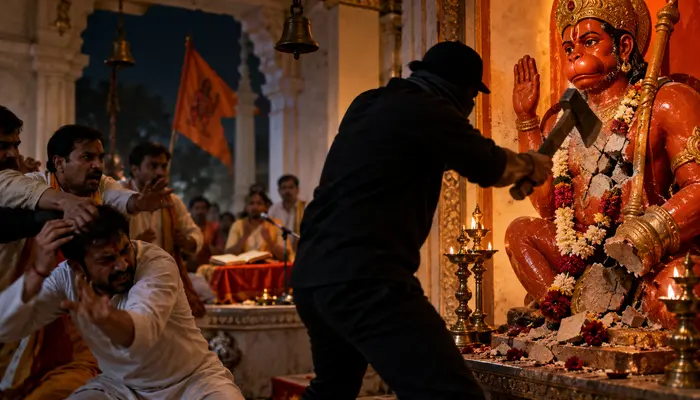
Case Summary
In Piprai town, Ashoknagar district, Madhya Pradesh, the idol of Lord Balaji (Hanuman) at the historic Balaji Temple in Ramlila Maidan was desecrated during a Ramayana recitation. The idol was damaged with an axe. Hindu devotees present at the temple were also abused and assaulted when they tried to stop the attacker. According to reports, on 5 September 2026, at around 3:45 pm, a man entered the Balaji Temple while devotees were reciting the Ramayana. The man, identified as Neelesh Lodhi, son of Sukhchand Narwaria, a resident of Lidhora village, struck the idol of Shri Balaji with an axe and damaged the religious site and the idol installed there. When people at the temple intervened, he engaged in abusive language and assaulted them. Nitesh Jain, a devotee, sustained an injury to his head, while Badal Singh Yadav, the complainant, sustained an injury to his left hand. The people present at the temple caught Neelesh and informed the police. Piprai Police arrived at the spot, took him into custody and brought him to the police station. The incident then spread through Piprai, drawing a large number of citizens, devotees, Hindu organisations and saints to Ramlila Ground. The incident led to a protest, with Hindu devotees and local residents blocking the main road for around three to four hours. The blockade disrupted traffic and left commuters stranded. The protesters and saints demanded that the damaged idol be removed and a new Lord Balaji idol installed according to prescribed religious rites. They also sought registration of an FIR under stringent provisions against the main accused and other persons involved, action against members of the accused's family, removal of any illegal or unauthorised construction linked to the accused's property, and better security for Hindu places of worship. As the protest continued, some protesters went to the accused's house, brought household belongings outside, and set them on fire. They also demanded action against other illegal constructions at or around the property. Tension remained high in the area, and the road blockade continued until late evening. In view of the situation, police and administrative officials reached the spot and attempted to persuade the protesters, restore normality and assure them of impartial action. The Revenue Department also inspected the accused's house in the presence of police personnel and examined the site and revenue records. Following the inspection, the administration determined that a portion of the house had been constructed on government land and treated it as an encroachment or unauthorised construction. The Revenue Department used a JCB/bulldozer to demolish the identified portion, bringing down approximately half of the house. The demolition was presented as action against construction on government land and was separate from the burning and removal of household belongings by people during the protest. Piprai Police registered a case against Neelesh Lodhi under relevant provisions of the Bharatiya Nyaya Sanhita for damaging the religious idol and assaulting people present at the temple. The police investigation examined the circumstances of the incident, Neelesh's statements, the reason behind the attack, the damage to the idol, the assaults on the devotees and whether any other person had been involved.
Why it is Hate Crime ?
The primary category selected in this case is: Attack on Hindu religious representations. The subcategory selected is: Desecration of Hindu religious symbol. Icons and symbols, or religious representations of a spiritual ideal, are widely revered in Hinduism. Iconography is of vital significance in the Hindu milieu. It helps connect people’s spiritual beliefs with the real world. Iconography within the Hindu faith takes several shapes and forms. Murtis are of great significance to Hindus, to which daily rituals, prayers and offerings are made. Besides the murtis, there are several other symbols which have deep significance in the Hindu faith – the Om and Swastika, for example. Since these Hindu religious symbols hold paramount importance in Hinduism, any desecration of symbols, icons, murtis, religious representations and manifestations is driven by animosity towards the faith itself, which manifests itself through these murtis, icons and symbols. Therefore, any desecration of these Hindu religious symbols and representations is considered a religiously motivated hate crime under this category. The other subcategory selected is: Attack on Temples. In Hinduism, a temple is the abode of the Deity. The Deity in the Temple is consecrated, thereby making it a real, breathing entity. Hindus believe that not just the Deity but the temple premises themselves are sacred to Hindus since Hindus hold the faith that the entire Temple space is an amalgamation of the divine energy of the deity. Given the central significance of Temples in Hindu Dharma, any attack against a Hindu Temple or its peripheral premises is an attack on the faith itself and is born out of animosity towards the faith, of which the Temple is a central tenet. Any manner of attack against a Temple and/or its premises would therefore be considered a religiously motivated hate crime. This case constitutes a religiously motivated hate crime because the perpetrator deliberately desecrated a sacred idol of Lord Hanuman installed within the Balaji Temple in Piprai during a Ramayana recitation. The act was not accidental or ordinary property damage but involved the deliberate targeting of an object of profound religious significance to Hindu devotees. By attacking a consecrated Hindu idol inside a temple, the perpetrator targeted central symbols and practices of Hindu faith and religious identity. Lord Balaji/Hanuman holds deep religious significance in Hinduism. Hanuman is revered as a powerful deity and a devoted bhakta of Lord Rama, and is associated with strength, courage, loyalty, devotion and protection. Temples dedicated to Hanuman serve as important places of prayer, worship and religious observance for Hindus. Balaji is a widely used name for the deity worshipped at the temple, and the idol represents the deity's sacred presence to devotees who worship there. Damage to such an idol therefore affects an object carrying profound spiritual and devotional significance for Hindus. The desecration of the Hindu deity's idol constituted a direct attack on a sacred symbol of Hindu faith. The idol of Lord Hanuman, installed inside the Balaji Temple, was struck with an axe and damaged. A consecrated deity idol is not merely an object or piece of property; it represents the divine presence that devotees worshipped and approached with reverence. Deliberately attacking and damaging such an idol therefore violated an object at the heart of Hindu religious devotion and constituted an affront to Hindu religious beliefs and sentiments. The attack on the Hindu place of worship itself added a distinct religious dimension to the incident. The Balaji Temple at Ramlila Maidan is a Hindu temple where devotees gather for worship, prayer, and religious observances. The damage occurred within this sacred setting rather than at an ordinary public or private property. By directing the act against a religious object inside a Hindu temple, the perpetrator violated a space consecrated for Hindu worship and disturbed its sanctity. Such an intrusion was an affront to Hindu religious sentiments because a temple is not merely a physical structure for devotees; it is a sacred space where Hindus worship their deity, perform religious rituals, and maintain their spiritual connection with the divine. Attacking the deity within that space therefore constituted a direct violation of the sanctity of a Hindu place of worship and an assault on the religious environment in which Hindu devotees practised their faith. The incident interrupted a Ramayana recitation taking place inside the temple, where devotees had gathered to participate. The Ramayana holds profound religious and cultural significance in Hinduism. It is one of the most revered Hindu epics and narrates the life, values, devotion and dharma of Lord Rama, who is worshipped as an incarnation of Lord Vishnu. The Ramayana is deeply embedded in Hindu religious traditions, with its recitation, reading and hearing forming important devotional practices for many Hindus. Its teachings emphasise dharma, righteousness, devotion, duty, loyalty and the triumph of good over evil, making a Ramayana recitation within a temple a meaningful act of Hindu worship and spiritual observance. The disruption therefore affected not only a physical religious symbol but also an ongoing act of Hindu worship and devotion. Interrupting a sacred recitation in a Hindu temple was an affront to the devotees' religious observance, as the Ramayana was being recited as an act of reverence, devotion and remembrance of Lord Rama. By disturbing the recitation while devotees were engaged in this practice and attacking the deity being worshipped in the same sacred setting, the incident violated the sanctity of a Hindu religious gathering and interfered directly with the devotees' ability to practise their faith peacefully. Lastly, the abuse and physical assault of devotees who attempted to intervene further affected Hindus in the course of protecting their religious practice and sacred space. The people present had attempted to stop the attack on the deity and were subjected to verbal abuse and physical violence. The violence therefore accompanied the desecration of the Hindu religious site and affected devotees who had intervened to protect their place of worship and its sacred idol. Assaulting devotees while they were attempting to safeguard a Hindu deity and temple compounded the religious offence, as the violence was directed at Hindus responding to an attack on an object central to their faith. It violated the peace and sanctity expected during Hindu worship and intimidated devotees who were exercising their religious devotion and attempting to preserve the sanctity of their temple. The physical harm to the devotees consequently represented a further affront to Hindu devotees in the immediate aftermath of the desecration of their sacred place and deity. The desecration of the Hindu idol, violation of the temple's sanctity, disruption of the Ramayana recitation, and assault on devotees who intervened point to a clear pattern of hostility towards Hindu religious practice. The deliberate targeting of the deity and the ongoing religious gathering shows a clear disregard for Hindu faith and the things Hindus hold sacred. By attacking the idol in the middle of a Ramayana recitation and then assaulting devotees who tried to protect it, the accused demonstrated contempt not only for the sacred space but also for Hindus asserting their right to practise and defend their faith. Accordingly, the case has been documented in the Hinduphobia Tracker's Hate Crime Database as an instance of religiously motivated hostility directed against Hinduism and the religious identity of the Hindu community. Disclaimer: The victim count has been recorded as 2 because two individuals were specifically identified as having been assaulted and injured while intervening at the temple. Nitesh Jain sustained a head injury, while Badal Singh Yadav, the complainant, suffered an injury to his left hand.
Victim Details
Total Victim
2
Deceased
0
Gender
- Male 2
- Female 0
- Third Gender 0
- Unknown 0
Caste
- SC/ST 0
- OBC 0
- General 2
- Unknown 0
Age Group
- Minor 0
- Adult 2
- Senior Citizen 0
- Unknown 0


Case Status
Complaint filed


Perpetrators Details
Perpetrators
Others
Perpetrators Range
One Person
Perpetrators Gender
male
 Sources




