Hindu villagers targeted for forced Christian conversion under guise of prayer meeting in Azamgarh, Uttar Pradesh
 Azamgarh, Uttar Pradesh, India
  3 September, 2026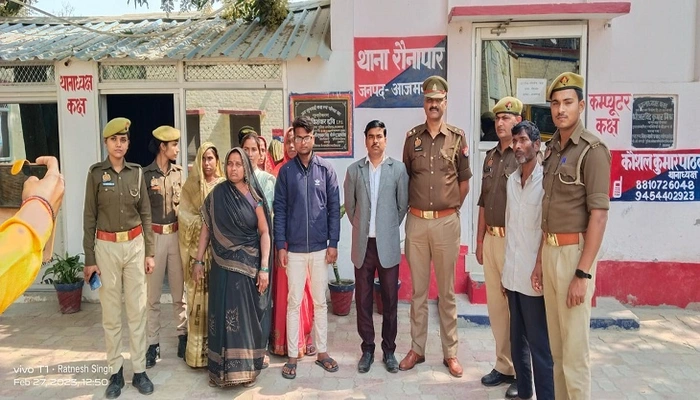
Case Summary
In the Kadipur village, Azamgarh district, Hindu villagers, including women, were targeted for forced Christian conversion under the guise of a prayer meeting. According to reports, the prayer meeting was held on 4 September 2026, at the house of Kanti Devi, a resident of Kadipur village in the Raunapar police station area of Azamgarh. Around 40–50 people, including women, were present at the gathering, which was organised as a prayer meeting dedicated to Jesus Christ. Shivsagar Bharti, head priest of the Rajdepur monastery, received information that religious conversions were being conducted during the meeting and informed Raunapar police station. A police team subsequently reached the location, following which several people left the premises. Five people present at the gathering were detained and later arrested. The arrested persons were identified as Kanti Devi and Rahul, both residents of Kadipur village; Babita Devi and Gharbharan, residents of Rasulpur village; and Suman, a resident of Turkauli village. Police registered an FIR against the five based on a written complaint submitted by Shivsagar Bharti and produced them before a court, which remanded them to judicial custody. Police subsequently questioned the arrested people and investigated the circumstances in which the gathering had been organised, the purpose for which people had been assembled and the activities that had taken place at the venue. They also found some material which they described as objectionable, although the nature of the material was not specified. Raunapar Station House Officer Sunil Kumar Dubey also stated that Kanti Devi had previously faced police action in a similar conversion case in 2022. According to his statement, she was sent to jail in that case and had obtained bail after approximately 22 days. The 2022 proceedings were separate from the current case. The Vishva Hindu Parishad also responded to the incident. Its district convenor, Gaurav Raghuvanshi, spoke about the matter following the police action. As of the date of writing this report, the police investigation into the prayer meeting, the religious-conversion complaint and the circumstances surrounding the gathering was ongoing.
Why it is Hate Crime ?
The primary category selected in this case is: Predatory Proselytisation. Within this, the subcategory selected is: Proselytisation by grooming, brainwashing, manipulation or subtle indoctrination, with the tertiary category being - Pattern of targeting Hindus. Religious brainwashing essentially means the often subtle and forcible indoctrination to induce someone to give up their religious beliefs to accept contrasting regimented ideas. Religious grooming or brainwashing also involves propaganda and manipulation. It involves the systematic effort, driven by religious malice and indoctrination, to persuade “non-believers’ to accept allegiance, command, or doctrine to and of a contrasting faith. Cases of such grooming or brainwashing are far more nuanced than direct threats, coercion, inducement and violence. In such cases, it is often seen that there is repeated, subtle and continual manipulation of the victim to induce disaffection towards their own faith and acceptance of the contrasting faith of the perpetrator. While subtle indoctrination is widely acknowledged as predatory, an element which is often understated in such conversions or in the attempts at such conversion is the role of loyalty and trust which might develop between the perpetrator and the victim. Fiduciary relationships are often abused to affect such religious conversion. For example, an educator transmitting religious doctrine of a competing faith to a Hindu student. The Hindu student is likely to accept what the teacher is transmitting owing to the existence of the fiduciary relationship. The exploitation of the fiduciary relationship to religiously indoctrinate victims would also be included in this category. Since the underlying animosity towards the victim’s faith forms the basis of predatory proselytisation, such cases are considered religiously motivated hate crimes. This case is added to the tracker because it involved a religious conversion effort in which Hindu villagers were targeted for forced Christian conversion under the guise of a prayer meeting. The focus on changing the attendees’ existing religious beliefs made religious conversion an integral part of the incident. The conduct therefore went beyond the ordinary holding of a Christian prayer meeting and involved an attempt to persuade attendees to adopt Christianity. The use of a Christian prayer meeting as the setting for the conversion activity was a significant religious marker. A prayer meeting ordinarily functions as a space for members of a particular faith to worship or engage in religious reflection. However, in this case, what was presented as a simple prayer gathering inside a house was in reality a covert attempt at religious conversion. These were not genuine community prayers but calculated efforts to exploit the trust of Hindus and manipulate them into abandoning their faith. The perpetrators deliberately held the meeting in secrecy and without permission from the administration, indicating a deliberate and deceptive strategy designed to avoid public attention and scrutiny. By conducting such gatherings covertly, the Christian missionaries sought to manipulate vulnerable Hindus, taking advantage of their emotional and social circumstances to push them towards conversion. The religious-conversion element was significant because the activity was described as an effort to move people attending a Christian prayer meeting towards Christianity. For Hindu attendees, such conversion represented a change in their existing religious identity and their connection with Hindu beliefs, practices and traditions. The religious significance therefore lay not merely in the presence of Christianity, but in the objective of replacing an existing faith with another. Such an effort sought to weaken the individuals’ connection with Hinduism, including the worship, customs and traditions associated with their faith, while also affecting the continuity of Hindu religious identity within their families and community. The circumstances of the incident, together with the previous involvement of one of the accused in a similar religious-conversion case, indicated a broader pattern of conversion-related activity directed towards members of the Hindu community. Kanti Devi had previously faced police action in 2022 in connection with a similar conversion case and had been jailed before obtaining bail. Her involvement in another conversion-related case in 2026 was significant in assessing the nature of the present incident, particularly as the current gathering had also involved efforts to bring people towards Christianity. Where individuals repeatedly engage in activities aimed at changing the religious allegiance of members of another faith, such conduct indicates that the conversion effort was not merely incidental to the gathering but formed a central objective of the activity. The repeated involvement of the same accused in conversion-related proceedings therefore provided an additional indication that the incident had a targeted religious dimension affecting the Hindu community. The Christian faith, by its very theological foundations, places a strong emphasis on proselytisation. In pursuit of conversion objectives, Christian evangelists often employ unethical means, ranging from psychological pressure and misinformation to inducements such as money or jobs. In such cases, Christian missionary groups often target and brainwash socially and economically vulnerable Hindus to further their agenda of religious conversions. This form of coercion strips Hindus of their agency and dignity and enforces forced conversions. These are not random or isolated incidents, but rather premeditated efforts to undermine the Hindu faith, persuade Hindus to discard their own faith, and convert to Christianity. Such acts were deeply rooted in religious animosity towards Hindu victims, and thus, this case was added to the tracker. Disclaimer: Media reports stated that around 40–50 people, including men and women, were present at the prayer meeting in Kadipur village of Azamgarh district, Uttar Pradesh. As no gender-wise breakdown was provided, the Hinduphobia Tracker has applied a proportional demographic estimate based on India’s Census 2011 and NFHS-5 (2019–21) rural population data. Accordingly, the 50 victims are estimated as 25 men (50%) and 25 women (50%), reflecting an equal gender distribution consistent with typical rural family demographics.
Victim Details
Total Victim
50
Deceased
0
Gender
- Male 25
- Female 25
- Third Gender 0
- Unknown 0
Caste
- SC/ST 0
- OBC 0
- General 0
- Unknown 50
Age Group
- Minor 0
- Adult 0
- Senior Citizen 0
- Unknown 50


Case Status
Arrested


Perpetrators Details
Perpetrators
Christian Extremists
Perpetrators Range
From 5 to 10
Perpetrators Gender
both
 Sources




