Hindu family assaulted, denied entry to rented home after returning from Janmashtami event; Muslim landlord threw prasad into drain
 Ghaziabad, Uttar Pradesh, India
  4 September, 2026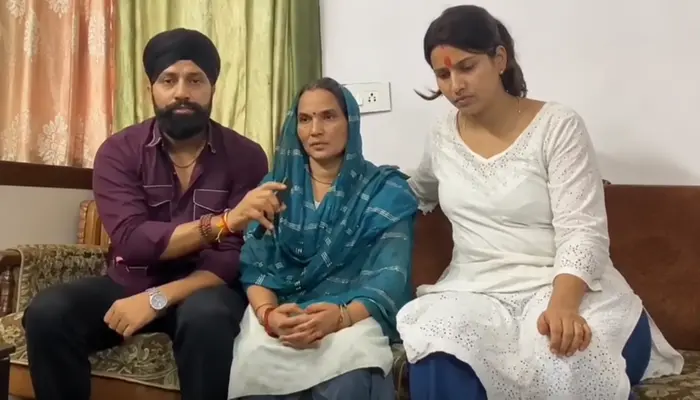
Case Summary
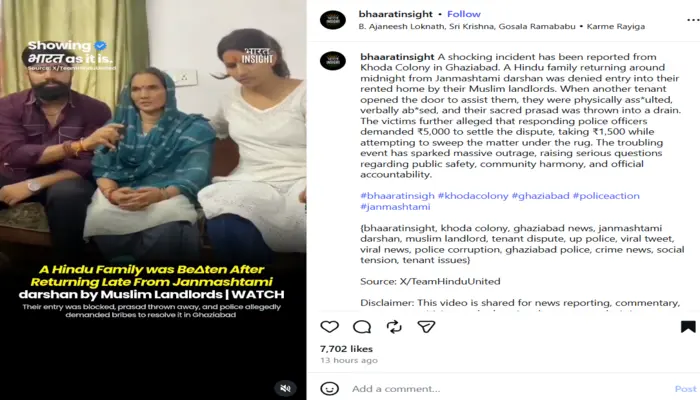
In Khoda Colony, Ghaziabad, Uttar Pradesh, a Hindu family returning from a Janmashtami event was denied entry to their rented home by their Muslim landlord. After they explained that they had gone to attend the Hindu religious event, their prasad (a sacred food offering) was thrown into a drain, and they were subjected to insults and physical assault. This incident occurred on 5 September 2026 at around 1:30 a.m. The Hindu family had returned to their rented accommodation after attending the Janmashtami event. They called out at the gate, but nobody opened it. After some time, another tenant opened the gate for them. The Muslim landlord then came outside under the pretext of questioning them about returning home so late at night. He then described their late-night arrival as their “daily drama” and asked where they had stayed so late. When they informed the Muslim landlord that they had gone to attend a Janmashtami function, he threw away their prasad and physically assaulted them. In a video that went viral, one of the victims, a Hindu woman, said that when her husband intervened to rescue her, the Muslim landlord also assaulted him. The occupants were then thrown into a nearby drain, struck in the face and had their clothes torn. Around ten people gathered at the location during the incident. A Hindu activist, speaking in the viral video, said that the Muslim group’s growing confidence was allowing them to target Hindu families. Another female Hindu activist also said that the perpetrators had laid hands on the woman and questioned who had given them permission to throw a woman into a drain, tear her clothes, take her belongings and beat her so severely. She demanded that action be taken against those responsible within 24 hours, wherever they were. The female Hindu activist also revealed that after the assault, the Hindu family went to the local police post to seek help and report the incident. However, the administration had failed to assist the victims, saying that instead of addressing their grievances, the authorities made them spend money from their own pockets, subjected them to further harassment and sent them back home. She also said that the perpetrators had boasted of having considerable influence at the police station and had maintained that nobody could take action against them. It was also revealed that when the Hindu family approached the police to file a First Information Report, they were intimidated and asked to pay ₹5,000. After the family said that they were poor and could not afford the amount, ₹1,500 was taken and the matter was settled. Following these revelations, the Hindu organisation members called on the administration to arrest those responsible at the earliest and ensure justice for the family.
Case Images
Why it is Hate Crime ?
The primary category selected in this case is: Attack not resulting in death. The subcategory selected is: Attacked for Hindu identity. In several cases, Hindus are attacked merely for their Hindu identity without any perceived provocation. A classic example of this category of religiously motivated hate crime is a murder in 2016. 7 ISIS terrorists were convicted of shooting a school principal in Kanpur because they got ‘triggered’ seeing the Kalava on his wrist and the tilak that he had put. In this, the Hindu victim had offered no provocation except for his Hindu religious identity. The motivation for the murder was purely religious, driven by religious supremacy. Such cases where Hindus are targeted merely for their religious identity would be documented as a hate crime under this category. The other subcategory selected is: Attacked for opposing radicals or trying to save victim. In several cases, Hindus are attacked for opposing religiously motivated crimes being committed against a fellow Hindu or simply for voicing an opinion opposing radical elements, who either have in the past or continue to persecute Hindus. In such cases, the initial attack against the victim, against which the Hindu was trying to defend the victim, would also need to be classified as a religiously motivated hate crime. Since the initial crime itself was religiously motivated and the subsequent crime of attempting to save the victim or speaking against the radical elements ends up inviting a violent attack, it would also be classified as a religiously motivated hate crime under this category. The other primary category selected in this case is: Attack on Hindu religious representations. The subcategory selected is: Desecration of Hindu religious symbol. Icons and symbols, or a religious representation of a spiritual ideal, are widely revered in Hinduism. Iconography is of vital significance in the Hindu milieu. It helps connect people’s spiritual beliefs with the real world. Iconography within the Hindu faith takes several shapes and forms. Murtis are of most significance to Hindus, to which daily rituals, prayers and offerings are made. Besides the murtis, there are several other symbols which have deep significance in the Hindu faith – the Om and Swastika, for example. Since these Hindu religious symbols hold paramount importance in Hinduism, any desecration of symbols, icons, murtis, religious representations and manifestations is driven by animosity towards the faith itself, which manifests itself through these murtis, icons and symbols. Therefore, any desecration of these Hindu religious symbols and representations is considered a religiously motivated hate crime under this category. This case demonstrated religiously motivated hostility directed against a Hindu family, with the confrontation escalating after the family disclosed that they had returned from attending a Janmashtami celebration. What began under the pretext of questioning their late-night return was followed by the disposal of their sacred prasad into a drain and physical assault against the Hindu family. The sequence and nature of these acts indicated that their Hindu religious identity and observance were central to the hostility directed against them. The religious significance of the conduct was particularly important in the context of Janmashtami, one of the most important Hindu festivals commemorating the birth of Lord Krishna, who is worshipped by Hindus as an incarnation of Lord Vishnu. Janmashtami is observed once a year and carries deep religious and spiritual significance for Hindus. Devotees observe the festival through fasting, prayers, bhajans, temple visits, darshan and religious ceremonies, with the principal celebrations traditionally taking place around midnight because Lord Krishna is believed to have been born at midnight. Consequently, returning home late at night after attending a Janmashtami celebration was consistent with the religious observance itself. The Hindu family was exercising its right to participate in a sacred religious festival and was not engaging in any conduct that, by itself, warranted violence or humiliation. Therefore, one of the first religious markers in this case was the fact that the Hindu family was targeted after revealing that they had come from a Janmashtami celebration. The Muslim landlord confronted them under the pretext of objecting to their late-night return, referring to their arrival as their “daily drama”, but the hostility escalated after they specifically informed him that they had been attending a Janmashtami function. He then discarded their prasad and subjected the family to physical assault. The once-a-year nature of Janmashtami was significant in this context. Unlike a situation in which occupants repeatedly returned home late every night, the family had been returning late because they had participated in a particular religious celebration whose principal observances traditionally occur at midnight. Even if the landlord had genuinely objected to their late-night arrival, he could have expressed his concern in a civil manner or pursued an appropriate legal or tenancy-related remedy. Nothing about their participation in a once-a-year Hindu festival justified assaulting them. The fact that the confrontation escalated immediately after they disclosed their religious purpose, accompanied by the deliberate disposal of their prasad, demonstrated that the late-night return served as a pretext for hostility directed at their Hindu identity and their participation in Janmashtami. The conduct therefore reflected hostility not merely towards the timing of their return but towards their exercise of a Hindu religious practice. The disposal of the prasad into a drain constituted a further and particularly direct form of religious desecration. Prasad is food that has been offered to a deity during Hindu worship and is subsequently received and consumed by devotees as a sacred blessing. Its significance therefore extends beyond that of ordinary food: it is connected to the deity, the act of worship and the religious observance during which it was offered. In this case, the prasad had been received by the Hindu family in connection with their observance of Janmashtami and consequently represented their participation in a sacred Hindu celebration. Throwing the prasad into a drain was therefore not simply an act of discarding food. It treated a sacred religious offering with contempt and deliberately violated the reverence accorded to it by Hindus. The act amounted to a clear desecration of a sacred Hindu object and directly demeaned the religious devotion and worship that the prasad represented. In the context of the preceding confrontation, this act further reinforced that the hostility was directed towards Hindu religious practice rather than being limited to an ordinary disagreement between a landlord and his tenants. The religious nature of the violence was further underscored when the victim’s husband intervened to protect her and was himself assaulted by the Muslim landlord. His intervention was not treated as a reason to de-escalate the confrontation; instead, he too became a target of physical violence. This demonstrated that the hostility extended beyond the initial Hindu woman and encompassed those who attempted to protect Hindu victims from the violence directed against them. The fact that a Hindu family member who intervened to defend another Hindu victim was himself subjected to assault showed the broader nature of the violence and reinforced the pattern of hostility towards the Hindu family as a collective. Such conduct demonstrated that even an attempt by one Hindu victim to protect another from the assault did not prevent the perpetrators from extending the violence to additional members of the Hindu family. The subsequent treatment of the family further aggravated the nature of the incident. The victims were thrown into a nearby drain, struck in the face and had their clothes torn, demonstrating that the confrontation involved humiliation and sustained physical violence rather than a brief verbal dispute over their arrival time. The manner in which the family was treated, particularly after their religious observance had been brought into the confrontation and their prasad had been desecrated, added to the evidence of contempt directed towards them as Hindus. The subsequent intimidation and demand for money when the family approached the police to seek redress also compounded their vulnerability and their inability to obtain immediate protection after being subjected to violence. Overall, the case meets the parameters of a religiously driven crime. Therefore, it is being added to the hate crime database of the Hinduphobia Tracker.
Victim Details
Total Victim
2
Deceased
0
Gender
- Male 1
- Female 1
- Third Gender 0
- Unknown 0
Caste
- SC/ST 0
- OBC 0
- General 0
- Unknown 2
Age Group
- Minor 0
- Adult 2
- Senior Citizen 0
- Unknown 0


Case Status
Complaint not filed


Perpetrators Details
Perpetrators
Muslim Extremists
Perpetrators Range
One Person
Perpetrators Gender
male
 Sources




