Hindu tribal families forcibly converted to Christianity through various inducements in Palghar, Maharashtra
 Palghar, Maharashtra, India
  3 September, 2026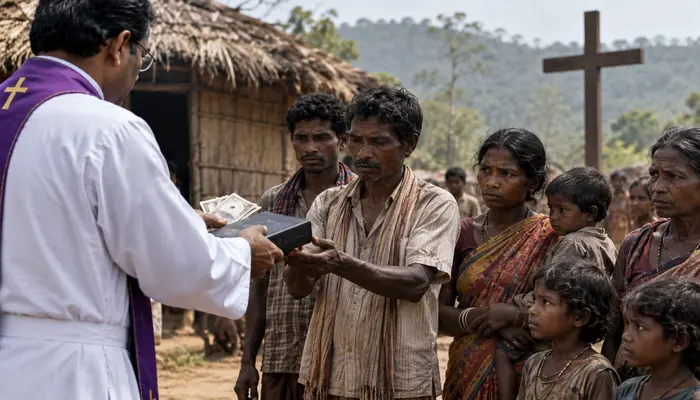
Case Summary
In Palghar, Maharashtra, Hindu tribal families were forcibly converted to Christianity through various economic, employment-related and other inducements offered by Christian missionaries. Poverty, financial difficulties and a lack of awareness were also cited as circumstances that contributed to the families being vulnerable to conversion. The matter came to light during a Gharwapsi ceremony held at the newly constructed Bhagwan Laddu Gopal Temple in Shirsad, Virar East, on 4 September 2026, on the occasion of Janmashtami. During the ceremony, 530 members of Hindu tribal families from Palghar and adjoining tribal areas returned to Hinduism. According to Jagadguru Narendraacharya Maharaj, the families had earlier converted to Christianity after being influenced through economic, employment-related and other inducements. Urmila Sitaram Chaudhary and Vanita Gavit, who had previously converted to Christianity, spoke about their experiences during the event. They said that after changing their religion, they felt increasingly distanced from their traditional deities, customs and Hindu culture and eventually realised that they had made a mistake. They also said that some of their relatives no longer treated them properly after their conversion. Wanting to reconnect with their original religion, traditions and method of worship, they decided to return to Hinduism but initially did not know how to do so. They subsequently came across a message from Narendraacharya Maharaj, through which they were able to return to Hinduism. The women said that they were brought back to Hinduism with respect and that they were now advising others not to change their religion. They said that Hinduism was their true religion and expressed a desire to reconnect with their ancestral faith, traditions and culture. The Ghar Wapsi ceremony was conducted through Vedic rituals, including the chanting of Vedic mantras, Homa-Havan and Gomata Puja. The participating families took a pledge stating, “I was born a Hindu and will live as a Hindu,” and pledged to follow Hindu worship, customs, rituals and traditions. Each participating family was honoured according to Vedic tradition. The ceremony lasted approximately three hours. Jagadguru Narendraacharya Maharaj, saints and religious leaders from different parts of India, mahants of various akharas and thousands of followers of the Jagadguru Ramanandacharya Narendraacharya Swami Sansthan attended the ceremony. Maharashtra Forest Minister Ganesh Naik and former legislators Hitendra Thakur and Kshitij Thakur were also present. More than one lakh devotees were said to have witnessed the event and had darshan of Bal Krishna. The ceremony was presented as an important milestone in the organisation's wider Ghar Wapsi campaign, which aimed to help people reconnect with their ancestral religion and strengthen their ties with their culture. The organisers said that the return to Hinduism had brought renewed vitality and a new sense of self-respect to the participating families. Narendraacharya Maharaj stated that his organisation had helped between 30,000 and 40,000 people return to Hinduism. Separately, a Marathi report stated that the Jagadguru Ramanandacharya Narendraacharya Swami Sansthan had facilitated the return of more than 1.56 lakh families to Hinduism across India.
Why it is Hate Crime ?
The primary category selected in this case is: Predatory Proselytisation. Within this, the subcategory selected is: Conversion/attempts to convert by inducement. Predatory Proselytisation is not limited to threat, harassment, force and violence, but it also has contours of stealth. In several cases, the Hindu victim is exploited to convert, with non-Hindus taking advantage of their poverty. In such cases, the Hindu victim who is suffering financially is offered monetary benefits, including lucrative offers for jobs, health treatment, education, etc, to induce the victim to change his/her religion. In such cases, the religious identity of the victim and the aim to disenfranchise him from his faith form the heart of the crime. Also, taking advantage of and exploiting an individual’s economic vulnerabilities is widely acknowledged as exploitation, forms of which are often penalised by law. Such cases therefore are considered religiously motivated hate crimes since the victim’s religious identity forms the very heart of the crime itself. This case has been added to the tracker because Hindu tribal families were forcibly converted to Christianity through economic, employment-related and other inducements offered by Christian missionaries. The conversions were significant because material assistance and livelihood-related considerations were used to influence the religious affiliation of economically vulnerable Hindu families. The circumstances indicated that financial hardship, lack of employment and limited awareness had created vulnerabilities that were exploited to facilitate a change in religious identity. Firstly, the conversion of Hindu tribal families to Christianity represented a disruption of the religious continuity of families whose identities had been rooted in Hindu traditions for generations. The impact extended beyond a change in personal religious affiliation, as the families had been separated from a religious and cultural framework through which they worshipped traditional deities, observed customs and rituals, celebrated festivals and maintained connections with their ancestral traditions and community. In the context of Hindu tribal communities, where religious practices and inherited cultural traditions are closely interconnected, such conversions therefore affected the continuity of their traditional religious and cultural identity. Secondly, the use of economic and employment-related inducements constituted a coercive strategy through which socio-economic vulnerabilities and financial hardships of Hindu families were exploited to convert them to Christianity. Such inducements were not acts of goodwill or charitable assistance when they were used as a means to influence a person's religious affiliation; rather, they functioned as coercive mechanisms that exploited the basic economic needs of vulnerable Hindus to bring about religious conversion. Where money, employment or other material benefits are offered as incentives for abandoning Hinduism, the resulting conversion cannot be regarded as genuinely voluntary, as it compromises the individual's freedom to make an independent religious choice and violates their religious autonomy and fundamental rights. The use of such material vulnerabilities to secure conversions of Hindus to Christianity therefore constituted a clear instance of religiously driven hate crime, in which economic hardship was deliberately exploited as a means of undermining Hindu religious identity and facilitating conversion. The subsequent accounts of families feeling distanced from their traditional deities, customs and Hindu culture further demonstrated the consequences of such coercive conversions. Their decision to return to Hinduism reflected an attempt to restore their connection with their ancestral religion, traditions and method of worship after experiencing the cultural and religious consequences of conversion. The use of economic and employment-related inducements to facilitate the conversion of vulnerable Hindu tribal families had therefore undermined the preservation and continuity of their inherited Hindu identity. Overall, since this case meets the parameters of a hate-driven offence, it is being documented in the Hinduphobia Tracker's Hate Crime Database. Disclaimer: The Hinduphobia Tracker records incidents based on when an event occurred or when the victim's ordeal began. It is important to clarify that none of the media sources covering this case has specified the exact date when the incident occurred. Therefore, for documentation purposes, we have recorded the date based on when the Gharwapsi event was conducted, 4th September 2026. Media reports stated that 530 Hindu tribal family members returned to Hinduism during the Ghar Wapsi ceremony in Palghar, Maharashtra, but no gender-wise breakdown of the participants was provided. For documentation clarity, the Hinduphobia Tracker has applied a proportional demographic estimate based on India's Census 2011 and National Family Health Survey-5 (2019–21) rural population data. Accordingly, the 530 participants are estimated as 265 men (50%) and 265 women (50%), reflecting an equal gender distribution consistent with typical rural family demographics. This estimate is used solely for demographic categorisation in the database and does not represent a gender-wise figure provided by the original reports.
Victim Details
Total Victim
530
Deceased
0
Gender
- Male 265
- Female 265
- Third Gender 0
- Unknown 0
Caste
- SC/ST 0
- OBC 0
- General 0
- Unknown 530
Age Group
- Minor 0
- Adult 0
- Senior Citizen 0
- Unknown 530


Case Status
Unknown


Perpetrators Details
Perpetrators
Christian Extremists
Perpetrators Range
Unknown
Perpetrators Gender
unknown
 Sources




