Minor Hindu girl befriended by Muslim man posing as Hindu, converted to Islam and threatened by his family in Faridabad, Haryana
 Faridabad, Haryana, India
  3 September, 2026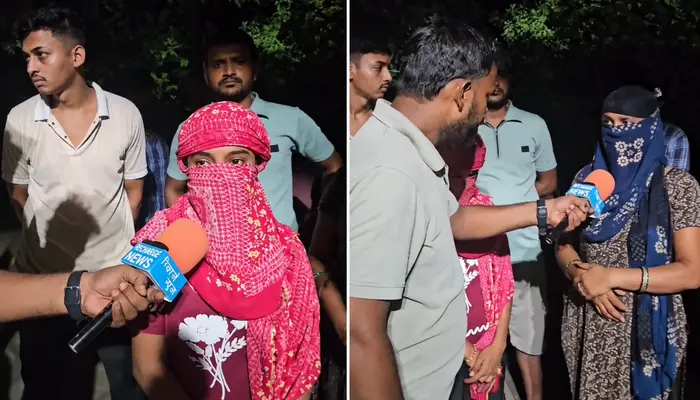
Case Summary
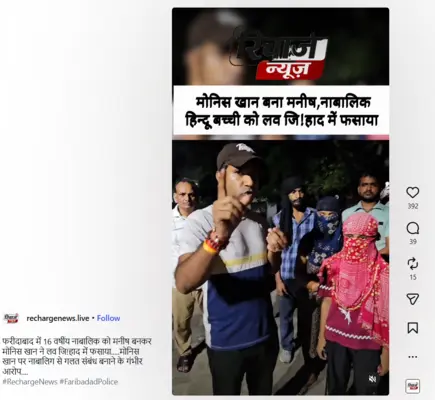
In Faridabad, Haryana, a Hindu minor girl was befriended by a Muslim man, Monish Khan, who pretended to be Hindu by introducing himself under a fake name, Manish. He subsequently converted her to Islam and introduced her to Islamic practices, including the use of the greeting ‘Assalamu Alaikum’. The Muslim man had been in contact with the girl for about a year. According to the police, he had regularly called her and asked her to meet him. During this period, he gave her a mobile phone and threatened her, saying that he would beat or kill her brother if she did not speak to him. The girl said that these threats had trapped her. She identified Khan as a resident of Uttar Pradesh who stayed in the Chungi area of Faridabad. About six months before the family approached the police, the girl’s mother learnt about Khan’s contact with her daughter and went to his home to confront the family. She said that Khan grabbed her younger brother and attempted to assault him, while insisting that they had done nothing wrong. Khan’s elder brother, Salman, later visited her shop and threatened to kill her, her family members and the girl if she tried to harm or assault Khan. Salman also warned the girl’s mother against taking the matter to the police. According to her, he told her that the police were “in his pocket” and that even the Station House Officer was “in his pocket”. He further threatened to kill her if she told anyone that his brother was speaking to the girl. The family remained silent because of these threats. The mother of the girl had approached Salman after learning about Khan, and he had threatened her with death. The matter came to the family’s attention again when the girl’s mother received a call from her school informing her that she had a phone. The family went to the school, where the teachers handed the phone over to them. After checking the device, they learnt how the girl had obtained it and brought her home at around 11:00 am. She remained at home doing household chores until approximately 12:30 pm or 1:00 pm. The girl then went out of sight. Her family did not know where she had gone and searched for her in several places. When they could not find her, they went to the police station. At around 5:30 pm or 6:00 pm, Khan returned the girl home. Afterwards, the girl told her family that Khan had taken her to several locations and sexually assaulted her several times. According to the report, she further told her mother that Khan had pressured her to convert her religion. The family subsequently handed material connected with the case to the police. A social activist said that the girl had been exploited for about a year and knew the routes Khan had taken her on and the places where he had kept her. He also said that Khan had given her a pregnancy test kit, which was handed over to the police along with other material. The police also took up the religious aspect of the case. A community member said that Khan had converted the girl to Islam and had pressured her to learn, saying the Arabic greeting “Assalamu Alaikum”. The community member submitted the material related to the religious-conversion aspect to the Station House Officer. The community member also identified the girl’s mother as belonging to the Rajput community and said that she had been distressed over what had happened to her minor daughter. The account also included threats made by Salman. A resident said that Salman had threatened to shoot a family member in the chest if his brother was sent to jail. The girl’s mother confirmed the threat and said that Salman had threatened to kill her, her husband and her daughter if he learnt about the matter. Following the mother’s complaint, Sector 58 Police Station registered a case against Khan under the Protection of Children from Sexual Offences Act and other relevant sections. Police arrested Khan and produced him before a court, which sent him to judicial custody.
Case Images
Why it is Hate Crime ?
The primary category selected in this case is: Predatory Proselytisation. The subcategory selected is: Proselytisation by grooming, brainwashing, manipulation or subtle indoctrination. The tertiary categories selected are: Rape and sexual assault/harassment and Conversion of minor. Religious brainwashing essentially means the often subtle and forcible indoctrination to induce someone to give up their religious beliefs to accept contrasting regimented ideas. Religious grooming or brainwashing also involves propaganda and manipulation. It involves the systematic effort, driven by religious malice and indoctrination, to persuade “non-believers’ to accept allegiance, command, or doctrine to and of a contrasting faith. Cases of such grooming or brainwashing are far more nuanced than direct threats, coercion, inducement and violence. In such cases, it is often seen that there is repeated, subtle and continual manipulation of the victim to induce disaffection towards their own faith and acceptance of the contrasting faith of the perpetrator. While subtle indoctrination is widely acknowledged as predatory, an element which is often understated in such conversions or in the attempts at such conversion is the role of loyalty and trust which might develop between the perpetrator and the victim. Fiduciary relationships are often abused to affect such religious conversion. For example, an educator transmitting religious doctrine of a competing faith to a Hindu student. The Hindu student is likely to accept what the teacher is transmitting owing to the existence of the fiduciary relationship. The exploitation of the fiduciary relationship to religiously indoctrinate victims would also be included in this category. Since the underlying animosity towards the victim’s faith forms the basis of predatory proselytisation, such cases are considered religiously motivated hate crimes. The other primary category selected is: Crimes against women in relationships and other sexual crimes. The subcategory selected is: Man pretends to be Hindu. The tertiary category selected is: Name Changed. When a non-Hindu man pretends to be a Hindu to deceive a Hindu woman into a relationship, the act is seen as triggered by mala fide intentions. In some cases, the woman eventually accepts the man’s original religious identity and converts after the man’s identity is revealed. These cases could be argued as cases of religious brainwashing and a result of the pressure a woman feels after getting into a relationship with a man. The woman, it can be argued, also changed her religious identity because of the stigma she believes she might face if she chooses to walk out of a deceptive relationship. However, for the purpose of documenting hate crimes, the cases in this subcategory are limited to those where there is explicit violence aimed at religious conversion against the wishes of the victim (force-feeding beef, blackmailing with intimate videos, rape on refusal to convert, etc), or if the woman herself complains of the man’s religious deception. In such cases, it is established that the deception of the non-Hindu man had a specific aim of religious conversion or targeting of the victim due to her Hindu religious identity, therefore making it a religiously motivated hate crime. The other subcategory selected is: Brainwashed and/or groomed. The tertiary categories selected are: Rape and sexual assault/harassment and Conversion of minor. In our database, we have not added incidents where women have converted to another religion of their free will, and no allegations of forced/involuntary conversion have been made. However, there are certain cases of conversion where the consent itself is a result of the brainwashing or grooming of a minor by the non-Hindu perpetrator trying to victimise a woman for her Hindu religious identity. The phenomenon of grooming points to non-Hindu perpetrators identifying their Hindu victims’ vulnerabilities and exploiting them over months and sometimes years to extract the supposed ‘consent’ to convert their religion. In most cases of grooming, the victims are minors or the grooming started when the victim was a minor. In other cases of grooming, the non-Hindu perpetrator brainwashes and grooms a minor victim to extract their trust and then proceeds to rape them repeatedly with the intent of converting them to their faith. It is pertinent to understand here that when the victim is a minor, the ‘consent’ to convert or enter into a romantic relationship with an adult itself is redundant – addressed by POCSO. While every case of conversion of a minor and incidents of establishing a physical relationship with a minor by an adult is a crime, for this database, a case would be considered a hate crime only if there is a distinct religious angle to the grooming. For example, in the UK, if a Hindu minor is targeted by Pakistani grooming gangs, it would be considered a hate crime because the victims are specifically targeted owing to their non-Muslim religious identity with the perpetrators being Muslim. In other cases, if a Hindu minor is brainwashed into entering a physical relationship with the non-Hindu adult perpetrator and the family alleges grooming/brainwashing of the minor to convert her religion, it would form a part of this database. If the victim is a Hindu adult, the case would form a part of this database only if the victim herself says that she was brainwashed/groomed to convert her religion. However, if the victim is deceased (murdered or otherwise), the case would form a part of this database if her family/friends provided testimony that the victim was brainwashed/groomed to convert her religion. Since these crimes have a distinct religious angle where the victim is being targeted owing to her Hindu religious identity, these cases are considered a hate crime. This case involved a Hindu minor girl being specifically targeted after Monish Khan, a Muslim man, pretended to be Hindu and introduced himself as “Manish” to gain her trust. He later converted her to Islam and taught her Islamic practices, including saying “Assalamu Alaikum”. The use of a false Hindu identity followed by an attempt to change the girl’s religious identity represented conduct directed at separating a Hindu minor from her faith and identity. Firstly, the use of a false Hindu identity directly targeted the victim’s Hindu identity. This concealment of his actual religious identity was significant because he had deliberately adopted a Hindu identity to gain the trust of a Hindu child. This was particularly offensive because a Hindu identity was used deceptively as a means to gain access to a Hindu minor and establish her trust. The conduct had therefore misused and misrepresented Hindu identity for a purpose that ultimately involved taking the girl away from her Hindu religious identity. It had not merely involved the use of a false name; it had involved the deliberate appropriation of a Hindu identity to facilitate conduct directed at a Hindu child. Secondly, the conversion of the Hindu minor to Islam, identified by a social activist and community member as part of what had happened to the girl, is an important religious marker. This represented the removal of a Hindu child from her existing religious identity and her movement into another faith. The conduct was an attack on the preservation of Hindu identity, particularly because the religious change had occurred in the context of the relationship and exploitation described in the case. It had not merely affected the girl’s individual religious affiliation; it had also undermined her connection with her Hindu family and community and their ability to preserve and pass on their religious identity. The teaching of Islamic practices reinforced the religious element. Khan was said to have instructed the girl to say “Assalamu Alaikum” and to have taught her other Islamic rituals. The greeting was an Islamic religious expression, and the community member connected its teaching with the broader conversion of the girl to Islam. This formed a significant marker because Islamic practices had been introduced to a Hindu minor in circumstances where her Hindu religious identity was already being displaced. The conduct therefore represented a further step away from her Hindu faith, traditions and cultural upbringing. By teaching her Islamic rituals after establishing contact through a falsely adopted Hindu identity, Khan had not simply interacted with her across religious lines; he had introduced practices associated with another faith into the life of a Hindu minor. Fourthly, the fact that the victim was a minor Hindu girl was an important religious marker because she belonged to the Hindu community while also being a child. Her age made her particularly vulnerable to influence, while her Hindu identity distinguished the religious background from that into which the community member said she had been converted. It is further important to note here that the victim was a minor, which means the element of consent and genuine change of conscience was missing ab initio. Minors, due to their young age and lack of maturity, are particularly vulnerable to manipulation and coercion. They may not have the ability to fully understand the implications of converting to another religion, and the Muslim perpetrator purposely targeted and exploited this vulnerability of the victim. Since this case exemplifies the use of coercion and manipulation to achieve religious conversion, it is a blatant act of religious hate, which is why it has been documented here in the hate tracker. Such actions stem from inherent hostility towards the victim's professed faith since Abrahamic faiths believe that any non-adherent to the faith is subject to being dehumanised till they convert. Such acts were not merely personal crimes; they were rooted in a desire to dominate and erase the religious identity of the victim. Since such predatory actions stem from doctrinal animosity towards the Hindu faith and its adherents, this case is being documented as a religiously motivated hate crime. Disclaimer: The Hinduphobia Tracker records incidents based on when an event occurred or when the victim's ordeal began. It is important to clarify that none of the media sources covering this case has specified the exact date when the incident occurred. Therefore, for documentation purposes, we have recorded the date based on when the incident was reported in the media, 4th September 2026.
Victim Details
Total Victim
1
Deceased
0
Gender
- Male 0
- Female 1
- Third Gender 0
- Unknown 0
Caste
- SC/ST 0
- OBC 0
- General 0
- Unknown 1
Age Group
- Minor 1
- Adult 0
- Senior Citizen 0
- Unknown 0


Case Status
Arrested


Perpetrators Details
Perpetrators
Muslim Extremists
Perpetrators Range
From 2 To 5
Perpetrators Gender
male
 Sources




