Hindu men assaulted and subjected to casteist slurs by Muslim mob for being associated with a Hindu organisation
 Ghaziabad, Uttar Pradesh, India
  1 September, 2026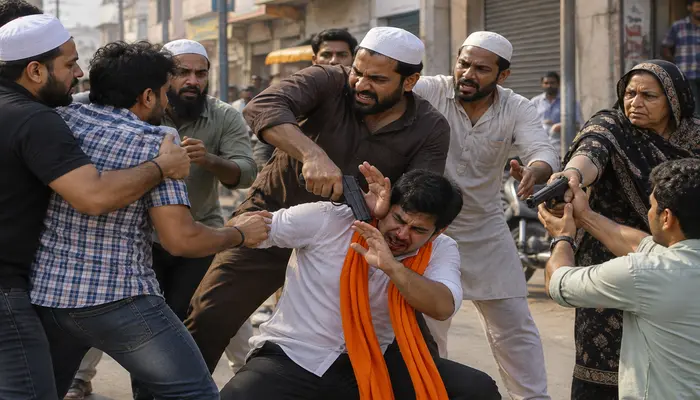
Case Summary
In Ghaziabad, Uttar Pradesh, Hindu men Sumit Sood and his colleague Mohit were beaten by a mob of more than 50 Muslims. The two, who worked for the Hindu Raksha Dal, were targeted after being identified as Hindu activists associated with the organisation. During the assault, the victims were subjected to casteist slurs and had their belongings snatched, while Sumit was struck in the face with the butt of a pistol, leaving him seriously injured and unconscious. The incident took place at around 2:30 pm on 2 September 2026, when Sumit, a resident of Ram Vihar, Loni, and his colleague Mohit were travelling on a motorcycle from Rashid Ali Gate towards the Hindu Raksha Dal office in Indrapuri. Sumit also worked as a chef for a London-based cruise company and had returned home a few days prior to the incident. While they were passing through the area, a car belonging Haji Salman and his brothers was parked on the road. Sumit stopped to speak on his phone when the car honked. A Muslim man identified as Shahnawaz then questioned him, asking whether he was associated with the Hindu Raksha Dal and referring to his video-making activities. Shahnawaz subsequently called his brother, Haji Salman, to the spot. According to Sumit’s complaint, Salman arrived and threatened him, called him by name and hurled casteist slurs at him. He also threatened to send Sumit abroad and told his associates to stop the victims. When Mohit resisted, he was grabbed and beaten. Sumit abandoned his motorcycle and attempted to intervene and save Mohit. During the assault, Sumit’s gold chain, which he had received at his wedding, was broken. When he took out his Samsung Z Fold mobile phone to call the police, the attackers snatched the phone and continued assaulting him. Salman then struck Sumit in the face with the butt of a pistol, knocking him unconscious. Both Sumit and Mohit suffered serious injuries to their heads and noses. A passerby named Gaurav intervened and attempted to rescue the victims. During the confrontation, Gaurav’s three-tola gold chain was also broken. Haji Salman’s mother, identified as Sanjeeda, then brought out a pistol and handed it to Salman, telling him to finish the victims. When Salman pointed the pistol, Gaurav managed to snatch it from him. Salman subsequently assaulted Gaurav and took the pistol back. According to the complaint, the accused and the accompanying mob later continued the assault before police arrived at the scene and rescued the victims. Following the incident, Sumit lodged a complaint at Loni police station naming Haji Salman, Shahnawaz, Kallu, Ved Akram, Sahjeem, Wasim, son of Chajju, Nazim and 50 unidentified Muslims. ACP Loni Ram Kishan said that a case had been registered on the basis of Sumit’s complaint and that the viral video was being examined before further action was taken. Following the assault, Hindu Raksha Dal workers gathered at Loni police station and staged a five-hour sit-in, protesting that the accused had not been arrested at the spot and demanding their immediate arrest. Hindu Raksha Dal national organisational secretary Amit Prajapati warned that if the accused were not arrested soon, the organisation would recite the Hanuman Chalisa at Rashid Ali Gate as a sign of protest. The workers left the police station at around 9 pm. Later that night, Loni MLA Nand Kishor Gurjar visited the police station and said that an attempt was being made to disturb the atmosphere ahead of the elections. He said that he would speak to the Chief Minister regarding bulldozer action against the accused and their properties.
Why it is Hate Crime ?
The primary category selected in this case is: Attack not resulting in death. The subcategory selected is: Attacked for supporting/being part of perceived Hindu party/org or working for Hindu community. In several cases, Hindus are attacked specifically or tangentially for their association with parties or organisations perceived to be pro-Hindu and/or for working in favour of the Hindu community. One of the classic cases was the attack against a Bharatiya Janata Party Yuva Morcha (BJYM) worker Praveen Nettaru. Nettaru was attacked and hacked to death for his association with Hindu organizations and his work for the Hindu community. He was murdered by PFI, a terror organization which aimed to commit a genocide of Hindus, target Hindu leaders specifically and turn India into an Islamic Nation. In such cases, it is possible that the immediate trigger for the violence is non-religious – either according to the perpetrator or the police. However, there are surrounding circumstances from which the conclusion can be reached that the victim was attacked for his association with a Hindu organization. In a similar case, Rinku Sharma was attacked by radicals. He was a member of Bajrang Dal and regularly worked for the Hindu community. While the police cited a different non-religious trigger for the attack, it is true that he was associated to a Hindu organization and the family of Rinku Sharma specifically attributed his gruesome murder to him working for Bajrang Dal and raising Jai Shree Ram slogans. Such cases are intrinsically driven by religious hate and would therefore be documented as a hate crime under this category. The other subcategory selected is: Attacked for opposing radicals or trying to save victim. In several cases, Hindus are attacked for opposing religiously motivated crimes being committed against a fellow Hindu or simply for voicing an opinion opposing radical elements, who either have in the past or continue to persecute Hindus. In such cases, the initial attack against the victim, against which the Hindu was trying to defend the victim, would also need to be classified as a religiously motivated hate crime. Since the initial crime itself was religiously motivated and the subsequent crime of attempting to save the victim or speaking against the radical elements ends up inviting a violent attack, it would also be classified as a religiously motivated hate crime under this category. Another primary category selected is: Hate Speech against Hindus. The subcategory selected is: Anti-Hindu slurs, mocking faith. Anti-Hindu slurs and the deliberate mocking of the Hindu faith owing to religious animosity involve the usage of derogatory terms, stereotypes, or offensive references to religious practices, symbols, or figures. One of the common anti-Hindu slurs used against Hindus is “cow-worshipper” and “cow piss drinker”. The intention of using this term is to demean and mock Hindus as a group and their religious beliefs since Hindus consider the cow holy. Additionally, some symbols and the slurs attached to them have a historical context that exacerbates the insult, hate, stereotyping, dehumanisation and oppression against Hindus. Cow worship has been used for centuries to denigrate Hindus, insult their faith and oppress Hindus specifically as a religious group. There has been overwhelming documentation about how cow slaughter has been used to persecute Hindus with cow meat being thrown in temples and places of worship. There has also been overwhelming documentation where cow meat (beef) has been force-fed to Hindus to either forcefully convert them to Islam or denigrate their faith. Apart from cow worship, the Swastika – which holds deep religious significance for the Hindus – has also been misinterpreted and distorted to use as a slur against Hindus. Similarly, the worship of the Shivling has been used by supremacist ideologies and religions to denigrate Hindus owing to religious animosity. Such slurs and denigration stem out of inherent animosity and hate towards Hindus and their faith, therefore, it is categorised as hate speech targeted at Hindus specifically owing to their religious identity. This incident qualified as a religiously motivated hate crime because the primary trigger for the violence was Sumit’s direct affiliation with the Hindu Raksha Dal. The attackers specifically intercepted him and questioned him about his membership in the Hindu organisation, showing that his association with a group working for the Hindu community was central to the confrontation. By singling him out because of his pro-Hindu affiliation and subsequently subjecting him to threats and violence, the perpetrators demonstrated deep-seated hostility towards pro-Hindu organisations and individuals associated with them. Their animosity towards Sumit’s work and his identification with the Hindu community showed that he was targeted not merely as an individual, but because of his religious identity and his work for the Hindu community, making the attack a clear case of a religiously driven hate crime. Another religious marker in this case is the fact that the victim was subjected to casteist slurs. The religious motive and animosity towards the Hindu victims are indicated by the caste slurs that were hurled at them. It can be argued by some that a caste-specific slur is aimed at the victims' micro identity of belonging to the Dalit section of the Hindu community and not their Hindu identity itself. However, as far as Abrahamic religions are concerned, the micro identities of caste, region, and language are secondary. It is the religious identity that drives the perpetrator's animosity against the Hindu victims. In this case, while the Muslim perpetrators hurled casteist abuses at the victims, the animosity was driven by their animosity towards Hinduism and Hindus, making this an instance of a religiously motivated offence. The attack on Gaurav, who intervened to rescue Sumit and Mohit, further demonstrated the religious hostility underlying the incident. Gaurav was not involved in the original confrontation but was attacked after attempting to protect the Hindu victims from the assault. His intervention was met with violence, showing that even Hindus who sought to resist the targeting of fellow Hindus or prevent them from becoming victims of religiously driven violence were themselves treated as adversaries. This reflected hostility towards those who stood in opposition to the Muslim perpetrators’ actions and attempted to protect members of their own religious community. The fact that Gaurav was also attacked for intervening on behalf of the Hindu victims indicated that resistance to the targeting of Hindus was itself met with aggression, further demonstrating the communal and religious hostility behind the attack. The mobilisation of a large group of approximately 50 Muslims further underscored the communal dimensions of the attack. The fact that around 50 individuals were named in the complaint in connection with the assault indicated that the victims were confronted by a substantial group rather than a lone individual acting impulsively. The rapid gathering of such a large mob suggested that the violence was not merely a spontaneous fit of rage following a minor dispute, but involved collective mobilisation against the Hindu victims because of their religious identity and association with Hindu organisations. The scale and coordinated nature of the attack therefore further demonstrated the communal hostility underlying the incident, making it a clear case of religiously driven hate crime. Since this case meets the parameters of a hate crime, it is being added to the hate crime database of the tracker.
Victim Details
Total Victim
3
Deceased
0
Gender
- Male 3
- Female 0
- Third Gender 0
- Unknown 0
Caste
- SC/ST 2
- OBC 0
- General 0
- Unknown 1
Age Group
- Minor 0
- Adult 3
- Senior Citizen 0
- Unknown 0


Case Status
Complaint registered


Perpetrators Details
Perpetrators
Muslim Extremists
Perpetrators Range
From 10 to 100
Perpetrators Gender
both
 Sources




