Hindus targeted in Kashmir through terror threats, hit lists, doxxing and intimidation, renewing fears of expulsion
 Jammu and Kashmir, India
  22 August, 2026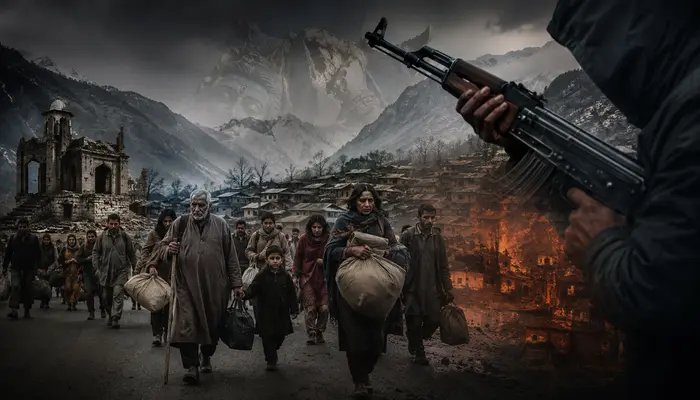
Case Summary
In Jammu and Kashmir, Kashmiri Hindu Pandit government employees were targeted through repeated threat communications, hit-listing, intimidation and the circulation of sensitive personal information. The communications identified Kashmiri Pandits as “white-collar terrorists” and “traitors”, warned that their movements were being watched, and threatened those whom the group accused of supporting the Rashtriya Swayamsevak Sangh agenda in Kashmir. A later communication also warned Kashmiri Pandits over efforts to reopen cases concerning their killings and displacement. The threat letter surfaced during the first week of August 2026, prompting the Jammu and Kashmir Police to tighten security in areas inhabited by Kashmiri Hindu Pandits. Some of these government employees were also allowed to work from home temporarily as a precaution. The communication was issued in the name of the United Liberation Council (ULC), a front associated with the Pakistan-based terrorist organisation Lashkar-e-Taiba (LeT). It contained the names and telephone numbers of several Hindu community members. On 14 August 2026, Farooq Abdullah, chief of the National Conference, called for a thorough investigation into the threat letter. He expressed doubts about its authenticity and sought a comprehensive probe to establish its legitimacy and address the security concerns of Kashmiri Pandits. On 23 August 2026, another threat poster surfaced on social media in the name of the United Liberation Council. The poster contained the names and personal details of Kashmiri Hindu Pandit government employees, including residential addresses and vehicle details. Sunny Raina, a Kashmiri Hindu migrant employee recruited under the Prime Minister’s Special Package and working in the Valley, said the new communication also contained Jammu residential addresses, vehicle numbers and telephone numbers, which had been circulated on social media. Raina said the latest threat had heightened apprehension among employees and their families. He called on security agencies to investigate the source of the information and determine who had provided personal details of Kashmiri Pandit government employees to those behind the threats. He sought permission to work from home as an immediate precaution and, if that was not possible, adequate security outside employees’ residences and workplaces. Raina referred to the 2022 killing of Rahul Bhat, a Kashmiri Pandit government clerk who was shot dead by terrorists inside his office at Chadoora in the Budgam district of Jammu and Kashmir, and said that threat letters had continued since his killing. He estimated that the latest communication was the 36th or 37th threat letter since then. He compared the situation with that of the 1990s, saying the pattern was creating fear among Kashmiri Hindu Pandits and forcing them to consider leaving the Valley. He also sought the deployment of security teams and protection for employees whose names appeared on the threatening posters. Raina also appealed to the Union Ministry of Home Affairs to assess the situation and send a delegation to the Valley to meet Kashmiri Hindu Pandit employees and understand their concerns. He referred to the support and assurance under which the employees had returned to Kashmir. The All PM Package Employees Forum Kashmir submitted a representation to the Chief Secretary of Jammu and Kashmir, seeking enhanced security for Prime Minister’s Package employees posted in the Valley. The forum requested immediate protection and security guidance for employees whose names, addresses or vehicle details appeared in the threat material. It also sought verification of the poster, identification of those responsible and an investigation into the source of the sensitive personal information. The forum said the police or security agencies had not verified the authenticity of the August 23, 2026 poster, but said the repeated circulation of threat letters and posters containing sensitive personal information was a matter of grave concern. It said the matter had already been brought to the notice of police and security agencies for verification and necessary action. Omar Abdullah, Chief Minister of Jammu and Kashmir, described the fresh threat as highly concerning and urged the police and security agencies to take it seriously. Community members subsequently sought increased security from the administration. On 27 August 2026, another ULC communication was issued, this time concerning efforts to reopen cases related to the killings and displacement of Kashmiri Pandits. The letter was signed by Ahmad Bilal, identified as the ULC media coordinator, who described himself as a “Soldier of Resistance”. The communication questioned the reopening of cases and threatened people whom the group described as “traitors”, warning that enhanced security would not guarantee their safety. The August 27, 2026 communication also referred to the 1993 Bijbehara firing and the incidents at Gawkadal, Sopore and Handwara, accusing Indian security forces of killing civilians. It questioned why cases concerning those incidents were not being reopened alongside cases concerning Kashmiri Pandit killings and displacement. Security and intelligence agencies were examining the communication to determine its authenticity, its source, and whether it indicated any specific planned activity. The Prime Minister’s Package under which the targeted employees were recruited was an employment programme for displaced Kashmiri Hindu Pandits intended to facilitate their return and rehabilitation in the Kashmir Valley. Reports stated that 3,000 appointments were made in the initial phase, followed by another 3,000, notably in 2014 and 2017. Further, government data showed that 14 Hindus, including four Kashmiri Pandits, were killed by terrorists in Jammu and Kashmir between 5 August 2019 and 24 March 2022. Separately, 34 people from minority communities were killed in terrorist attacks across J&K between 2017 and 2021, including 11 in 2021.
Why it is Hate Crime ?
The primary category selected in this case is: Hate speech against Hindus. The first subcategory selected is: Doxxing and harassment of Hindu for religious reasons. Doxxing is the act of making available publicly personal, identifiable information of an individual with the intention of compromising their safety, security and privacy. When doxing is done with religious animosity forming the basis of the intention, it often involves severe consequences like loss of employment, physical harm, physical threat, harassment and/or discrimination for the victim’s religious beliefs. Such doxxing also involves projecting the religious beliefs, affiliations, and rituals of the victim, specifically a Hindu, in a manner that can lead to loss of employment, physical harm, physical threat, harassment and/or discrimination. Apart from doxxing, harassment would also include misrepresentation of an individual's views and religious beliefs that would invite abuse, loss of employment, physical harm, physical threat, harassment and/or discrimination owing to religious hate and animosity. There have been several such instances where religious animosity by one section has led to the doxxing and harassment of Hindus. For example, when a Hindu who worked in the UAE commented on the historical persecution of Hindus at the hands of Muslim invaders, his information was leaked online, leading to loss of employment, physical harm, physical threats, harassment and/or discrimination. In another case, a Hindu man’s information was leaked online, leading to violent attacks, after he responded with an emoji to a post about Tipu Sultan, the Islamic tyrant who persecuted Hindus. Such cases are born out of intrinsic religious animosity towards Hindus and therefore would be considered religiously motivated hate speech. The second subcategory selected is: Violent threats. Violent threats, explicit, implicit or implied, are the most dangerous form of hate speech since it goes beyond discriminatory and prejudicial language to express the intent of causing harm to an individual or a group of people based on their religious identity and faith. There could be several different kinds of threats that are issued to Hindus based on religious animosity. An explicit threat would mean a direct threat of violence towards an individual Hindu, a group of Hindus or Hindus at large. Physical violence, death threats, threats of destruction of property belonging to Hindus and threats of genocide would mean explicit threats against Hindus for their religious identity. Implicit threats may not be a direct threat but implied through the use of symbols or actions – for example – in the Nupur Sharma case, other than explicit threats, there were also implicit threats when Islamists took to the streets to burn and beat her effigies. It implies that they want to do the same to Nupur Sharma – thereby is considered an implicit threat. Violent threats can be delivered in person, through letters, phone calls, graffiti, or increasingly through social media and other online platforms. It would be important to understand that a threat – explicit or implicit, online or offline – to an individual who happens to be a Hindu does not qualify as a religiously motivated threat. Such a threat, while vile and dangerous, could be owing to non-religious reasons and/or personal animosity. To qualify as a religiously motivated threat, it would need to exhibit an indication that the individual is being targeted for religious reasons and/or owing to his/her religious identity as a Hindu. This incident stands as a clear instance of religiously motivated hate speech, as perpetrators belonging to the Islamic terror group United Liberation Council (ULC) targeted Kashmiri Hindu Pandits with explicit threats, intimidation, and hit-listing specifically for their Hindu religious identity, thereby showcasing the perpetrators' profound religious animosity. Firstly, the repeated identification of the victims as Kashmiri Hindu Pandits constituted a direct religious marker because Kashmiri Pandits were being targeted specifically as a distinct Hindu community. The threats did not simply concern their employment, individual actions, or personal conduct; they singled out people because they belonged to a Hindu community with a longstanding religious and cultural presence in Kashmir. Their Hindu identity was therefore being turned into a basis for selection, intimidation and hostility. This was wrong against Hinduism because it treated the very existence and identity of Kashmiri Hindus in their ancestral homeland as something to be threatened and suppressed. Targeting Kashmiri Hindu Pandits attacked their right to live openly as Hindus, preserve their community's presence, return to their ancestral land and maintain their religious and cultural identity without fear. Secondly, calling Kashmiri Pandit employees “white-collar terrorists” and “traitors” was a form of religiously directed vilification. These labels were applied to Hindu employees who had returned to the Valley under the Prime Minister’s Package, portraying their presence, employment and return to their ancestral homeland as hostile and illegitimate. The language degraded members of the Hindu community and cast them as enemies rather than as civilians and members of a historically rooted Hindu community. This was wrong against Hinduism because it sought to stigmatise Kashmiri Hindus for their identity and presence in Kashmir, turning their return and participation in public life into grounds for hatred and persecution. By branding Hindu employees as terrorists and traitors, the perpetrators sought to strip them of legitimacy and dignity, portray their presence as something threatening that needed to be opposed, and create an atmosphere in which Hindus were made to feel unwelcome and unsafe in their own ancestral homeland. The references to the Rashtriya Swayamsevak Sangh (RSS) also introduced an explicitly Hindu-associated ideological marker into the threats. The communication warned people who were seen as implementing the RSS agenda in Kashmir and connected their activities with the reason for targeting them. The RSS, as a Hindu social and cultural organisation, has been associated with promoting Hindu cultural identity, social service and the interests of the Hindu community. By portraying the RSS and those associated with it as a hostile force and threatening Hindu employees on that basis, the communication turned a Hindu-associated organisation and its supporters into targets of intimidation. This was wrong against Hinduism because it treated the expression and promotion of Hindu identity as something deserving hostility and punishment. It sought to stigmatise Hindus for supporting Hindu cultural or nationalist causes, thereby attacking their freedom to maintain, express and strengthen their Hindu identity and community presence in Kashmir. Another key marker was opposition to the return and resettlement of Kashmiri Pandits in Kashmir, which carried a direct communal dimension because it targeted the restoration of a Hindu community's presence in the Valley, its ancestral homeland. The threats sought to create fear among Kashmiri Pandits who had returned for employment and rehabilitation, making their continued presence as Hindus a central point of hostility. This was wrong against Hinduism because it sought to prevent Kashmiri Hindus from reclaiming their place in a land deeply connected to their religious, cultural and ancestral heritage. By intimidating Hindu families and employees over their return, the perpetrators sought to make Hindus feel that they had no legitimate place in Kashmir and that returning to live and work there would expose them to danger. Such intimidation undermined the Hindu community's ability to restore its presence, preserve its traditions and live openly in its ancestral homeland. Overall, the incident reflected a sustained pattern of hostility directed at Kashmiri Hindus because of their Hindu identity, extending beyond threats against individual employees to hostility towards their community's return, rehabilitation, cultural presence, ancestral properties and pursuit of justice for past killings and displacement. The use of derogatory labels such as “white-collar terrorists” and “traitors”, the targeting of those associated with Hindu cultural and nationalist activity, and intimidation surrounding the restoration of Kashmiri Pandits' presence and rights demonstrated an attempt to stigmatise, intimidate and marginalise Hindus in their ancestral homeland. The threats therefore affected both the personal security of Hindu individuals and the wider religious identity, dignity and continuity of the Kashmiri Hindu community. Accordingly, this case has been documented in the Hinduphobia Tracker's Hate Crime Database as an instance of religiously motivated hostility directed against Hinduism and the religious identity of the Hindu community.


Case Status
Unknown


Perpetrators Details
Perpetrators
Muslim Extremists
Perpetrators Range
Unknown
Perpetrators Gender
unknown
 Sources




