Hindu temple targeted, idols of revered Hindu deities vandalised in Pahang, Malaysia
 Bentong Town, Pahang, Malaysia
  14 August, 2026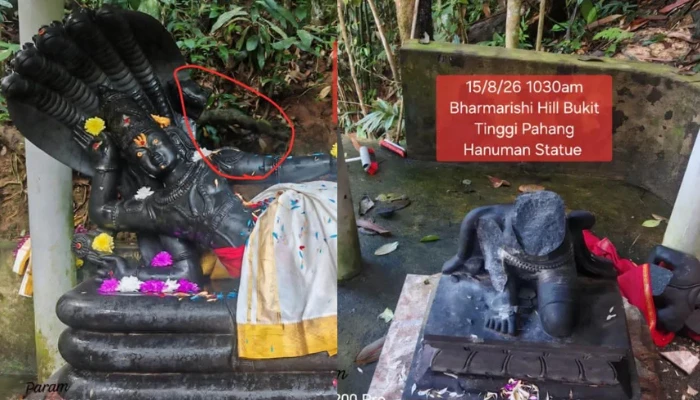
Case Summary
In Bukit Tinggi, Pahang, Malaysia, a Hindu temple on Brahmarishi Hill was vandalised, with the idols of Maha Vishnu, Maha Lakshmi and Lord Hanuman damaged and broken by unknown miscreants. The incident occurred on 15 August 2026 at approximately 10:30 am. Police received three reports concerning the incident on 16 August 2026. The reports were lodged by a 49-year-old security guard, a 45-year-old monk and a 41-year-old man. The incident caused distress among members of the local Hindu community. Police visited the site and found that there were no CCTV cameras installed in the temple area and no independent witnesses who had witnessed the incident. Pahang acting police chief Datuk Azry Akmar Ayob said that police were investigating to determine the cause of the incident and identify those responsible. The case was investigated under Section 295 of the Penal Code and Section 233 of the Communications and Multimedia Act 1998. At the time of writing this report, the police said that investigations remained underway. Police also urged the public not to speculate or spread unverified information, particularly on social media, as this could affect the investigation or cause public concern. Members of the public with information, photographs or videos that could assist the investigation were asked to provide them to the authorities. The temple management and locals appealed for calm and urged people to share information about any suspicious activity or photographs or videos that could help establish the cause.
Why it is Hate Crime ?
This case has been added to the tracker under the primary category: Attack on Hindu religious representations. The subcategory selected is: Attack on Temples. In Hinduism, a temple is the abode of the Deity. The Deity in the Temple is consecrated, thereby making it a real, breathing entity. Hindus believe that not just the Deity but the temple premises themselves are sacred to Hindus since Hindus hold the faith that the entire Temple space is an amalgamation of the divine energy of the deity. Given the central significance of Temples in Hindu Dharma, any attack against a Hindu Temple or its peripheral premises is an attack on the faith itself and is born out of animosity towards the faith, of which the Temple is a central tenet. Any manner of attack against a Temple and/or its premises would therefore be considered a religiously motivated hate crime. The other subcategory selected is: Desecration of Hindu religious symbols. Icons and symbols, or a religious representation of a spiritual ideal, are widely revered in Hinduism. Iconography is of vital significance in the Hindu milieu. It helps connect people’s spiritual beliefs with the real world. Iconography within the Hindu faith takes several shapes and forms. Murtis are of great significance to Hindus, to which daily rituals, prayers and offerings are made. Besides the murtis, there are several other symbols which have deep significance in the Hindu faith – the Om and Swastika, for example. Since these Hindu religious symbols hold paramount importance in Hinduism, any desecration of symbols, icons, murtis, religious representations and manifestations is driven by animosity towards the faith itself, which manifests itself through these murtis, icons and symbols. Therefore, any desecration of these Hindu religious symbols and representations is considered a religiously motivated hate crime under this category. This case was included in the Hinduphobia Tracker because the deliberate desecration of idols of Maha Vishnu, Maha Lakshmi and Hanuman directly targeted sacred Hindu symbols within a Hindu place of worship. Maha Vishnu, Maha Lakshmi and Hanuman are revered as divine figures in Hinduism, and their consecrated idols form an integral part of the Hindu faith. Idols of Hindu deities hold deep religious significance for Hindu devotees, as they serve as sacred representations of the deities and are central to prayers, rituals and worship. Damaging these sacred representations therefore causes religious harm beyond ordinary property damage and directly hurts the sentiments of Hindu devotees. It amounts to a direct desecration of sacred representations of Hindu Gods and Goddesses and violates the sanctity attached to them by devotees. The fact that the idols were desecrated inside a Hindu temple also amounted to an attack on the sanctity of the temple itself, as the temple and its consecrated idols form an interconnected sacred space in Hindu worship. Hindu temples are sacred places dedicated to the worship of deities and serve as important centres of prayer, rituals and religious practice. The sanctity of the idols is therefore closely connected to the sanctity of the temple in which they are installed and worshipped. Desecrating the idols consequently violated not only the sacred representations of the deities but also the sanctity of the temple itself, thereby targeting a place central to the religious life of Hindu devotees. The extent of the damage further demonstrated the hostility involved. The idols were not merely damaged superficially but were broken, with some split into halves, and the destruction affected most of the idols in the temple rather than a single idol. The scale and manner of the damage indicated that the destruction was deliberate rather than accidental or incidental. Moreover, targeting multiple Hindu deities within a temple reflected a conscious disregard for the Hindu faith and its religious symbols. The scale and manner of the damage showed that the perpetrator had no fear of violating a sacred Hindu space and displayed deep hostility towards Hinduism and its practices. At the time of writing this report, although the identities of the perpetrators remained unknown, the nature of the actions showcased deep-seated religious hostility towards Hinduism. Therefore, this case is being added to the hate crime database of the Hinduphobia Tracker.


Case Status
Complaint registered


Perpetrators Details
Perpetrators
Unknown
Perpetrators Range
Unknown
Perpetrators Gender
unknown
 Sources




