Hindu students' faith violated in Shariatpur, Bangladesh; cow meat served as mutton at Institutional event
 Shariatpur District, Bangladesh
  1 September, 2026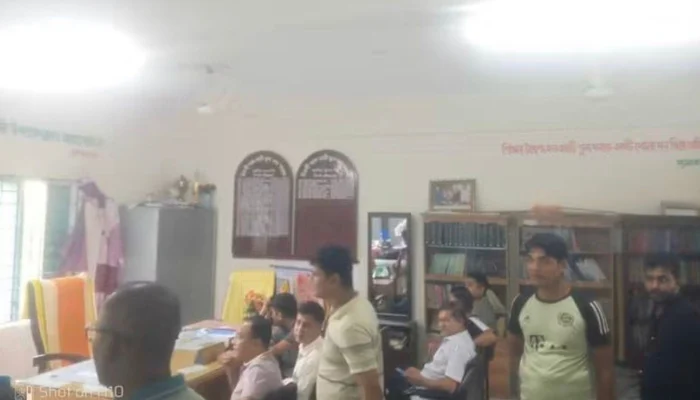
Case Summary
In Shariatpur, Bangladesh, during a school event at Chikandi Saraf Ali School and College, Hindu students were deliberately served beef under the false pretext of being served mutton. According to reports, the programme was attended by the local Member of Parliament, and food was distributed among the participating students. Hindu students consumed the meal believing that it contained mutton, but later learned that they had instead been served beef, directly violating their religious dietary beliefs. After learning that they had been served cow meat, several Hindu students were distressed, while some reportedly fell ill and vomited. The incident sparked anger and anxiety among the students, their families, and members of the local Sanatani Hindu community, particularly because the students had consumed the meat without knowing what it was. For Hindus who refrain from consuming beef because of the sacred status accorded to the cow in Hinduism, being made to consume it through deliberate misrepresentation amounted to a serious violation of their religious beliefs. The incident subsequently came to public attention after a video circulated on social media showing a local delegation visiting the educational institution and confronting teachers over the matter. Those raising objections questioned how Hindu students had been told that they were being served mutton when the food actually contained beef and demanded that responsibility for the preparation and distribution of the meal be established. Questions were specifically raised regarding Head Master Nur Hossain and other teachers connected with the event. Families of the Hindu students demanded that the headmaster, teachers, food preparers, and those responsible for distributing the meals be questioned to determine how the Hindu students were served beef after being given different information about the meat. They maintained that the matter could not simply be dismissed without establishing whether the incident resulted from negligence or whether the Hindu students had been deliberately misled. The families consequently sought an impartial investigation and strict action against those responsible if deliberate wrongdoing was established. Members of the local Hindu community also demanded safeguards to ensure that the religious dietary restrictions of Hindu students were respected within educational institutions and that students were not again placed in a situation where they unknowingly consumed food prohibited by their faith. The incident also led to concerns among some students that the serving of cow meat may have been a deliberate attempt to undermine their religious practices and facilitate conversion to Islam. This incident occurred against the broader backdrop of the historical persecution faced by Hindus in Bangladesh. While the Hindu minority has endured discrimination, targeted violence, and religious hostility over decades, such persecution has intensified in distinct spurts during periods of political and social instability. The latest major escalation began and continued after the ouster of Sheikh Hasina’s government in August 2024, followed by another surge after the death of Sharif Osman Bin Hadi in December 2025, and subsequently in the immediate aftermath of the 13th National Parliamentary Election in 2026. Following the ouster of Sheikh Hasina, multiple incidents involving attacks on Hindu homes, temples and religious institutions were documented, alongside intimidation, arson and mob violence targeting Hindu localities. The Hinduphobia Tracker recorded 336 incidents involving the Hindu minority during this period, reflecting the scale of the escalation and the continuing vulnerability of Hindus in Bangladesh. A further spurt of violence followed the death of Sharif Osman Bin Hadi, a Muslim political activist and student leader known for his anti-Hindu and anti-India rhetoric, in December 2025. In the aftermath, Hindu communities were subjected to retaliatory violence, with Hindu homes and properties selectively attacked and several families forced to flee. Among the victims was Dipu Chandra Das, who was lynched and whose body was subsequently set ablaze by a Muslim mob over false blasphemy allegations. The Hinduphobia Tracker documented 51 incidents of anti-Hindu violence in the period following Hadi’s death alone, further illustrating how existing hostility towards the Hindu minority intensified during moments of communal mobilisation. During the same period, posters and written material calling for the extermination of Hindus were also displayed in public spaces. Such rhetoric, when viewed alongside incidents of arson, vandalism, assault and targeted intimidation, reflected an environment in which hostility towards Hindus was not merely episodic but repeatedly resurfaced in more intense forms during periods of unrest. The most recent escalation followed the 13th National Parliamentary Election in 2026. In the immediate aftermath of the election results, Hindu families in districts including Noakhali, Rangpur, Nilphamari, Sylhet, Thakurgaon and Dinajpur faced attacks involving arson, looting, assault and vandalism of Hindu homes and temples. In several instances, Hindu properties were selectively targeted, and families were threatened with displacement. The present incident therefore occurred within a much longer history of persecution of Hindus in Bangladesh, where hostility towards the community has persisted over time and intensified in repeated spurts. The latest cycle began after the ouster of Sheikh Hasina and continued through subsequent periods of political and communal upheaval, leaving the Hindu minority increasingly vulnerable to targeted violence, intimidation and religious hostility.
Why it is Hate Crime ?
The primary category selected for this case is: Attack not resulting in death. The subcategory selected for this case is: Attacked for Hindu identity. In several cases, Hindus are attacked merely for their Hindu identity without any perceived provocation. A classic example of this category of religiously motivated hate crime is a murder in 2016. 7 ISIS terrorists were convicted for shooting a school principal in Kanpur because they got ‘triggered’ seeing the Kalava on his wrist and the tilak that he had put. In this, the Hindu victim had offered no provocation except for his Hindu religious identity. The motivation for the murder was purely religious, driven by religious supremacy. Such cases where Hindus are targeted merely for their religious identity would be documented as a hate crime under this category. The other category selected is: Predatory Proselytisation. Within this, the subcategory selected is- Proselytisation by grooming, brainwashing, manipulation or subtle indoctrination. Religious brainwashing essentially means the often subtle and forcible indoctrination to induce someone to give up their religious beliefs to accept contrasting regimented ideas. Religious grooming or brainwashing also involves propaganda and manipulation. It involves the systematic effort, driven by religious malice and indoctrination, to persuade “non-believers’ to accept allegiance, command, or doctrine to and of a contrasting faith. Cases of such grooming or brainwashing are far more nuanced than direct threats, coercion, inducement and violence. In such cases, it is often seen that there is repeated, subtle and continual manipulation of the victim to induce disaffection towards their own faith and acceptance of the contrasting faith of the perpetrator. While subtle indoctrination is widely acknowledged as predatory, an element which is often understated in such conversions or the attempts of such conversion is the role of loyalty and trust which might develop between the perpetrator and the victim. Fiduciary relationships are often abused to affect such religious conversion. For example, an educator transmitting religious doctrine of a competing faith to a Hindu student. The Hindu student is likely to accept what the teacher is transmitting owing to existence of the fiduciary relationship. The exploitation of the fiduciary relationship to religiously indoctrinate victims would also be included in this category. Since the underlying animosity towards the victim’s faith forms the basis of predatory proselytization, such cases are considered religiously motivated hate crimes. This case constituted a religiously motivated attack on Hindu students because they were served beef after being told that the meat being provided to them was mutton. The key issue was not simply that the students were served the wrong food, but that they were told they were eating mutton and therefore consumed the meat without knowing its actual identity. The absence of informed choice is central to the religious harm: the students were deprived of the ability to follow their own faith-based dietary practice and were made to violate it without their knowledge. The cow is widely revered in Hindu religious tradition, and avoidance of beef is closely associated with Hindu religious observance, purity and respect for the sacred. Deliberately concealing the identity of cow meat and presenting it as another form of meat therefore carries a meaning far beyond an ordinary food-related dispute. It places a Hindu student in a position where the very act of eating becomes a violation of a religious conviction. The deception is particularly significant because the students would have had no opportunity to refuse the food on religious grounds if they were deliberately misinformed about what they were consuming. The involvement of minors in an educational setting makes the manipulation more serious. Children naturally place a high degree of trust in teachers and other adults responsible for them. Using that trust to expose Hindu students to a practice prohibited by their own faith, while concealing its true nature, functions as a form of subtle religious conditioning. The child is not simply being exposed to another religion; the child is being made to participate in something contrary to his or her own religious practice without informed consent. Repeated conduct of this nature can weaken a child's understanding of the boundaries of their faith and gradually normalise religious conformity. The concern about proselytisation arises from precisely this element of conditioning. Religious conversion does not always begin with an explicit demand to change one's faith. It can also involve gradually normalising practices associated with another religion while making the victim's own beliefs appear unnecessary, outdated, or irrelevant. When Hindu minors are deliberately made to violate a core dietary practice through deception, the conduct can be understood as part of such a process of religious manipulation, particularly where the surrounding circumstances suggest an intention to influence their religious identity. The incident therefore has two connected dimensions. First, the Hindu students' religious identity was targeted by making them unknowingly violate a practice central to their faith. Second, the use of deception against minors created an environment in which a religious boundary was crossed without their knowledge or consent. This combination of religious deception, manipulation of minors, and interference with Hindu religious practice gives the incident its distinctly anti-Hindu character and is why it has been documented under the relevant categories of the Hinduphobia Tracker. Disclaimer: The Hinduphobia Tracker records the incident date based on when the incident actually occurred, rather than the date on which it was subsequently reported or published. However, in this case, the exact date on which the Hindu students were served beef after being told that it was mutton could not be established from the available information. Therefore, 2nd September 2026, the date on which the news outlet reported the incident, has been used as the indicative incident date for documentation purposes only.


Case Status
Unknown


Perpetrators Details
Perpetrators
Muslim Extremists
Perpetrators Range
One Person
Perpetrators Gender
male
 Sources




