Hindus, including minors, targeted for religious conversion through inducements and indoctrination by Christian missionaries in Bihar
 Saran, Bihar, India
  3 August, 2026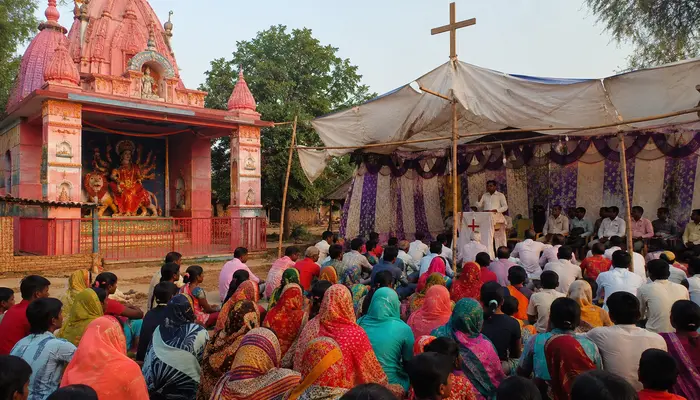
Case Summary
In Saran, Bihar, Hindu residents, including minors, were targeted for forced religious conversion by Christian missionaries. This occurred during a prayer meeting held outside a local Maa Durga temple, referred to as the Bhavani Temple. The victims were offered inducements and indoctrinated with Bible teachings to convert them to Christianity. The incident came to light after a video of the gathering went viral on social media, showing religious conversion activities taking place near the local Durga temple. The video showed a Christian prayer gathering being held where local Hindus were being encouraged to convert to Christianity through temptation, greed, helplessness or a lack of education. The gathering involved Hindu men, women and children, with attendees being provided free meals and Bibles distributed under the Hindi name “Pavitra Shastra”. Those Hindus who were present were also encouraged to attend future prayer meetings. The video further showed an appeal to local Member of the Legislative Assembly (MLA) Vinay Kumar Singh, Member of Parliament (MP) Rajiv Pratap Rudy, various Hindu organisations and the local administration to intervene in the matter. A formal written petition was subsequently shown being drafted, seeking an official inquiry into the gathering and the activities taking place there. The video concluded with a demand for strict legal action against those responsible. The person making the video also clarified that the purpose was not to insult or disrespect any religion, but to ensure that law and order were upheld and that the matter was subjected to a fair investigation.
Why it is Hate Crime ?
The primary category selected in this case is: Predatory Proselytisation. Within this, the subcategory selected is: Conversion/attempts to convert by inducement. Predatory Proselytisation is not limited to threat, harassment, force and violence, but it also has contours of stealth. In several cases, the Hindu victim is exploited to convert, with non-Hindus taking advantage of their poverty. In such cases, the Hindu victim who is suffering financially is offered monetary benefits, including lucrative offers for jobs, health treatment, education, etc, to induce the victim to change his/her religion. In such cases, the religious identity of the victim and the aim to disenfranchise him from his faith form the heart of the crime. Also, taking advantage of and exploiting an individual’s economic vulnerabilities is widely acknowledged as exploitation, forms of which are often penalised by law. Such cases therefore are considered religiously motivated hate crimes since the victim’s religious identity forms the very heart of the crime itself. The other subcategory selected is: Proselytisation by grooming, brainwashing, manipulation or subtle indoctrination. The tertiary category selected is: Conversion of minor. Religious brainwashing essentially means the often subtle and forcible indoctrination to induce someone to give up their religious beliefs to accept contrasting regimented ideas. Religious grooming or brainwashing also involves propaganda and manipulation. It involves the systematic effort, driven by religious malice and indoctrination, to persuade “non-believers’ to accept allegiance, command, or doctrine to and of a contrasting faith. Cases of such grooming or brainwashing are far more nuanced than direct threats, coercion, inducement and violence. In such cases, it is often seen that there is repeated, subtle and continual manipulation of the victim to induce disaffection towards their own faith and acceptance of the contrasting faith of the perpetrator. While subtle indoctrination is widely acknowledged as predatory, an element which is often understated in such conversions or the attempts of such conversion is the role of loyalty and trust which might develop between the perpetrator and the victim. Fiduciary relationships are often abused to affect such religious conversion. For example, an educator transmitting religious doctrine of a competing faith to a Hindu student. The Hindu student is likely to accept what the teacher is transmitting owing to existence of the fiduciary relationship. The exploitation of the fiduciary relationship to religiously indoctrinate victims would also be included in this category. Since the underlying animosity towards the victim’s faith forms the basis of predatory proselytization, such cases are considered religiously motivated hate crimes. This case is a clear example of a religiously driven hate crime because Hindus were specifically targeted for conversion to Christianity through inducements and indoctrination techniques by Christian missionaries. Forceful or coercive conversion violates a person's religious autonomy by interfering with their ability to freely determine, practise and retain their faith. It also undermines the fundamental right to freedom of conscience, which includes the right to choose one's religion and to retain one's existing religious beliefs without coercion or manipulation. In this case, the conversion efforts were directed specifically at members of the Hindu community rather than being a neutral religious interaction involving people of different faiths. The deliberate targeting of Hindus with methods intended to separate them from their existing religious identity therefore amounts to a hate crime rooted in religious hostility. The use of inducements further demonstrates how the socio-economic vulnerabilities of the victims were exploited to facilitate conversion. Providing free meals and other material benefits in the context of an organised conversion effort uses the immediate needs and circumstances of vulnerable individuals as a means of advancing a religious agenda. Instead of allowing individuals to make an independent and informed decision about their faith, the perpetrators targeted their socio-economic realities and presented material assistance alongside efforts to influence their religious beliefs. Such tactics amount to arm-twisting vulnerable victims by exploiting circumstances that leave them more susceptible to accepting inducements in return for participation in conversion activities. The exploitation of economic or social vulnerability for a religious conversion agenda therefore represents a deliberate targeting of disadvantaged members of the Hindu community and demonstrates disregard for their religious autonomy and identity. The indoctrination of Hindu victims through Bible teachings further reinforces the religiously hostile nature of the incident. Bibles were distributed under the Hindi name “Pavitra Shastra”, presenting Christian scripture to Hindu attendees through a culturally familiar term while simultaneously exposing them to teachings intended to influence their religious beliefs. Indoctrination operates by repeatedly introducing individuals to the doctrines, scriptures and practices of another faith with the objective of reshaping their existing religious understanding. In this case, the distribution of Christian scripture was not an isolated religious exchange but formed part of a gathering where Hindu attendees were being encouraged towards conversion. Such systematic exposure to Christian teachings seeks to weaken attachment to the victims' existing Hindu beliefs, introduce doubt about their faith and establish Christianity as the preferred religious alternative. The process therefore targets not merely an individual's religious choice but their existing religious identity and worldview. When such indoctrination is combined with inducements and an organised effort to secure conversion, it constitutes a deliberate attempt to manipulate the religious conscience of Hindu victims rather than allowing them to arrive at an independent and fully informed decision. A conversion produced through such manipulation does not represent genuine freedom of conscience and instead reflects religious hostility directed at the victims' Hindu faith. It's also important to note that the victims included Hindu children. This means the element of consent and genuine change of conscience was missing ab initio. Minors, due to their young age and lack of maturity, are particularly vulnerable to manipulation and coercion. They do not have the ability to fully understand the implications of converting to another religion, and the Christian perpetrators purposely targeted and exploited this vulnerability of the minor victims. Since this case exemplifies the use of coercion and manipulation to achieve religious conversion, it is a blatant act of a religiously motivated hate crime against Hindus. These instances of targeted proselytisation activities stem from inherent hostility towards the victims' professed faith, since Abrahamic faiths believe that any non-adherent to their faith is subject to being dehumanised till they convert, making it a religiously motivated crime against Hindus. Therefore, this case is being added to the hate crime database of the Hinduphobia Tracker. Disclaimer: The Hinduphobia Tracker records incidents based on when an event occurred or when the victim's ordeal began. It is important to clarify that none of the media sources covering this case has specified the exact date when the incident occurred. Therefore, for documentation purposes, we have recorded the date based on when the incident was reported in the media, 4th August 2026.


Case Status
Unknown


Perpetrators Details
Perpetrators
Christian Extremists
Perpetrators Range
Unknown
Perpetrators Gender
unknown
 Sources




