Hindu college girl befriended by Muslim classmate, found disoriented and being made to wear burqa in Vasai-Virar, Maharashtra
 Virar, Maharashtra, India
  31 August, 2026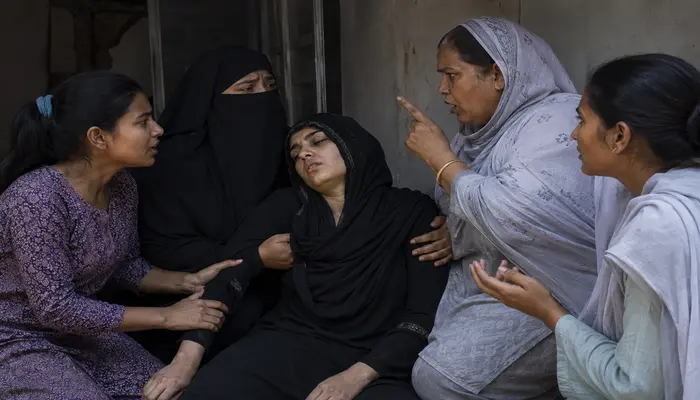
Case Summary
In Vasai-Virar, Maharashtra, a Hindu college student, Sujita Choubey, was found in a semi-conscious and highly disoriented state inside the home of her Muslim classmate, Naushida. The victim was made to wear a burqa by Naushida’s mother. The victim’s friends revealed that Naushida’s mother also hurled abuses at them and threatened them, asking, “How did you dare to enter my area?” The incident came to light after Sujita went missing from college and her family began searching for her. The previous night, Sujita received a phone call from a Muslim man named Mohsin, who asked her to visit the residence. The following day, when Sujita did not return and could not be located at college, her mother and sister began searching for her. Suspecting that she might have gone to Naushida’s house, Sujita’s sister asked her friends to check the residence. When the friends reached the house, they found Sujita inside, dressed in a burqa and in a semi-conscious and incoherent state. According to her friends, Naushida’s mother was forcing Sujita to wear the burqa. Sujita appeared unaware of her surroundings and did not seem to understand what was being asked of her, merely nodding in response to questions without comprehension. Her condition led the friends to suspect that she was being prepared to be taken somewhere. Naushida’s mother and younger sister, who were the only people present at the house at the time, initially prevented the friends from entering. The friends immediately informed Sujita’s sister, who arrived at the residence to take her back. While Sujita’s family and friends were taking her away from the house, Naushida’s mother verbally abused them and questioned how they had dared to enter her area. She also threatened them with consequences if they returned there. Sujita’s family and friends expressed concerns that she had been deliberately targeted and manipulated and that the burqa had been put on her as part of a plan to take her elsewhere. They also raised concerns about the circumstances in which Sujita was found, particularly her semi-conscious and disoriented condition and the fact that she was being made to wear Islamic attire inside the residence. The incident caused outrage among local Hindus, particularly Hindu activists, who condemned the incident and demanded action against those responsible.
Why it is Hate Crime ?
This case is being added to the Undecided database because the available case details do not establish a direct or definitive religious motive behind the crime. Although certain circumstances in the incident raise questions about whether the victim was targeted because she was Hindu, there is currently insufficient evidence to establish that religious hostility was the reason for the incident. The available information primarily establishes that a Hindu girl was found in a semi-conscious and disoriented condition inside the home of her Muslim classmate, Naushida, where she was being made to wear a burqa. According to her friends, the situation appeared to indicate that the girl was being prepared to be taken somewhere while wearing the burqa. Considering the identities of both the victim and the perpetrators involved in the incident, this raises the question of whether the burqa was imposed on her by force because she was a Hindu and whether there was an intention to impose an Islamic identity on her. This possibility becomes relevant because there have been multiple cases in which Hindu women have been targeted by Muslims in circumstances involving forced conversion, religious coercion and the imposition of Islamic practices or attire. Therefore, when a Hindu woman is found in a Muslim household in a semi-conscious and disoriented condition while being made to wear a burqa, it is reasonable to examine whether the act had a religious component. At the same time, the available evidence does not establish that the burqa was imposed specifically because the victim was Hindu, nor does it establish that there was an intention to convert her to Islam. The incident therefore raises a legitimate religious suspicion, but that suspicion cannot by itself establish a religious motive. Another circumstance that raises communal suspicion is the territorial language and abusive behaviour attributed to Naushida’s mother when the victim’s friends arrived at the residence. While the family and friends were taking the victim away, Naushida’s mother questioned how they had dared to enter her area and threatened them with consequences if they returned. Such statements raise questions about whether the woman viewed the locality in communal or territorial terms. This is relevant because there have been numerous instances in which Hindus have been threatened or prevented from entering, passing through or living in areas described as Muslim-dominated. In that broader context, a statement such as “How did you dare to enter my area?” can raise suspicion about whether the hostility shown towards the victim’s Hindu friends had a communal dimension. However, the statement alone does not establish that the woman was acting out of hatred towards Hindus. The phrase could also have been used as a general territorial or confrontational threat unrelated to religion. Therefore, while this behaviour adds to the communal suspicion surrounding the case, it does not provide conclusive proof of a religious motive. However, it was also possible that the incident had no religious motive and was instead a crime of opportunity involving the attempted concealment and removal of the victim. The burqa could have been used simply as a means of disguising the victim’s appearance so that she could be taken somewhere without being recognised. If that was the purpose, the use of the burqa would have been connected to concealment rather than religious conversion, religious hostility or the imposition of an Islamic identity. This possibility is particularly important because the available information does not establish where the victim was supposed to be taken or why she was being made to wear the burqa. Furthermore, the victim herself had not provided a statement establishing that she was forcibly made to wear the burqa because she was a Hindu or that anyone intended to convert her to Islam. Her semi-conscious and disoriented condition also meant that the circumstances surrounding the incident remained unclear. Therefore, although the religious angle could not be dismissed, the possibility of a non-religious criminal motive also remained significant. For these reasons, the case could not be definitively classified as a hate crime at the current stage. Hinduphobia Tracker follows strict parameters for documenting an incident as a hate crime, and the presence of Muslim perpetrators and a Hindu victim, by itself, was not sufficient to establish religious motivation. Therefore, at the stage of documentation, this case will remain in the Undecided database. If further information emerges that the crime was rooted in religious animosity, it would be transferred to the hate crime database of the tracker. Disclaimer: Hinduphobia Tracker records incident dates based on when the crime occurs rather than when it is reported by the media. However, in this case, the exact date on which the incident occurred was not known. Therefore, 1 September 2026, the date on which details of the incident went viral on social media, is being recorded as the incident date. This date is being recorded for documentation purposes only and does not indicate that the crime itself occurred on 1 September 2026.
Victim Details
Total Victim
1
Deceased
0
Gender
- Male 0
- Female 1
- Third Gender 0
- Unknown 0
Caste
- SC/ST 0
- OBC 0
- General 0
- Unknown 1
Age Group
- Minor 0
- Adult 0
- Senior Citizen 0
- Unknown 1


Case Status
Unknown


Perpetrators Details
Perpetrators
Muslim Extremists
Perpetrators Range
From 2 To 5
Perpetrators Gender
both
 Sources




