Hindu man assaulted and threatened at gunpoint by his Muslim girlfriend's family over their interfaith relationship
 Moradabad, Uttar Pradesh, India
  30 August, 2026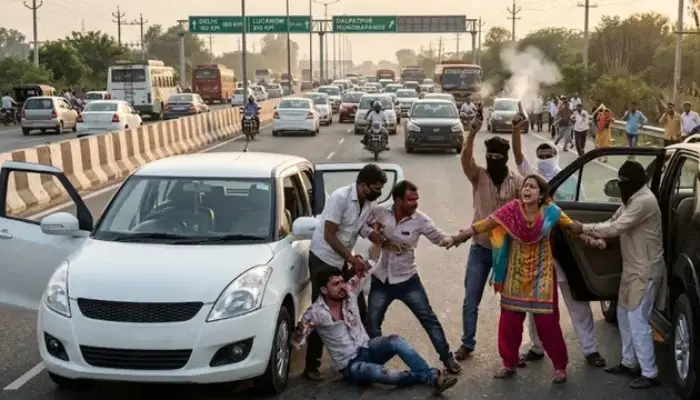
Case Summary
In Moradabad, Uttar Pradesh, a Hindu man named Raj Kumar was attacked and threatened at gunpoint by the family members of his Muslim partner, Nazia, over their interfaith relationship. This incident occurred while the couple was travelling towards Rampur after completing legal formalities concerning their relationship at the Moradabad court. According to media reports, Nazia, a resident of Pattikala Ghosipura in the Swar area of Rampur, had been in a relationship with and living with Raj Kumar, a resident of Bharatpur Dadhiyal in the Tanda area. They were in a relationship for around one to two years. Raj Kumar told police that the couple had been living together like husband and wife. After Nazia’s family learnt about the relationship, they began restricting her movements and subsequently started searching for her. On 27 August 2026, Nazia left her family home and went to Raj Kumar, following which her father approached the Swar police station. On 31 August 2026, Raj Kumar and Nazia travelled to the Moradabad court, where documents concerning their live-in relationship were prepared. They subsequently travelled towards the Swar police station so that Nazia could record her statement. Raj Kumar was accompanied in the car by his relatives and associates, including Vivek Saxena, Satpal, Ompal and Pramod. As their vehicle reached the Dalpatpur area under the jurisdiction of Moondapande police station, near a petrol pump on the Delhi-Lucknow highway/Dalpatpur-Aliganj route, several vehicles began following them. According to Raj Kumar’s complaint, around 10 to 12 people in vehicles followed the car and eventually surrounded it from the front and rear near the petrol pump. The assailants opened fire with country-made pistols, causing panic on the road and bringing traffic to a halt. People near the petrol pump also came out after hearing the gunfire, while commuters gathered at the spot. After the vehicle was stopped, Nazia’s father Tasleem and her brothers Danish and Bilal pointed a gun at Raj Kumar and threatened him that if he wanted to remain alive, he should hand Nazia over to them. When Raj Kumar refused and attempted to prevent them from taking Nazia, the assailants forcibly pulled her out of the car. Raj Kumar, his maternal uncle and the other men travelling with him resisted and were assaulted. Raj Kumar also revealed that the assailants fired at them with country-made pistols during the confrontation. The attackers vandalised the vehicle during the assault. The assailants then forcibly placed Nazia in another vehicle and drove away towards Aliganj. Raj Kumar and his companions informed the police immediately after the attackers left. Police personnel reached the location, gathered information and pursued the fleeing vehicles, but the group had already escaped with Nazia. The gunfire and armed confrontation created panic among commuters and people present near the petrol pump, with vehicles temporarily stopping on the route. Raj Kumar subsequently submitted a written complaint at Moondapande police station. Police registered a case against Tasleem, Danish, Bilal and 10–12 other people under provisions relating to abduction and attempt to murder and began searching for the accused and Nazia. SP City Kumar Ran Vijay Singh confirmed the registration of the case, while CO Highway Varun Kumar stated that further action would be taken on the basis of the police investigation. Raj Kumar was also associated with a Hindu organisation. Following the attack and Nazia’s forcible removal, he informed members of the organisation, who gathered at Moondapande police station and demanded immediate police action. When registration of the case was delayed, the members protested and created a commotion at the police station. The protest ended after police registered the case and assured them that efforts were underway to locate Nazia and apprehend those involved.
Why it is Hate Crime ?
The primary category selected for this case is: Men attacked for being associated with non-Hindu women. The subcategory selected is: Attacked by a non-Hindu partner/or her family. When Hindu men are in a relationship with non-Hindu women, there are cases where the man is forced to convert his religion, and upon his refusal to do so, the partner or/and her family attacks the victim. Such relationships may be consensual, with the religious identity of the non-Hindu woman known to the victim. Somewhere along the relationship, the non-Hindu woman or her family starts forcing/pressurizing the Hindu man to convert. In some of these cases, the association could be non-consensual as well, or the religious identity of the non-Hindu woman could be previously unknown to the Hindu victim. In such cases, the Hindu man is first forced/pressurized to change his religion by the non-Hindu woman or her family. The force/pressure could involve threats. The trigger for directing violence against the Hindu man is, in these cases, his refusal to comply and change his religion under threat and/or force. In other cases that have been documented, it is also seen that the Hindu partner is assaulted by the non-Hindu woman or her family simply for his relationship with the non-Hindu woman and by virtue of him following the Hindu faith and not the religion of the non-Hindu woman. In such cases, the relationship is consensual in most cases, and the religion of both partners is known to the other. Often, in such cases, there is no direct force/pressure to convert either; however, the attack is a result of the Hindu man being in a relationship with the non-Hindu partner and not following her religion/following Hinduism specifically. Such cases are driven by specific religious motivations and against the religious identity of the victim and are therefore qualified as hate crimes. In this case, a Hindu youth was attacked and threatened at gunpoint by members of the family of his Muslim partner, who was forcibly taken away from him. The family members opened fire, assaulted the Hindu man and those accompanying him, vandalised their vehicle and threatened the Hindu man that he would be killed if he did not hand over the Muslim woman. Since the motive for the crime isn't laid out explicitly, people may argue that it is possible that the crime was not motivated by religion, and as such, it should not be included in this tracker. Therefore, at this point, it becomes essential to understand why we have added this case to the hate crime database. In this case, two primary factors establish that it was a religiously motivated hate crime. The first component that makes it worthy of being documented as a religiously motivated hate crime is the testimony of the Hindu victim himself. The Hindu man himself testified that members of his Muslim partner's family attacked him and threatened him with firearms when he refused to hand over his Muslim partner. The second component is the nature of the crime itself. The Hindu man was attacked by members of the Muslim woman's family specifically in the context of their relationship, and the perpetrators resorted to firing, death threats, assault, and forcibly taking the woman away from him. In several cases where a Hindu man is in a relationship with a Muslim woman, the family of the Muslim woman ends up assaulting or attacking the man because of their disapproval of the relationship. In such cases, the relationship is consensual, and the man and woman are with each other, knowing each other's identity fully well. Such cases are often called ‘honour- related crimes' and are seen in associations across religions, castes, economic strata, etc. In several such cases, the motivations for the violence or murder are stated and clear. For example, in some cases, the perpetrators would clearly mention what their main motivation to commit the crime was, whether it was because the partner was economically weaker, from a different caste or religion. In some cases, however, the motives are not stated and/or reported. To determine whether such cases are religiously motivated hate crimes, in the absence of a clearly stated motive, one has to understand what could possibly be the main factor that the perpetrators perceive as diminishing the family’s ‘honour’ and thereby leading to the crime. For the purpose of this tracker, we would only be looking at cases where one of the determining factors of the crime is religion, which is to say that the man belongs to the Hindu faith and the woman to a non-Hindu faith. In such cases, even if the motivation is not stated, it can be said that the determining factor or at least one of the main considerations, leading to the crime would be the religious identity of the Hindu man, especially if the woman in the relationship is a Muslim. In the Islamic faith, any sort of relationship or marriage is deemed illegitimate if the non-Muslim partner does not convert to Islam. For those who practice the faith, when the Muslim woman in their family is in a relationship or marriage with a Hindu man without the man converting to Islam, the difference in religions followed becomes the main point of disapproval for the family of the Muslim woman. Because of the ingrained element of religious supremacy in Islam, even if the motivations are not explicit, it can reasonably be concluded as one of the determining factors of the assault committed by the Muslim family against the Hindu man. In this case, the attack on Raj Kumar in Moradabad, Uttar Pradesh, is an instance of a hate crime targeting a Hindu man for being in a relationship with a Muslim woman. Raj Kumar and Nazia were in a consensual relationship, but he was subsequently attacked by members of Nazia's family. As per Raj Kumar, Nazia's father and brothers, along with other members of her family, attacked him and forcibly took Nazia away from him. The family directly targeted the Hindu man in the context of his relationship with the Muslim woman, highlighting the communal angle and suggesting that Raj Kumar was targeted because of his Hindu identity and his relationship with a Muslim woman. Such incidents, where Hindu men are attacked by the family of a Muslim woman because of their relationship or marriage, are deeply rooted in religious disdain, disapproval, and hatred towards the Hindu man because of his religious identity. Therefore, this case warrants inclusion in the hate crime database. Disclaimer: Although Raj Kumar was the primary victim in this case, other members of his group were also assaulted during the attack. These included Vivek Saxena, Satpal, Om Pal, Pramod and Raj Kumar’s maternal uncle. Therefore, while Raj Kumar was the main Hindu victim targeted in the incident, the total victim count includes all six individuals who were assaulted. Accordingly, the total victim count for this case is 6.
Victim Details
Total Victim
6
Deceased
0
Gender
- Male 6
- Female 0
- Third Gender 0
- Unknown 0
Caste
- SC/ST 0
- OBC 0
- General 0
- Unknown 6
Age Group
- Minor 0
- Adult 6
- Senior Citizen 0
- Unknown 0


Case Status
Complaint registered


Perpetrators Details
Perpetrators
Muslim Extremists
Perpetrators Range
From 10 to 100
Perpetrators Gender
male
 Sources




