Hindu woman lured through superstition, sexually assaulted, pressured to convert to Islam and wear burqa by Muslim man posing as Hindu
 Shajapur, Madhya Pradesh, India
  2 July, 2026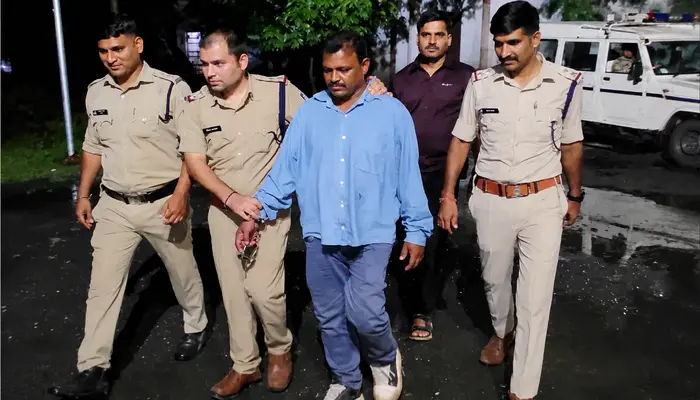
Case Summary
In Shajapur, Madhya Pradesh, a 39-year-old Hindu woman working as a nurse was pressured to convert to Islam and wear a burqa by a Muslim man who pretended to be Hindu. The accused, identified as Shakir, had introduced himself as Raju to gain the woman's trust. The victim was also subjected to sexual assault, fraudulent rituals, blackmail, intimidation and extortion. The Hinduphobia Tracker team contacted Lalghati Police Station in Shajapur, where a police officer confirmed that the victim was a Hindu. On 3 July 2026, the woman met Shakir, 44, a resident of Badawad/Badavad village in Ujjain district, during a train journey from Jabalpur to Shajapur. He introduced himself as Raju and presented himself as someone knowledgeable in esoteric and occult practices. He gained her confidence by telling her that her in-laws had performed black magic against her family and warning her that the family could face misfortune and harm. He then obtained her mobile number. On 4 July 2026, Shakir went to the woman's rented house in Shajapur. Under the pretext of removing black magic and conducting a religious or occult ritual, he told her to remove her clothes so that he could prepare a sacred thread. The woman complied out of fear, following which he sexually assaulted her. He also took her body measurements and prepared a thread or amulet as part of the purported ritual. A few days later, Shakir told the woman that the supposed black magic could only be removed if she established sexual relations with him. He then recorded an obscene video of her and threatened to circulate it. Using the video as leverage, he repeatedly blackmailed and intimidated her, demanded money from her and sexually assaulted her on multiple occasions. He subsequently took her to the Hussain Tekri shrine in Jaora and to Ajmer, where the sexual abuse continued. During this period, he made her wear a burqa and pressured her to convert to Islam, particularly while they were in Ajmer. On 16–17 July 2026, Shakir brought another male associate into the sequence of events. He told the woman that she would have to establish sexual relations with another man to eliminate the supposed curse. He brought the associate to her room, where the two men sexually assaulted her and recorded obscene videos. The second accused later remained absconding as police searched for him. Shakir also extorted money and valuables from the woman. He took approximately ₹4.10 lakh in cash, a gold mangalsutra and later her Activa scooter. He persuaded her to hand over the money on the pretext of purchasing a bus in his own name as part of the purported ritual. He subsequently took away her scooter along with its documents and demanded another ₹50,000. He threatened to upload the obscene videos on social media if she refused to comply with his demands. On 21 July 2026, Shakir was present at the woman's rented house when two of her female nurse colleagues were also there. The woman had previously shared details of her ordeal with the two junior colleagues. Shakir subjected the two women to indecent behaviour and attempted obscene acts towards them. They resisted and escaped from the premises. The two women did not immediately report the incident and remained silent for around a week. On 29 July 2026, the two nurse colleagues approached the police and informed them about the incident. Police subsequently called the woman to the police station. She initially did not disclose the complete sequence of events. After police counselled her and assured her that action would be taken, she broke down and detailed the incidents. Police registered a case under Sections 70(1), 64(2)(m), 318(4), 308(2), 351(3) and 75(2) of the Bharatiya Nyaya Sanhita. The charges covered offences including repeated rape, aggravated rape, fraud, extortion, criminal intimidation and sexual harassment. Following the registration of the case, Shajapur Superintendent of Police Priyanka Shukla directed Lalghati Police Station in-charge Arjun Singh Mujalde to form a team to locate the principal accused. Police conducted a search operation and arrested Shakir alias Raju Shah within approximately 15 hours of the case being registered. He was taken into custody for questioning about the sequence of events, after which police intended to produce him before the court and seek his remand. Shakir was described in one report as a private bus operator. Police said that he was married and had three children. Police recovered ₹4.46 lakh in cash, a scooter valued at approximately ₹90,000, a mobile phone, the woman's driving licence, other articles and photographs showing her wearing a burqa. However, another report stated that police recovered ₹3.48 lakh out of the ₹4.10 lakh that Shakir had taken from the woman, along with a two-wheeler. The woman also recorded her statement before the court/magistrate. Police continued investigating the identity and role of the second accused, including his involvement in the sexual assault, extortion and recording of obscene videos. The accusations made by the complainant remained subject to judicial examination.
Why it is Hate Crime ?
The primary category selected in this case is: Crimes against women in relationships and other sexual crimes. The subcategory selected is: Man pretends to be Hindu. The tertiary category selected is: Name changed. When a non-Hindu man pretends to be a Hindu to deceive a Hindu woman into a relationship, the act is seen as triggered by malafide intentions. In some cases, the woman eventually accepts the man’s original religious identity and converts after the man’s identity is revealed. These cases could be argued as cases of religious brainwashing and a result of the pressure a woman feels after getting into a relationship with a man. The woman, it can be argued, also changed her religious identity because of the stigma she believes she might face if she chooses to walk out of a deceptive relationship. However, for the purpose of documenting hate crimes, the cases in this subcategory are limited to those where there is explicit violence aimed at religious conversion against the wishes of the victim (force-feeding beef, blackmailing with intimate videos, rape on refusal to convert, etc), or if the woman herself complains of the man’s religious deception. In such cases, it is established that the deception of the non-Hindu man had a specific aim of religious conversion or targeting of the victim due to her Hindu religious identity, therefore, making it a religiously motivated hate crime. The other subcategory is: Brainwashed and/or Groomed. The tertiary categories are: Victim says was brainwashed/groomed, Rape and sexual assault/harassment. In our database, we have not added incidents where women have converted to another religion of their free will and no allegations of forced/involuntary conversion have been made. However, there are certain cases of conversion where the consent itself is a result of the brainwashing or grooming of a minor by the non-Hindu perpetrator trying to victimise a woman for her Hindu religious identity. The phenomenon of grooming points to non-Hindu perpetrators identifying their Hindu victims’ vulnerabilities and exploiting them over months and sometimes years, to extract the supposed ‘consent’ in order to convert their religion. In most cases of grooming, the victims are minors or the grooming started when the victim was a minor. In other cases of grooming, the non-Hindu perpetrator brainwashes and grooms a minor victim to extract their trust and then proceeds to rape them repeatedly with the intent of converting them to their faith. It is pertinent to understand here that when the victim is a minor, the ‘consent’ to convert or enter into a romantic relationship with an adult itself is redundant – addressed by POCSO. While every case of conversion of a minor and incidents of establishing a physical relationship with a minor by an adult is a crime, for the purpose of this database, a case would be considered a hate crime only if there is a distinct religious angle to the grooming. For example, in the UK, if a Hindu minor is targeted by Pakistani grooming gangs, it would be considered a hate crime because the victims are specifically targeted owing to their non-Muslim religious identity with the perpetrators being Muslim. In other cases, if a Hindu minor is brainwashed into entering a physical relationship with the non-Hindu adult perpetrator and the family alleges grooming/brainwashing of the minor to convert her religion, it would form a part of this database. If the victim is a Hindu adult, the case would form a part of this database only if the victim herself says that she was brainwashed/groomed to convert her religion. However, if the victim is deceased (murdered or otherwise), the case would form a part of this database if her family/friends provided testimony that the victim was brainwashed/groomed to convert her religion. Since these crimes have a distinct religious angle where the victim is being targeted owing to her Hindu religious identity, these cases are considered a hate crime. In this case, the Hindu woman was deceived into establishing a connection with a Muslim man pretending to be Hindu. The perpetrator introduced himself as Raju and used this false identity to gain the victim's trust. After this, she was sexually exploited and then was pressured to convert to Islam and wear a burqa. Firstly, the perpetrator's act of deception by posing as a Hindu itself demonstrates a clear bias and malicious intent towards the victim’s religion. By hiding his true identity, the Muslim man manipulated the Hindu woman's trust and targeted her under false pretences, indicating a premeditated effort to exploit the woman based on her religious background. Additionally, establishing a connection under a false Hindu identity legitimised the relationship in the eyes of the woman and enabled the perpetrator to gain access to and influence her. This constituted a direct violation of her right to make informed choices about whom she chooses to associate with, as well as an infringement upon her religious beliefs. Thus, the perpetrator’s deliberate decision to hide his religious identity strongly underscores the religious motive behind this crime. In such instances, identity concealment is not just a deceptive tactic for personal reasons but a calculated strategy rooted in religious profiling and targeting. The accused was aware that the victim, being Hindu, would likely refuse to trust or engage with him if she knew his real identity, and he circumvented this by lying, which directly points to a religiously driven intent. This deception reflects a larger pattern where Hindu women are specifically singled out using false identities, often with coercion or conversion in mind. Such targeted victimisation based on religion not only demonstrates a fundamental disregard for Hinduism but also exposes a deeper animosity toward Hindus and their beliefs. The perpetrator established control over the victim through superstition and psychological manipulation. He brainwashed her by telling her that her in-laws had committed black magic against her family. He used the fear created by these claims to establish psychological and mental control over her. He then exploited this vulnerability to sexually assault her repeatedly, violating her bodily autonomy. He further used this control to pressure her to convert to Islam and wear a burqa. Here, it is important to state that the repeated sexual assault that the victim was subjected to showcased the deep-seated hostility motivating this crime. The sexual violence was not merely an act of sexual gratification. It was carried out in a manner that selectively targeted, violated and humiliated a Hindu victim because of her religious identity. In this case, sexual violence was also used to break her spirit and make her more vulnerable to the perpetrator's control. He further manipulated her through superstitious claims, making her increasingly vulnerable to conversion. This showcased the religiously driven nature of the sexual violence and amounted to religiously motivated rape. The fact that the victim was subjected to sexual violence several times by the perpetrator himself and by other men further showcased the dehumanising manner in which she was treated because of her Hindu identity. This made the sexual violence religiously driven in nature. The fact that the victim was taken to several Islamic shrines and was subsequently pressured to convert to Islam further showcased deep-seated religious animosity. When conversion is not undertaken out of free and informed conviction but through force, coercion and psychological manipulation, it showcases deep-seated religious hostility. It violates the victim's religious autonomy and her fundamental right to practise her faith. This overall amounted to a hate crime because the perpetrator treated the victim's existing faith as something that had to be discarded through force, coercion and psychological manipulation. The attempt to replace her Hindu faith with Islam through such means therefore demonstrated the religiously driven nature of the crime. The fact that the victim was also forced to wear a burqa further showcased religious animosity. The burqa, being a garment associated with Islamic religious and cultural practices, represented the imposition of an Islamic way of life upon the Hindu victim. The fact that she was forced to wear it demonstrated how the psychological manipulation and coercion were working gradually to introduce Islamic customs and practices into her life, including her manner of dress. This showcased the extent of control and religious coercion to which the victim was subjected, making it a clear case of a religiously driven hate crime. The overall blackmail, coercion and financial exploitation to which the victim was subjected further intensified the severity of the abuse and its psychological consequences. The perpetrator used obscene videos, threats and financial demands to maintain control over the victim and prevent her from resisting or escaping the abuse. These acts of intimidation and exploitation compounded the religious coercion she faced. The same control was used to subject her to sexual violence, pressure her towards conversion and impose Islamic practices upon her. The cumulative nature of this exploitation therefore further demonstrated the coercive and religiously hostile circumstances in which the victim was targeted, contributing to the overall character of the crime as a religiously driven hate crime. Since this case meets the parameters of a hate-driven offence, it is being added to the hate crime database of the Hinduphobia Tracker. Disclaimer: In this case, although the main perpetrator was Shakir, another perpetrator also sexually assaulted the victim under the pretext of curing a curse. Therefore, the perpetrator count was recorded as two for documentation purposes only.
Victim Details
Total Victim
1
Deceased
0
Gender
- Male 0
- Female 1
- Third Gender 0
- Unknown 0
Caste
- SC/ST 0
- OBC 0
- General 0
- Unknown 1
Age Group
- Minor 0
- Adult 1
- Senior Citizen 0
- Unknown 0


Case Status
Arrested


Perpetrators Details
Perpetrators
Muslim Extremists
Perpetrators Range
From 2 To 5
Perpetrators Gender
male
 Sources




