Bangladeshi Hindu activist targeted for fighting for Hindu rights; Muslim journalist makes obscene remarks invoking sexual violence
 Bangladesh
  29 August, 2026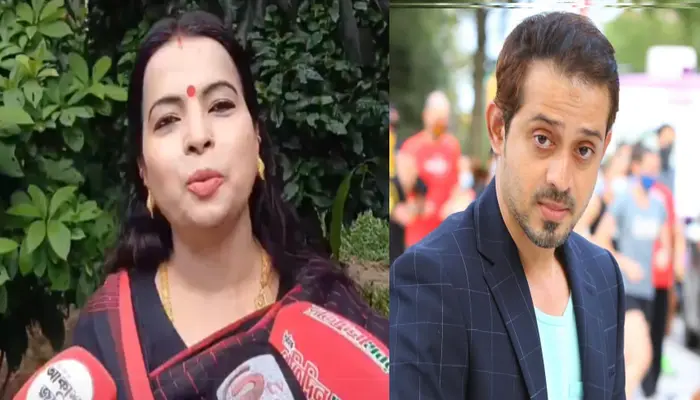
Case Summary
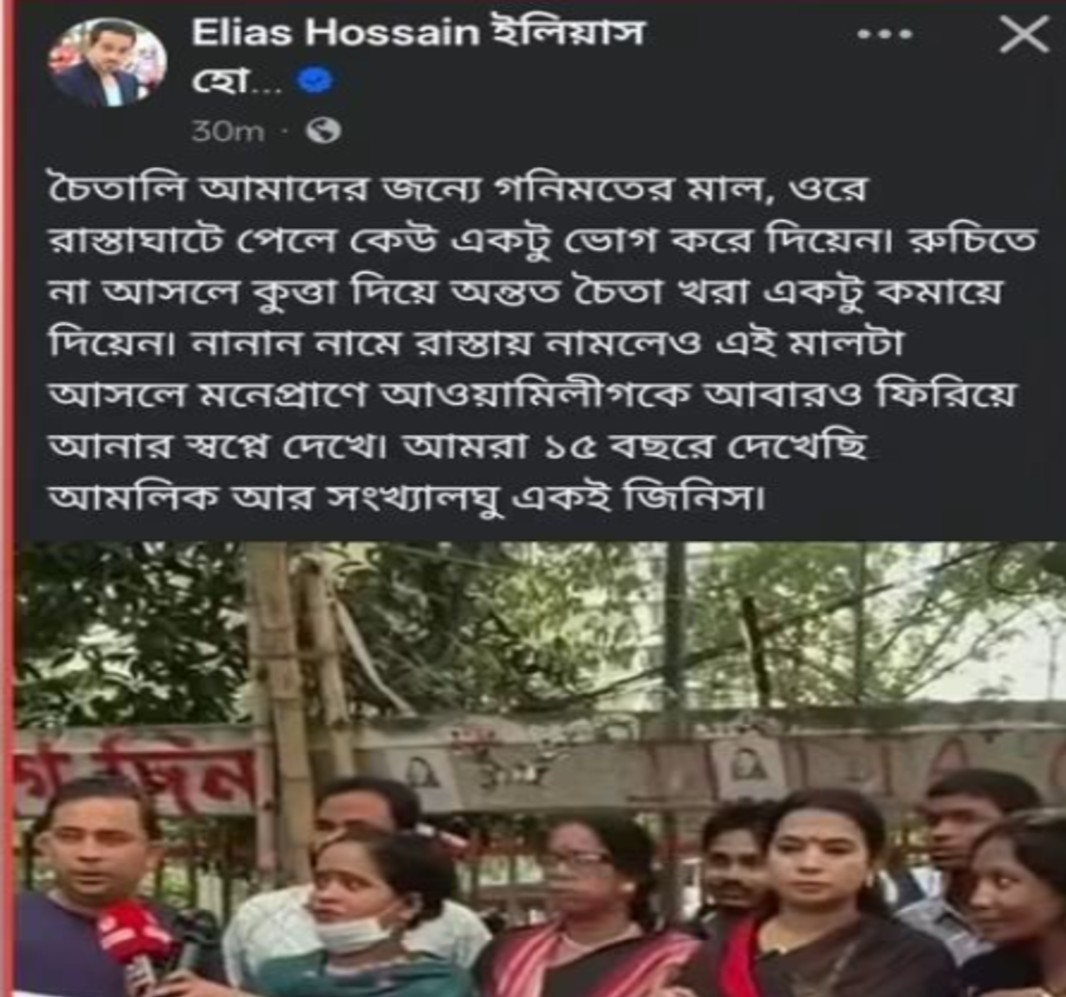
Bangladeshi Hindu lawyer and human-rights activist Chaitali Chakraborty was targeted with sexually abusive and misogynistic remarks by a Muslim journalist, Ilias Hossain, on social media. A screenshot of Hossain’s Facebook post circulated widely and drew criticism for its obscene language and threats of sexual violence against Chakraborty. In the Facebook post, Hossain described Chaitali Chakraborty as “war booty” and made a direct sexual reference to assaulting her, asking whether someone would “enjoy her a little” if they got the opportunity. He further used an obscene and derogatory expression suggesting that, even if she was not to someone’s taste, she could still be used to “satisfy” their sexual desire. The post portrayed Chakraborty as a sexual object and called for sexual violence against her if found on the street. Hossain also attacked her political position, accusing her and others who participated in street demonstrations of secretly wanting to restore the Awami League to power, while making a disparaging reference to the terms “secular” and “majority”. Chakraborty had been an outspoken advocate for the rights and security of Bangladeshi Hindus and had publicly spoken about persecution faced by the Hindu community. In an interview with Salah Uddin Shoaib Chowdhury, she described the difficulties she had faced, including the freezing of her bank account, the freezing of accounts belonging to her husband and other family members, the loss of access to her professional mobile number and harassment within the Supreme Court premises. She maintained that the pressure against her had intensified because she spoke publicly as a Sanatani Hindu and defended the rights of her community. During the interview, Chakraborty said that Hindus who remained silent were being killed and that she therefore chose to speak. She also accused the Jamaat-BNP political establishment and elements of the state machinery of persecuting Hindus and linked the violence against the community to the killing of Ganapathi Chakraborty’s family in Rangpur. She further stated that she had felt considerably safer during Sheikh Hasina’s 17-year tenure and that the situation for Hindus had deteriorated after 5 August 2024, when the Yunus-led interim government came to power. The social-media attack against Chakraborty therefore occurred against the backdrop of her outspoken defence of Bangladeshi Hindus and criticism of Islamist political forces. The sexualised language used against her was directed at a Hindu woman who had publicly challenged persecution of her religious community, giving the incident a clear religious dimension in addition to its misogynistic character. The threats and degrading references were capable of intimidating Chakraborty and discouraging her from continuing to speak publicly for Hindu rights in Bangladesh. This dehumanisation of Hindus in Bangladesh has unfolded in three distinct phases: first, following the ouster of Sheikh Hasina’s government in August 2024; second, after the death of Sharif Osman Bin Hadi in December 2025; and third, in the immediate aftermath of the 13th National Parliamentary Election 2026. Following the ouster of Sheikh Hasina, multiple reports documented attacks on Hindu homes, temples, and religious institutions, alongside intimidation campaigns, arson, and mob assaults targeting minority neighbourhoods. The Hinduphobia tracker has recorded 336 such incidents against the Hindu minority, underscoring the scale and persistence of anti-Hindu violence during this period. A further escalation occurred following the death of Sharif Osman Bin Hadi, a Muslim political activist and student leader known for his anti-Hindu and anti-India rhetoric. Hadi had been involved in political unrest after the fall of the Hasina government and was killed in Dhaka on 18 December 2025 during clashes. In the aftermath of his death, Hindu communities were blamed and subsequently targeted in retaliatory violence. Hindu homes were selectively set ablaze in multiple localities, forcing families to flee and leaving many displaced. The attacks appeared patterned rather than sporadic, with Muslim mobs focusing on Hindu neighbourhoods, properties, and religious symbols. Among the victims was Dipu Chandra Das, who was lynched to death and his body was set ablaze by a Muslim mob over false blasphemy allegations. The Hinduphobia tracker documented 51 incidents of anti-Hindu violence in the period following Hadi’s death alone. Such incidents underscore the vulnerability of the Hindu minority amid rising communal hostility and the weaponisation of religious accusations. Reports further indicated that posters and written materials calling for the extermination of Hindus were displayed in public spaces, signalling an alarming normalisation of genocidal rhetoric. When combined with acts of arson, vandalism, assault, and targeted intimidation, these developments suggest a coordinated environment of hostility aimed at terrorising the Hindu community and reinforcing majoritarian dominance. The third phase of violence was unleashed after the 13th National Parliamentary Election 2026. Within days of the announcement of results, Hindu families in districts such as Noakhali, Rangpur, Nilphamari, Sylhet, Thakurgaon, and Dinajpur reported coordinated attacks involving arson, looting, assault, and vandalism of temples and homes. In several instances, Hindu homes were selectively targeted, looted, and families were threatened with displacement.
Case Images
Why it is Hate Crime ?
This case has been added to the tracker under the primary category of - Hate speech against Hindus. Within it, the sub-category selected here is - Violent threats. Violent threats, explicit, implicit or implied, is the most dangerous form of hate speech since it goes beyond discriminatory and prejudicial language to express the intent of causing harm to an individual or a group of people based on their religious identity and faith. There could be several different kinds of threats that are issued to Hindus based on religious animosity. An explicit threat would mean the direct threat of violence towards an individual Hindu, a group of Hindus or Hindus at large. Physical violence, death threats, threats of destruction of property belonging to Hindus and threats of genocide would mean explicit threats against Hindus for their religious identity. Implicit threats may not be a direct threat but implied through the use of symbols of actions – for example – in the Nupur Sharma case, other than explicit threats, there were also implicit threats when Islamists took to the streets to burn and beat her effigies. It implies that they want to do the same to Nupur Sharma – thereby is considered an implicit threat. Violent threats can be delivered in person, through letters, phone calls, graffiti, or increasingly through social media and other online platforms. It would be important to understand that a threat – explicit or implicit, online or offline – to an individual who happens to be a Hindu does not qualify as a religiously motivated threat. Such a threat, while vile and dangerous, could be owing to non-religious reasons and/or personal animosity. To qualify as a religiously motivated threat, it would need to exhibit an indication that the individual is being targeted for religious reasons and/or owing to his/her religious identity as a Hindu. The incident also formed part of the broader pattern of anti-Hindu hostility in Bangladesh, where Hindus have faced targeted violence, intimidation, discrimination and attacks because of their religious identity. In Chakraborty’s case, the religious motive was particularly evident from the context in which she was targeted. She was not simply a woman involved in a political disagreement; she was a Hindu lawyer and activist who had repeatedly spoken out about the persecution of Hindus, defended the rights of the Hindu community and criticised Islamist political forces. Her Hindu identity and her advocacy for Hindus were therefore central to the public profile against which the attack was directed. The language used by Hossain further demonstrated the dehumanising character of the hostility. By describing a Hindu woman who publicly defended her community as “war booty” and invoking her sexual violation, he reduced her to an object that could be possessed and abused. The reference to rape and sexual gratification was particularly significant because it transformed hostility towards a Hindu woman and community advocate into a threat of sexual domination. In the context of her outspoken defence of Hindus, this was an attempt at religious intimidation: it conveyed that a Hindu woman who challenged anti-Hindu forces and refused to remain silent would be humiliated, sexually degraded and threatened with violence. The sexual nature of the threat was itself significant to the religious character of the incident. Sexual violence has historically been used to humiliate, dominate and terrorise women belonging to targeted religious communities, making the threat particularly degrading when directed at a woman because of her association with that community. Here, the invocation of rape against a Hindu woman who had publicly challenged the persecution of Hindus served to attack both her personal dignity and the identity she represented. The abuse therefore functioned not merely as misogynistic insult, but as a means of demeaning a Hindu woman in the context of her religious identity and publicly expressed commitment to defending Hindus. Taken together, the circumstances demonstrated that the attack carried a clear anti-Hindu dimension, with sexualised and dehumanising abuse being directed at Chakraborty in the context of her identity and advocacy as a Hindu. The incident therefore represented an attempt to intimidate and degrade a prominent Hindu voice speaking against the persecution of her community. Disclaimer: The Hinduphobia Tracker records incidents based on when an event occurred or when the victim's ordeal began. It is important to clarify that the report does not specify the exact date when the accused posted the offensive content. Therefore, for documentation purposes, we have recorded the date based on when the incident was reported in media, 30 August 2026.
Victim Details
Total Victim
1
Deceased
0
Gender
- Male 0
- Female 1
- Third Gender 0
- Unknown 0
Caste
- SC/ST 0
- OBC 0
- General 0
- Unknown 1
Age Group
- Minor 0
- Adult 1
- Senior Citizen 0
- Unknown 0


Case Status
Unknown


Perpetrators Details
Perpetrators
Muslim Extremists
Perpetrators Range
One Person
Perpetrators Gender
male
 Sources




