Hindu boy dragged into mosque, tied to a pole and brutally beaten over unverified allegations of petty theft; victim says he was targeted because of his religious identity
 Lalmonirhat District, Bangladesh
  26 August, 2026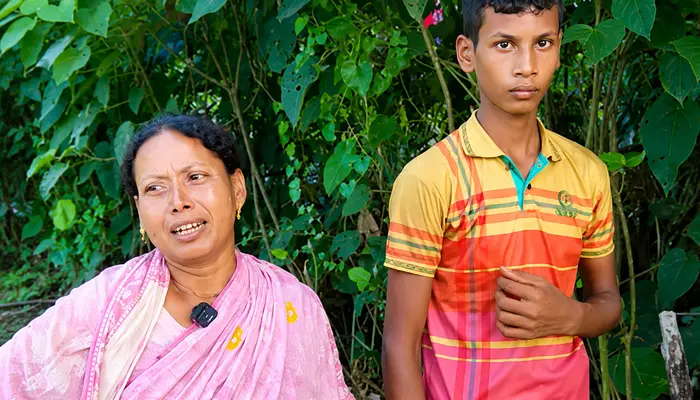
Case Summary
In Lalmonirhat District of Bangladesh, a Hindu minor named Sourabh Chandra Roy was brutally assaulted and tortured over allegations of petty theft. The victim, in a viral video, testified that he was assaulted because of his Hindu identity. On 27th August 2026, the boy was detained near Chaparhat Market in Kaliganj Upazila after being accused of theft, a charge his family, residents and local journalist Asaduzzaman Sazu described as fabricated. Sourabh was dragged inside the Chaparhat Al-Hera Jame Masjid, tied up with ropes and beaten, then dragged to the mosque verandah and subjected to another brutal assault. He was also dragged around during the night, beaten on the soles of his feet, and repeatedly struck on his thighs, back and stomach. Around 10 to 12 people gathered, watched the assault and then proceeded to beat him even harder. Photographs and accounts of the incident showed multiple visible injuries, including bruises and torn skin across his back. Sourabh informed, while showing some of his injuries, that he was tortured brutally after his Hindu identity was confirmed. His mother, Shantona Rani, was overcome with grief and sobbed that there was no one there to provide them justice. She also stated that she had not been at home on the day of the incident and later filed a formal complaint as the plaintiff at Kaliganj Police Station. Video footage of the assault was circulated on social media, bringing the incident to the attention of the Superintendent of Police in Lalmonirhat. The Superintendent directed Kaliganj Police Station to take necessary legal action. As of 30th August 2026, police had not arrested the principal perpetrators, while only one accomplice had been detained. Sourabh’s family and residents further accused sections of the police of shielding the principal accused and attempting to derail the case. The main culprits also attempted to cover up the incident and alter the course of the investigation. Journalist Asaduzzaman Sazu, who brought the incident to public attention, faced intense social media backlash. Islamists on social media accused him of being “a disgrace in the name of a Muslim”, of “hurting religious sentiments”, and of “provoking local Muslims”. The incident raises wider concerns about the treatment and protection of Bangladeshi Hindus who have been facing continued persecution, and that has only increased manifold since the ouster of Sheikh Hasina in August 2024. This escalation of violence against Hindus in Bangladesh unfolded in three distinct phases: first, following the ouster of Sheikh Hasina’s government in August 2024; second, after the death of Sharif Osman Bin Hadi in December 2025; and third, in the immediate aftermath of the 13th National Parliamentary Election 2026. Following the ouster of Sheikh Hasina, multiple reports documented attacks on Hindu homes, temples, and religious institutions, alongside intimidation campaigns, arson, and mob assaults targeting minority neighbourhoods. The Hinduphobia tracker has recorded 336 such incidents against the Hindu minority, underscoring the scale and persistence of anti-Hindu violence during this period. A further escalation occurred following the death of Sharif Osman Bin Hadi, a Muslim political activist and student leader known for his anti-Hindu and anti-India rhetoric. Hadi had been involved in political unrest after the fall of the Hasina government and was killed in Dhaka on 18 December 2025 during clashes. In the aftermath of his death, Hindu communities were blamed and subsequently targeted in retaliatory violence. Hindu homes were selectively set ablaze in multiple localities, forcing families to flee and leaving many displaced. The attacks appeared patterned rather than sporadic, with Muslim mobs focusing on Hindu neighbourhoods, properties, and religious symbols. Among the victims was Dipu Chandra Das, who was lynched to death and his body was set ablaze by a Muslim mob over false blasphemy allegations. The Hinduphobia tracker documented 51 incidents of anti-Hindu violence in the period following Hadi’s death alone. Such incidents underscore the vulnerability of the Hindu minority amid rising communal hostility and the weaponisation of religious accusations. Reports further indicated that posters and written materials calling for the extermination of Hindus were displayed in public spaces, signalling an alarming normalisation of genocidal rhetoric. When combined with acts of arson, vandalism, assault, and targeted intimidation, these developments suggest a coordinated environment of hostility aimed at terrorising the Hindu community and reinforcing majoritarian dominance. The third phase of violence was unleashed after the 13th National Parliamentary Election 2026. Within days of the announcement of results, Hindu families in districts such as Noakhali, Rangpur, Nilphamari, Sylhet, Thakurgaon, and Dinajpur reported coordinated attacks involving arson, looting, assault, and vandalism of temples and homes. In several instances, Hindu homes were selectively targeted, looted, and families were threatened with displacement.
Why it is Hate Crime ?
This case is added to the tracker under the primary category: Attack not resulting in death. The subcategory selected is: Attacked for Hindu identity. In several cases, Hindus are attacked merely for their Hindu identity without any perceived provocation. A classic example of this category of religiously motivated hate crime is a murder in 2016. 7 ISIS terrorists were convicted for shooting a school principal in Kanpur because they got ‘triggered’ seeing the Kalava on his wrist and tilak that he had put. In this, the Hindu victim had offered no provocation except for his Hindu religious identity. The motivation for the murder was purely religious, driven by religious supremacy. Such cases where Hindus are targeted merely for their religious identity would be documented as a hate crime under this category. This case is presented as a clear example of a religiously motivated hate crime because a minor Hindu boy, Sourabh Chandra Roy, was brutally assaulted after his Hindu identity was confirmed. The theft accusation was described by his family and residents as fabricated, and the violence went far beyond any legitimate response to such an accusation. Sourabh was tied up, beaten, dragged into the mosque and assaulted again, while he stated that he was tortured because he was Hindu. The brutality of the assault and the stated religious motive indicate that the violence was driven by communal bias and hatred rather than the alleged theft accusation itself. The fact that the assault took place inside a mosque is also significant in understanding the environment surrounding the incident. The mosque became the setting in which the Hindu minor was restrained and tortured, while others gathered and participated in or watched the assault. This transformed what began as an accusation of theft into a collective act of intimidation against a vulnerable Hindu child. The subsequent efforts to shield the principal perpetrators and derail the investigation, if established, would further aggravate the victim's vulnerability and deny him meaningful protection. It is important to mention here that even if, for once, the accusation of theft is taken at face value, there is no reasonable justification for the manner in which the victim was treated. A minor accused of a petty offence could have been handed over to the police for lawful investigation. Instead, the Hindu boy was dragged into a mosque, tied up, and subjected to prolonged and brutal physical torture. The extreme nature of the violence was completely disproportionate to the accusation and cannot be explained as ordinary punishment for a minor offence. When a petty allegation becomes the pretext for such severe violence against a Hindu victim, particularly after his religious identity is confirmed, it indicates that the accusation served as a trigger for hostility that went far beyond the supposed offence. The conduct therefore reflects deep-seated animosity towards the Hindu victim, with the theft allegation providing an opportunity to direct that hostility against him. The incident also needs to be viewed against the wider insecurity faced by Hindus in Bangladesh. The Hindu minority has experienced repeated episodes of attacks on homes, temples and religious institutions, along with arson, intimidation, displacement and mob violence. The Hinduphobia Tracker has documented 336 incidents following the ouster of Sheikh Hasina's government in August 2024, followed by a further 51 incidents after the death of Sharif Osman Bin Hadi in December 2025. These developments form the broader environment in which this assault occurred. Against this background, the targeting of a Hindu minor becomes particularly significant. A child belonging to a vulnerable religious minority was subjected to severe collective violence, and the victim himself identified his Hindu identity as the reason for the treatment. The incident therefore reflects not merely criminal violence but the use of violence and humiliation against an individual on account of his religious identity, warranting inclusion in the tracker. Disclaimer: In the media reports, although the assault involved multiple individuals, the exact number of perpetrators has not been independently specified. However, the victim stated that around 10 to 12 people had gathered during the assault and had proceeded to beat him. Therefore, for the purpose of documenting this crime, 12 perpetrators have been recorded based on the victim’s statement.
Victim Details
Total Victim
1
Deceased
0
Gender
- Male 1
- Female 0
- Third Gender 0
- Unknown 0
Caste
- SC/ST 0
- OBC 0
- General 0
- Unknown 1
Age Group
- Minor 1
- Adult 0
- Senior Citizen 0
- Unknown 0


Case Status
Complaint filed


Perpetrators Details
Perpetrators
Muslim Extremists
Perpetrators Range
From 10 to 100
Perpetrators Gender
male
 Sources




