Hindu sentiments outaged as ancient Hindu text publicly burnt during political protest in New Delhi
 New Delhi, Delhi, India
  29 August, 2026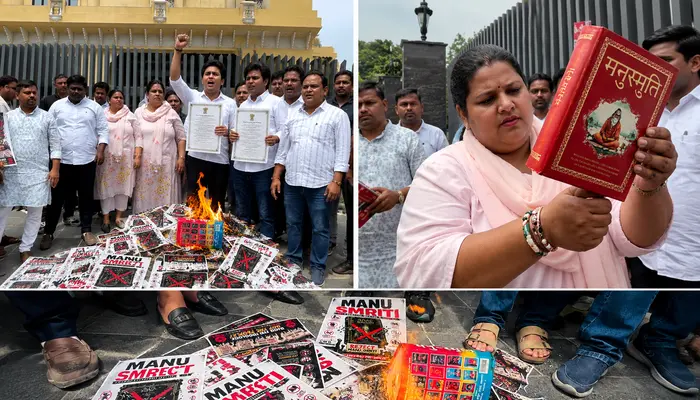
Case Summary
In New Delhi, the ancient Hindu text Manusmriti was publicly burnt by political workers outside the Rashtriya Swayamsevak Sangh headquarters in Jhandewalan during a political protest, and slogans were raised against it. The incident took place on 30th August 2026, when members of the Indian Youth Congress marched towards the Rashtriya Swayamsevak Sangh headquarters. The demonstration was led by Indian Youth Congress national president Uday Bhanu Chib. The workers carried copies of the Preamble to the Constitution along with copies of the Manusmriti, and some activists set a copy of the Manusmriti on fire. They carried posters stating "Reject Manusmriti" and raised slogans including “Manusmriti Nahi Samvidhan Chahiye” (We choose the Constitution, not the Manusmriti) and “Daliton ka ye Apmaan Nahi Sahega Hindustan” (India will not tolerate insults to Dalits). They claimed the BJP and RSS follow a casteist ideology inspired by the Manusmriti rather than the Constitution. The protesters demanded that the Sangh apologise to the nation for what they described as a mindset that harboured caste discrimination. After the incident, Delhi Police deployed heavy force in the area. Police detained Chib and several other Congress activists and took them to Paharganj Police Station. Notably, this protest followed a controversy in Haldwani, Uttarakhand. On August 8 2026, a Congress rally was held at a ground in Haldwani and was attended by Congress national president Mallikarjun Kharge, who comes from the Dalit community. A Havan ceremony was subsequently organised at the same ground on 10th August 2026 by the Shri Ram Seva Dharmarth Nyas. After the Havan ceremony was performed, Congress leaders falsely connected the shuddhikaran (purification) ceremony with Kharge’s visit and accused the BJP and Rashtriya Swayamsevak Sangh of an anti-Dalit mentality and alleged that it promoted ‘untouchability’ against Dalits by performing the Havan ceremony. The controversy intensified when Congress leader Rahul Gandhi also jumped into the fray and claimed that the Havan ceremony was an act of untouchability against a Dalit, Mallikarjun Kharge. He called the purification ceremony at the Ramlila Maidan in Uttarakhand a “crime” and demanded that a First Information Report be registered. Kharge raised the matter in the Rajya Sabha. Members of the Shri Ram Seva Dharmarth Nyas, meanwhile, clarified that the ground had been left filthy after the Congress rally, littered with rubbish and urine-filled bottles. They said the site was used to organise the Ram Leela event and that the organisation had cleaned the ground before performing a puja to restore its sanctity. Members of the organisation, including those from the Dalit community, rejected claims that the Havan was conducted to purify the ground because Kharge had visited it. Ankit Pal, a Hindu Dalit man and a member of the Shri Ram Seva Dharmarth Nyas organisation, which performed a Havan ceremony on 10th August at a venue in Haldwani where a Congress rally was held on 8th August, rejected the allegations by Rahul Gandhi and his party. Pal, who reportedly participated in the ‘purification’ ritual, reiterated that after the Congress rally, the venue, where Ram Lila is traditionally organised, was left littered and dirty. He added that Islamic slogans like Allahu Akbar were also raised at the Congress rally at a place where Hindu religious events are organised. “Look, I had made this clear through your channel that the shuddhikaran havan was performed because a political programme was held on that stage. First of all, it is a cultural stage, and no political party should be allowed to use that stage. And through that stage, slogans of ‘Allah Hu Akbar’ were raised, as we saw in the videos we received. So, the havan was performed there for its shuddhikaran…” Pal said. Meanwhile, Uttarakhand Bharatiya Janata Party chief Mahendra Bhatt also defended the purification ceremony, saying that the Islamic slogans raised during the rally addressed by Kharge were not in keeping with the sanctity of the Ramlila Ground and asking what was wrong with purifying the ground.
Why it is Hate Crime ?
This case has been added to the tracker under the primary category of: Attack on Hindu religious representation. Under this, the sub-category selected is: Desecration of Hindu religious symbol. Icons and symbols, or a religious representation of a spiritual ideal, are widely revered in Hinduism. Iconography is of vital significance in the Hindu milieu. It helps connect people’s spiritual beliefs with the real world. Iconography within the Hindu faith takes several shapes and forms. Murtis are of great significance to Hindus, to which daily rituals, prayers and offerings are performed. Besides the murtis, there are several other symbols which have deep significance in the Hindu faith – the Om and Swastika, for example. Since these Hindu religious symbols hold paramount importance in Hinduism, any desecration of symbols, icons, murtis, religious representations and manifestations is driven by animosity towards the faith itself, which manifests itself through these murtis, icons and symbols. Therefore, any desecration of these Hindu religious symbols and representations is considered a religiously motivated hate crime under this category. The other category is: Hate speech against Hindus. The sub- category selected under it is: Subversion of scriptures. Subverting the religious scriptures of Hindus has particularly devastating consequences. Subversion of the scriptures of Hindus is often done to justify or promote hatred, discrimination, or violence against specific individuals or groups of Hindus. Religious scriptures are often nuanced and those who harbour religious animosity towards Hindus often misquote or misrepresent the scripture to legitimise their animosity and hate towards the faith and its adherents. Any such misquoting of scriptures or subversion to justify hate, violence and discrimination against Hindus owing to religious animosity is hate speech and is categorised as such. This case has been added to the tracker because Congress Party workers publicly burnt copies of the Hindu holy book Manusmriti during a political protest and made derogatory remarks by portraying the text as anti-Dalit and casteist. The Manusmriti is a religious text within Hinduism, traditionally attributed to the sage Manu. It functions as a dharmashastra, guiding morality, law, social order and religious conduct, and represents an important symbol of Hindu religious and cultural heritage. For Hindus, the text forms part of the broader corpus of Hindu religious and Dharmic literature and carries historical and civilisational significance. The public burning of this sacred text constituted a direct affront to Hinduism and its adherents. By publicly desecrating this text, the Congress members directly attacked Hindu religious sentiments, seeking to provoke animosity against Hindus and to incite hostility toward their faith. The incident was designed to outrage religious sentiments and deliberately provoke the Hindu community, thereby risking disruption of public peace and communal harmony. By targeting a Hindu religious symbol in a public setting, the act sought to inflame tensions and create conditions conducive to disorder. Secondly, the characterisation of the Manusmriti as “anti-Dalit” denigrated the Hindu text by reducing its significance to a negative description and associating it with hostility towards an entire social community. The statement was not confined to criticism of a particular passage or interpretation. It presented the Manusmriti as representative of an inherently discriminatory outlook. In doing so, the remarks attached a derogatory meaning to a text belonging to Hindu religious tradition and contributed to a broader portrayal of Hinduism as being rooted in caste discrimination. No alternate or benign explanation exists for the public desecration of a Hindu religious text before a large gathering. The deliberate nature, symbolism, and public execution of the act establish inherent animosity toward Hinduism as the motivating factor. Such incidents have been documented by the Hinduphobia Tracker in the past, demonstrating that this is not an isolated or one-off occurrence. Multiple similar cases have taken place in which the Manusmriti has been deliberately denigrated with the sole objective of hurting the religious sentiments of Hindus. These repeated acts reflect a recurring pattern of targeted hostility toward Hindu religious symbols rather than isolated expressions or spontaneous acts. Since contempt for the Hindu religion was the central purpose of this incident, the case has been documented in the Hinduphobia Tracker.


Case Status
Unknown


Perpetrators Details
Perpetrators
State and Establishment
Perpetrators Range
Unknown
Perpetrators Gender
both
 Sources




