Onam celebrations marred as woman desecrates sacred Athapookkalam in Kochi, Kerala
 Ernakulam, Kerala, India
  24 August, 2026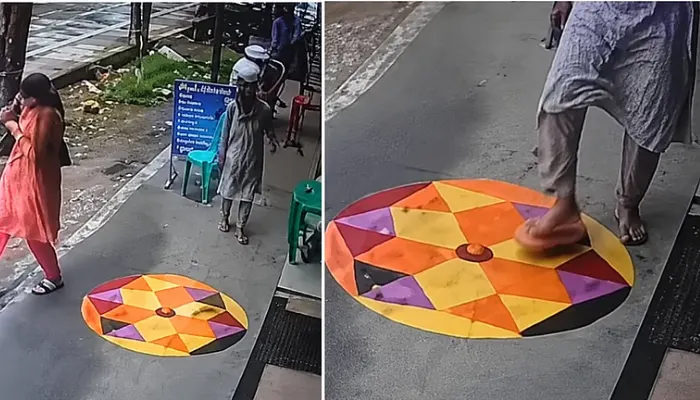
Case Summary
In Palarivattom, Kochi, Ernakulam, Kerala, a sacred Athapookkalam, a traditional floral rangoli prepared during the Onam festival, was desecrated by a woman who kicked it with her feet, scattering the flowers across the road. The incident occurred at around 2 PM on Tuesday, 25 August 2026, on Uthradam day, after shopkeepers and employees had completed the floral arrangement in front of Mint Jewellery near Mythili Mandiram, close to a metro pillar in Palarivattom. The Pookkalam had been prepared as part of the Onam celebrations, after which the shopkeepers and employees stepped away for their lunch break. When they returned, they found the flowers scattered across the road. They subsequently checked closed-circuit television (CCTV) cameras installed in the building and nearby establishments. The footage showed a woman walking along the road before deliberately kicking the Pookkalam with her feet and scattering the flowers. She then walked away from the spot. The footage subsequently circulated widely on social media, leading to various campaigns and discussions. The footage was initially circulated with claims that it occurred in Bengaluru. It was later established that the incident had actually taken place in Palarivattom, within Kochi city limits, in Ernakulam district, Kerala. After the actual location was established, police expedited action based on complaints received in connection with the incident. Building owners and local public activists approached the police seeking to establish the facts behind the act and requesting action against the person responsible. On Saturday, 29 August 2026, Bharatiya Janata Party leader C. G. Rajagopal and Balachandran submitted a complaint at Palarivattom Police Station. Based on the complaint, police registered a First Information Report (FIR) against the unidentified woman under Section 192 of the Bharatiya Nyaya Sanhita (BNS), which deals with acts intended to cause or likely to cause a riot. The FIR stated that the floral rangoli had been kicked and scattered with the intention of creating a disturbance in society. At the time of writing this report, the woman had not yet been identified. Palarivattom police continued examining CCTV footage from other cameras in the area to trace her, establish further details and determine the circumstances behind the incident. The investigation was ongoing, and reports stated that the woman could be arrested once she was identified.
Why it is Hate Crime ?
This case has been added to the tracker under the prime category: Attack on Hindu religious representations. The subcategory relevant in this case is: Desecration of Hindu religious symbol. Icons and symbols, or religious representations of a spiritual ideal, are widely revered in Hinduism. Iconography is of vital significance in the Hindu milieu. It helps connect people’s spiritual beliefs with the real world. Iconography within the Hindu faith takes several shapes and forms. Murtis are of great significance to Hindus, to which daily rituals, prayers and offerings are performed. Besides the murtis, there are several other symbols which have deep significance in the Hindu faith – the Om and Swastika, for example. Since these Hindu religious symbols hold paramount importance in Hinduism, any desecration of symbols, icons, murtis, religious representations and manifestations is driven by animosity towards the faith itself, which manifests itself through these murtis, icons and symbols. Therefore, any desecration of these Hindu religious symbols and representations is considered a religiously motivated hate crime under this category. This case is a clear example of a religiously driven hate crime, as the perpetrator desecrated a sacred Athapookkalam during Onam celebrations in Kerala. The act demonstrated hostility towards the Hindu faith and its sacred symbols, as the woman deliberately targeted a religiously significant representation associated with the festival. Onam is one of the most significant Hindu festivals celebrated by Hindus in Kerala and is deeply rooted in the cultural and religious traditions of the Hindu community. The festival commemorates the annual return of King Mahabali, a revered figure in Hindu tradition, to Kerala. It is observed over several days and involves rituals, prayers, traditional festivities and the preparation of elaborate floral decorations. For Hindus, Onam therefore carries religious and cultural significance and is an important occasion for celebrating their traditions and heritage. The Athapookkalam, also known as Pookkalam, is a traditional floral arrangement (rangoli) prepared by Hindus as an integral part of Onam celebrations. It is made using flowers arranged in intricate patterns, often placed at the entrance of homes, temples and other public or community spaces. The floral arrangement has religious and cultural significance and forms an important part of the rituals and traditions associated with Onam. Its preparation is also considered an act of devotion and an expression of reverence towards the festival and the traditions associated with it. Therefore, the act of desecrating the Athapookkalam amounted to the desecration of a sacred Hindu religious symbol and constituted an act of hurting Hindu religious sentiments during the celebration of their sacred festival. The fact that the woman kicked the Athapookkalam with her feet and scattered the flowers further demonstrated sheer disrespect towards a sacred Hindu symbol. In Hindu religious and cultural traditions, touching or treating sacred objects with one's feet is considered disrespectful and is regarded as inappropriate in the context of reverence. Deliberately kicking and destroying a religiously significant floral arrangement therefore constituted an act of desecration. The nature of the act demonstrated hostility towards Hinduism and amounted to a clear case of a religiously driven hate crime. A careful examination of the video further showcased that the desecration did not occur accidentally or as a result of the woman inadvertently stepping on the Athapookkalam. The woman was seen deliberately kicking the floral arrangement with her feet, scattering and destroying it before walking away from the spot. The deliberate nature of the act demonstrated that it was not a random occurrence or an accidental act, but a conscious act of desecrating something that Hindus held sacred and hurting their religious sentiments. This deliberate targeting of a religiously significant symbol during a sacred festival further established the act as a religiously driven hate crime. Although the identity of the perpetrator remained unknown at the time of writing this report, this did not diminish the apparent religious motivation behind the desecration. Therefore, the case met the parameters for inclusion as a hate crime and was added to the hate crime database of the Hinduphobia Tracker.


Case Status
Complaint registered


Perpetrators Details
Perpetrators
Unknown
Perpetrators Range
One Person
Perpetrators Gender
female
 Sources




