Hindus religiously profiled and assaulted in Muslim-dominated area of Bilaspur; Hindu activists also subjected to mob violence for opposing denigration of Hindu symbols
 Bilaspur, Chhattisgarh, India
  27 August, 2026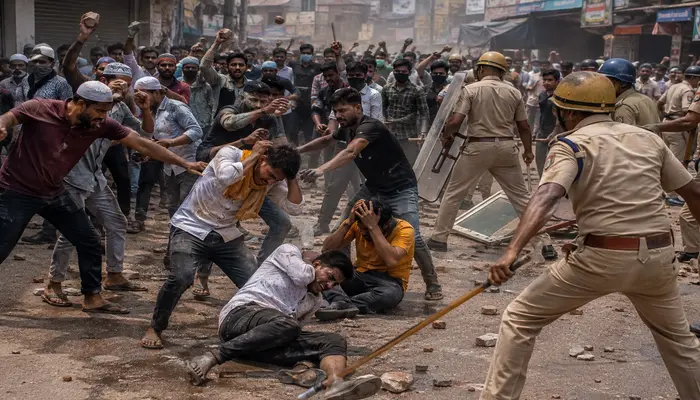
Case Summary
In a Muslim-majority area of Bilaspur, Chhattisgarh, four Hindu youths, who were travelling to celebrate Raksha Bandhan, were religiously profiled and brutally attacked by Muslim men, led by Sohail Khan and his associates. The attackers questioned the victims about their religious identity before launching the assault by stabbing them with a knife. Prior to the attack, the accused, Sohail Khan, had made objectionable anti-Hindu comments against Hindu religious symbols. Furthermore, when members of Hindu organisations went to file a complaint, they were attacked and stone-pelted by a Muslim mob. The incident of assault on Hindu youths was preceded by objectionable posts on social media platforms, including Instagram and Facebook, against cows and Hindu religious symbols. The posts were made by the Muslim accused, Sohail Khan, and other members of the Muslim community, which angered members of Hindu organisations in Bilaspur. The matter subsequently became a source of tension in the Masanganj area. Meanwhile, four Hindu youths, including one identified as Akshat Singh, were passing through the Masanganj area, a Muslim-majority area, when they were stopped by Sohail Khan and his associates. The Hindu youths were travelling to celebrate Raksha Bandhan with their sister when they were questioned about their religious identity, following which a confrontation took place. Sohail Khan and his associates then brutally assaulted Hindu youth Akshat Singh and one of his companions. The assault prompted the youths to inform members of the Hindu organisation about what had happened, after which a large number of members gathered in the area and went to the City Kotwali police station seeking action against those responsible. Videos about the incident went viral on X (formerly Twitter), detailing what had happened to the victims. Hindu organisation members stated that the Hindu victims were stopped while passing through a lane and told that they could not pass through the area. When they questioned why they were being stopped, the accused (Muslim) responded aggressively that the road did not belong to their father, followed by a physical confrontation. Afterwards, a mob of around 50 people gathered and began pelting stones. The situation later escalated outside the City Kotwali police station as well, when members from the Hindu community went to file a complaint. Muslim mob gathered outside the police station and began pelting stones at them, injuring around 30–40 people, including several police personnel. The Muslim mob also damaged vehicles and vandalised nearby shops and houses before entering the police station premises, escalating tensions in the area. Police attempted to disperse the crowds through a lathi charge and the use of tear-gas shells. As the situation continued to deteriorate, additional police forces were brought in from across Bilaspur district as well as neighbouring Mungeli and Janjgir-Champa districts and the Chhattisgarh Armed Force. Collector Sanjay Agarwal and Superintendent of Police Rajneesh Singh reached the spot and supervised the operation. The crowd remained around the City Kotwali area for several hours during the night, prompting the deployment of heavy security forces and barricades in Masanganj, Khaparganj and other sensitive parts of the city. A senior police official claimed that the two groups had an prior dispute. According to him, one person struck another with a stone, after which the one side called his associates, who arrived and began pelting stones. By the time police reached the spot, stone-pelting had also started from the other side. The official said that the police brought the situation under control and that strict action would be taken against those responsible. Following the violence, police examined CCTV and drone footage to identify those involved in the stone-pelting and vandalism and detained several people for questioning. Restrictions under Section 144 were imposed in the City Kotwali area, while police maintained a heavy presence and conducted patrols in sensitive areas. Authorities stated that the situation had been brought under control and that action would be taken against those found responsible for the violence.
Why it is Hate Crime ?
This case has been added to the tracker under the primary category- Attack not resulting in death. The sub-category selected is- Attacked for Hindu identity. In several cases, Hindus are attacked merely for their Hindu identity without any perceived provocation. A classic example of this category of religiously motivated hate crime is a murder in 2016. 7 ISIS terrorists were convicted for shooting a school principal in Kanpur because they got ‘triggered’ seeing the Kalava on his wrist and tilak that he had put. In this, the Hindu victim had offered no provocation except for his Hindu religious identity. The motivation for the murder was purely religious, driven by religious supremacy. Such cases where Hindus are targeted merely for their religious identity would be documented as a hate crime under this category. The other sub-category selected is- Attacked for crossing 'Muslim area. One of the reasons that Hindus get attacked unprovoked specifically by Islamists is for crossing ‘Muslim areas’. Essentially, Muslim mobs often attack Hindus crossing or present in certain areas which have a majority Muslim population. It has often been cited as one of the reasons to blame Hindus for attacks against themselves, signalling that Hindus displaying religious symbols, taking our religious processions or crossing any area which is dominated by Muslim residents is a provocation in and of itself. These areas are mostly ghettoized areas where mobs mobilize quickly to attack Hindus for a variety of reasons like playing music during a religious procession, crossing a mosque, wearing a tilak or any other religious symbol in a Muslim-dominated area, praying at a local temple in that area etc. There have been cases where the few local Hindus of that area have been attacked on their way to the Temple for prayers as well, simply because the area is considered a Muslim-dominated area. Several times, it is entirely possible that the immediate trigger for the violence against Hindus was non-religious in nature, however, the violence became religiously motivated in nature because the area was Muslim dominated and the residents on the whole harboured animosity towards Hindus, evidenced from the actions of the mob, the slogans, and the nature of the attack. Such crimes are motivated by the religious identity of the victims and are therefore classified as hate crimes under this category. The other sub-category selected here is - Attacked for opposing radicals or trying to save victim. In several cases, Hindus are attacked for opposing religiously motivated crimes being committed against a fellow Hindu or simply for voicing an opinion opposing radical elements, who either have in the past or continue to persecute Hindus. In such cases, the initial attack against the victim, against which the Hindu was trying to defend the victim, would also need to be classified as a religiously motivated hate crime. Since the initial crime itself was religiously motivated and the subsequent crime of attempting to save the victim or speaking against the radical elements ends up inviting a violent attack, it would also be classified as a religiously motivated hate crime under this category. The other sub-category selected is- Communal Clash/Attack. Communal clash is a form of collective violence that involves clashes between groups belonging to different religious identities. For a communal clash between Hindus and non-Hindus to qualify as a religiously motivated hate crime, the trigger of the violence itself would have to be anti-Hindu in essence. For example, if there is a Hindu religious procession that comes under attack from a non-Hindu mob and after the initial attack, Hindus retaliate in self-defence, leading to a communal clash between the two religious communities. While at a later stage, both communities are involved in the clash/violence, the initial trigger of the violence was by the non-Hindu mob against the Hindus and therefore, it could safely be termed as an anti-Hindu violence. Further, the trigger would also have to be religiously motivated. In the cited example, the attack by the non-Hindu mob was against religious processions and therefore, can be concluded to be religiously motivated. In some cases, the trigger may be non-religious, however, it develops into religious violence against Hindus at a later stage. In such cases too, the foundational animosity towards Hindus becomes the motivating factor of the crime and therefore, it would be classified as a religiously motivated hate crime against Hindus under this category. The second primary category selected here is - Hate speech against Hindus. The sub-category selected is- Anti-Hindu slurs, mocking faith Anti-Hindu slurs and the deliberate mocking of the Hindu faith owing to religious animosity involve the usage of derogatory terms, stereotypes, or offensive references to religious practices, symbols, or figures. One of the common anti-Hindu slurs used against Hindus is “cow-worshipper” and “cow piss drinker”. The intention of using this term is to demean and mock Hindus as a group and their religious beliefs since Hindus consider the cow holy. Additionally, some symbols and the slurs attached to them have a historical context that exacerbates the insult, hate, stereotyping, dehumanisation and oppression against Hindus. Cow worship has been used for centuries to denigrate Hindus, insult their faith and oppress Hindus specifically as a religious group. There has been overwhelming documentation about how cow slaughter has been used to persecute Hindus with cow meat being thrown in temples and places of worship. There has also been overwhelming documentation where cow meat (beef) has been force-fed to Hindus to either forcefully convert them to Islam or denigrate their faith. Apart from cow worship, the Swastika – which holds deep religious significance for the Hindus – has also been misinterpreted and distorted to use as a slur against Hindus. Similarly, the worship of the Shivling has been used by supremacist ideologies and religions to denigrate Hindus owing to religious animosity. Such slurs and denigration stem out of inherent animosity and hate towards Hindus and their faith, therefore, it is categorised as hate speech targeted at Hindus specifically owing to their religious identity. The incident qualified as a hate crime because the conduct directed against the Hindu youths was connected to their religious identity rather than being limited to an ordinary personal dispute. Firstly, the questioning of the youths about their religion constituted religious profiling, as their faith was specifically identified and established as a relevant factor immediately before the assault. The subsequent attack on the youths after they had been religiously profiled demonstrated that their Hindu identity was central to the confrontation. Targeting individuals after identifying them on the basis of their religion portrayed clear religious animosity, as the violence was directed against Hindu individuals in a context where their faith had been specifically singled out. This premeditated act of profiling based on religious identity, followed by a brutal attack, was nothing but a targeted hate crime. Furthermore, the attack occurred while they were travelling to celebrate Raksha Bandhan, a deeply significant Hindu festival. By intercepting and assaulting individuals on their way to participate in a cultural and religious observance, the Muslim attackers actively sought to disrupt Hindu practices. Targeting Hindus while they are participating in their religious festivals is a recognised method used to instill fear and discourage the public expression and celebration of the Hindu faith. Secondly, it is important to note that this incident occurred in a Muslim-majority area, which shaped how the Muslim perpetrators understood the space. Muslims often treat areas around mosques, dargahs, or zones where their community is in the majority as “Muslim areas” where non‑Muslims, particularly Hindus, are expected to be unobtrusive or even unwelcome. The physical location of the attack revealed a clear attempt to enforce territorial dominance over the local Hindu community. This mindset reflects a disturbing sense of Islamic supremacy in which public space is treated as belonging to one religious community, and any assertion or even presence of Hindu religious identity is framed as an intrusion. Thus, the assault on the Hindu victims was motivated by this supremacist ideology, under which Muslims in the neighbourhood looked down upon Hindus and believed they had the right to control who could move freely and express their faith in “their area”. This transforms the space into one where Hindu faith is not tolerated, and the act of crossing such a space becomes a trigger for communal violence. The assault therefore represented an infringement not only of the victims' physical safety but also of their ability to move through a locality without being subjected to hostility or violence because of their faith. Religious identity functioned as a marker that exposed the victims to differential treatment and violence. Such an attitude is rooted in exclusion, intolerance, and religious animosity, making this case a clear illustration of a crime motivated by religious hatred. Thirdly, the objectionable social-media posts made by Sohail Khan formed an important part of the hate-crime context because they targeted Hindu religious beliefs and symbols, including the sacred cow. The cow holds profound religious and cultural significance in Hinduism and is revered by Hindus as a sacred being. Its veneration is deeply embedded in Hindu religious traditions, scriptures, rituals, and cultural practices, thus, making derogatory remarks concerning cows particularly sensitive within the Hindu religious context. The posts therefore did not merely express hostility towards a particular individual but targeted a religiously significant aspect of Hindu faith and identity. By directing offensive remarks towards the sacred cow and other Hindu religious symbols, the posts denigrated beliefs that are integral to Hindu religious practice and identity. The nature of these remarks demonstrated hostility towards Hinduism and its associated beliefs and symbols, making the speech itself relevant to the hate-crime classification. The use of derogatory expressions against matters regarded as sacred by Hindus contributed to an environment of religious hostility and contempt towards the Hindu community. This was distinct from ordinary criticism or a personal disagreement because the subject of the expression was Hindu religious belief itself. The posts consequently served as an important indicator of anti-Hindu animosity within the wider circumstances of the incident. Fourth, the violence escalated when members of the Hindu community sought legal recourse over the assault on the youths. The Hindu organisation members had gone to the City Kotwali police station to lodge a complaint and seek action against those responsible. Despite pursuing the matter through lawful channels, they were confronted and attacked by a Muslim mob, which subjected them to stone-pelting. This secondary assault demonstrated a broader form of hostility towards the Hindu community, as the attack extended beyond the individuals involved in the initial confrontation. Their targeting despite their non-violent pursuit of legal action underscored an attempt to intimidate Hindus from challenging such conduct or seeking intervention from the authorities. This was significant to the hate-crime classification because the violence was intended as a form of collective punishment meant to intimidate Hindus into silence and submission. The violence therefore carried a message of intimidation and dominance: that opposing or resisting Muslims when they denigrate Hindu symbols or attack Hindus would result in violent consequences. The retaliatory attack by the Muslim mob was particularly significant because it transformed an incident involving specific Hindu victims into violence directed at a wider group of Hindus. The Hindu community was not the aggressor who initiated the confrontation; they became targets of violence while responding to an attack on fellow Hindus. In fact, they were victims who had approached the police to report the assault and demand action. Their targeting demonstrated that the hostility had expanded from the original victims to other Hindus associated with opposing the conduct of the accused. The resulting escalation from the targeting of individual Hindu youths to a larger communal confrontation demonstrated religious animosity towards Hindus, as hostility that initially affected specific Hindu victims expanded into violence involving the wider Hindu community. The progression showed that the religious hostility was not confined to the original confrontation but had extended to other Hindus who became associated with opposing or responding to the treatment of the victims, ultimately escalating into a broader communal clash. It is further important to note here that the police attempted to deny the communal angle in this incident by claiming that the attack occurred in the context of a prior dispute. The police, in many such cases, where the motive behind the crime is obvious but not explicitly mentioned, deny that the crime committed was in any way motivated by a religious bias or say that there was ‘no communal angle’ to the crime. Several factors are generally at play here. Many a time the police downplay incidents of low-level communal crime because it is their jurisdiction that comes under question. The police also often say that there was ‘no communal angle’ to a crime when there was one because they wish to ensure that, owing to the crime already committed, there is no further flare-up in the area. Likewise, the Left media and the leftist elite are also inclined to emphasise this "no communal angle" trope, especially wherever the victim of the crime is a Hindu. However, only a police statement or a media report, for instance, cannot be enough to determine whether there is a communal angle present in the crime that has been committed. In fact, to determine whether the crime is communal in nature or not, we need to give emphasis to the ground realities. For example, in the case of Rinku Sharma, the Bajrang Dal activist who was mercilessly stabbed in his house in front of his family members in Delhi’s Mangolpuri area in the year 2021, the leftist media and the leftist ecosystem had tried to peddle that there was no communal angle to the crime. Even the police denied that the crime was communal in nature. However, Opindia spoke to several people who are on the ground with the family of Rinku Sharma, and we were told that the communal tension in the area is palpable. The family of Rinku Sharma has said that the Muslims of the area have held a grudge against Rinku ever since he celebrated the Ram Mandir verdict. Like the case of Rinku Sharma, those cases where even if the police have denied a communal angle or the leftist media have gone on an overdrive to peddle the ‘no communal angle’ trope, the ground reality, like the victim’s family or relative's testimonies, make it clear that there was an obvious religious bias that led to the crime, will be documented in this tracker. Going by the same logic, since the members of the Hindu organisation who were in direct contact with the victims testified that the attack occurred after Muslim youths questioned the victim's religious identity, this case has also been included in the hate tracker. Ultimately, this sequence of events satisfied all the conditions of a religiously motivated hate crime. The combination of online faith mockery, territorial intimidation, a direct identity-based physical assault, and subsequent mob violence illustrated a clear effort to subjugate the local Hindu population. The perpetrators used physical violence and public disorder not just to harm the immediate victims, but to terrorise the wider Hindu community, deny them their legal rights, and assert religious supremacy. Disclaimer: The original assault involved four Hindu youths who were identified as victims. The subsequent communal clash resulted in around 30–40 injuries; however, the available sources did not provide a verified breakdown of how many of those injured were Hindus, police personnel or members of the other group. The Hinduphobia Tracker acknowledges that multiple Hindus may have become victims during the ensuing communal violence. However, as only four Hindu victims from the original assault were explicitly identified and confirmed in the available reporting, the Hindu victim count has been conservatively recorded as 4. This figure is recorded for documentation purposes only. Disclaimer: The available reports identified Sohail Khan as an accused in the original assault on the four Hindu youths and also referred to his associates as having participated in the attack. During the subsequent communal violence, a Muslim mob also attacked Hindus gathered at the City Kotwali police station, with stone-pelting, vandalism and other acts of violence reported in the area. However, the sources did not provide a verified or complete identification of the individuals who participated in either the original assault or the subsequent mob violence. However, as only Sohail Khan was explicitly identified and confirmed as an accused in the available reporting, the perpetrator count has been conservatively recorded as 1. This figure is recorded for documentation purposes only.
Victim Details
Total Victim
4
Deceased
0
Gender
- Male 4
- Female 0
- Third Gender 0
- Unknown 0
Caste
- SC/ST 0
- OBC 0
- General 0
- Unknown 4
Age Group
- Minor 0
- Adult 4
- Senior Citizen 0
- Unknown 0


Case Status
Complaint registered


Perpetrators Details
Perpetrators
Muslim Extremists
Perpetrators Range
One Person
Perpetrators Gender
male
 Sources




