Hindu priest brutally assaulted for opposing illegal encroachment of Hindu temple in Ayodhya, Uttar Pradesh
 Ayodhya, Uttar Pradesh, India
  24 August, 2026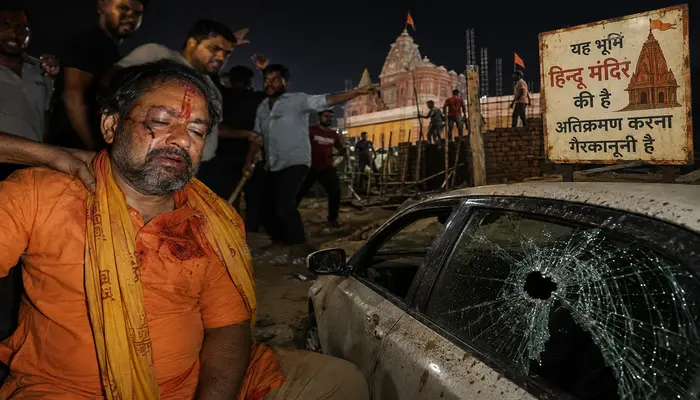
Case Summary
In Kadipur village in the Purakalandar area of Ayodhya, Uttar Pradesh, a Hindu priest, Sudama Das, was brutally assaulted after he confronted a group over illegal encroachment of a Hindu temple. According to reports, Sudama Das, a resident of Bada Sthan Ramkot, Ayodhya, was responsible for overseeing the Hindu temple and the temple's land, including the adjoining farmland. He received information that Geeta Yadav, Nikhil Yadav, Shiva Yadav, Raman Yadav, Rinku Yadav and 10–15 unidentified persons were carrying out illegal construction on the temple property. On 25 August 2026 at around 10 pm, Das reached the site along with police personnel and asked the group to stop the construction. The situation escalated after he objected to the work. The accused abused and assaulted Das and threatened to kill him. His car was also vandalised during the incident. Shots were fired into the air, and his disciple, Rajveer, was also assaulted. The group fled from the spot after additional police forces arrived to control the situation. Das subsequently lodged a complaint at the police station seeking action against those involved. Police registered an FIR in connection with the assault and firing and initiated an investigation into the incident.
Why it is Hate Crime ?
The primary category for this case is: Attack on Hindu religious representations. The subcategory for this case is: Encroachment or illicit takeover of temple land/ land near a temple. In Hinduism, a temple is the abode of the Deity. The Deity in the Temple is consecrated, thereby making it a real, breathing entity. Hindus believe that not just the Deity but the temple premises themselves are sacred to Hindus since Hindus hold the faith that the entire Temple space is an amalgamation of the divine energy of the deity. Not only the Temple but the Temple premises in their entirety are considered sacred by Hindus. In several cases, the premises of the Temple and/or religious centre are illicitly taken over by institutions belonging to other faiths – like the Waqf board or the Church. Other times, the temple property, land or the property of religious centres are illicitly encroached by non-Hindu groups. Any illicit takeover or encroachment is a crime an initio; however, when non-Hindu groups illicitly take over or encroach the sacred land of Hindus, it is an affront to the Hindu community and is therefore classified as a religiously motivated hate crime under this category. The other primary category selected here is - Attack on Hindu religious representations. Within it, the sub-category selected here is - Attacked for opposing radicals or trying to save victim. In several cases, Hindus are attacked for opposing religiously motivated crimes being committed against a fellow Hindu or simply for voicing an opinion opposing radical elements, who either have in the past or continue to persecute Hindus. In such cases, the initial attack against the victim, against which the Hindu was trying to defend the victim, would also need to be classified as a religiously motivated hate crime. Since the initial crime itself was religiously motivated and the subsequent crime of attempting to save the victim or speaking against the radical elements ends up inviting a violent attack, it would also be classified as a religiously motivated hate crime under this category. The incident qualified as a hate crime because the violence was closely connected to a dispute over land belonging to a Hindu temple and was directed at a sadhu who was acting to protect and oversee that religious property. The circumstances therefore gave the assault a clear religious dimension that distinguished it from an ordinary dispute over private land. Das was not confronted in an unrelated personal disagreement; the confrontation arose specifically because he objected to construction taking place on property associated with a Hindu temple. His position as a sadhu and his responsibility for overseeing the temple land further connected the violence to his religious role. The nature of the response to his objection was also significant. Rather than being limited to a disagreement over the legality or ownership of the property, the confrontation escalated into abuse, physical violence, threats to kill, destruction of his vehicle and firing of shots into the air. Such conduct served to intimidate a Hindu religious figure who was attempting to prevent the unauthorised use or alteration of temple property. The violence therefore had the effect of deterring him from continuing to defend the religious institution and its property. The assault on his disciple, who was present with him, further demonstrated that the intimidation extended beyond the immediate dispute with Das. Temple land has a distinct religious and community significance within Hinduism because it supports the functioning and continuity of a place of worship. It is not merely ordinary property or a commercial asset; it is inseparable from the temple ecosystem itself. Land attached to a temple holds religious sanctity, supports the functioning and preservation of the temple, and remains intrinsically connected to the Deity and the religious institution. Any attempt to usurp or unlawfully seize such land therefore goes beyond an ordinary property dispute and constitutes an affront to a sacred Hindu institution. By seeking to encroach upon land, the perpetrators interfered with property dedicated to a Hindu place of worship, undermined Hindu religious beliefs, hurt the religious sentiments of Hindus and attacked their ability to preserve and protect a sacred religious institution. In this context, the use of force was not simply a means of resolving a property disagreement; it was used against a person who had intervened in defence of property attached to Hindu religious worship. The identity and role of the victim were particularly relevant to establishing the religious character of the incident. As a sadhu, Das was a Hindu ascetic and religious figure, and his involvement was directly tied to his responsibility for the temple property. The perpetrators' response to his intervention therefore had the potential to intimidate not only him personally but also other Hindu religious figures or community members who might attempt to resist encroachment on temple land. Threatening a religious custodian with serious violence in the course of defending a Hindu temple could consequently create a broader chilling effect on the protection of Hindu religious spaces. The incident was thus significant from a hate-crime perspective because the religious nature of the property, the religious identity and role of the victim, the subject of his intervention, and the subsequent pattern of intimidation and violence were all interconnected. The assault occurred in the context of opposition to activity affecting a Hindu temple and was directed at the person responsible for protecting that property. Taken together, these circumstances indicated hostility associated with the victim's Hindu religious role and his defence of a Hindu religious institution, making the incident more than a conventional physical assault arising from a neutral land dispute. Disclaimer: The perpetrator count has been recorded as 20, comprising five named individuals and 15 unidentified persons, based on the number of people identified in the available report. The exact identities and individual roles of all those involved had not been established at the time of reporting.
Victim Details
Total Victim
2
Deceased
0
Gender
- Male 2
- Female 0
- Third Gender 0
- Unknown 0
Caste
- SC/ST 0
- OBC 0
- General 0
- Unknown 2
Age Group
- Minor 0
- Adult 2
- Senior Citizen 0
- Unknown 0


Case Status
Complaint filed


Perpetrators Details
Perpetrators
Others
Perpetrators Range
One Person
Perpetrators Gender
both
 Sources




