Hindu woman was harassed, assaulted and pressured to convert to Islam by her Muslim husband, who pretended to be Hindu
 Mainpuri, Uttar Pradesh, India
  1 November, 2022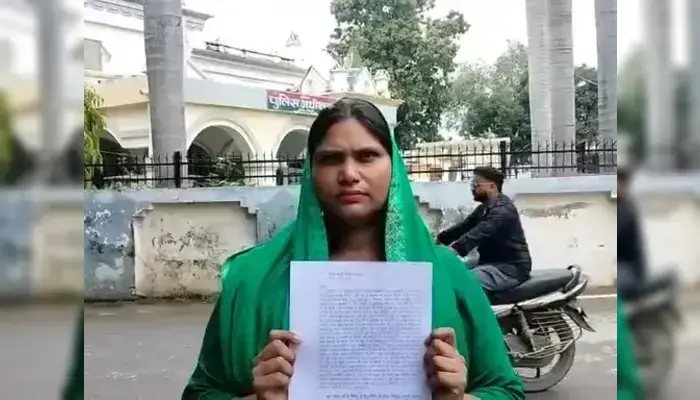
Case Summary
In Mainpuri, Uttar Pradesh, a Hindu woman was harassed, assaulted and pressured to convert to Islam by her Muslim husband, who lured her by pretending to be Hindu. According to reports, the Hindu woman, Deepti, a resident of Mohalla Gariwan, approached the women’s police station and submitted a complaint seeking action against her husband Faisal, his mother, his sister and another woman. Deepti stated that she had separated from her first husband before marrying a Muslim man, Faisal, on 3 November 2022. She stated that Faisal pretended to be a Hindu man and lured her into a relationship. When his real identity was revealed, he promised that, before the marriage, he would convert to Hinduism and live according to Hindu customs. Subsequently, they married as per Hindu customs; however, around a year into the marriage, she said that he began pressuring her to convert to Islam and follow Muslim customs. Deepti had two daughters from her first marriage and a one-year-old son, Parth, with Faisal. Deepti further stated that Faisal was having an affair with another woman. She stated that when she objected to the pressure to convert and confronted him about the relationship, Faisal, his mother, his sister and the other woman subjected her to abuse and physical assault on multiple occasions. She also stated that she had provided jewellery worth approximately ₹10.5 lakh for her sister-in-law’s wedding, with Faisal promising to return the money within a year, but the amount had not been returned. Deepti stated that at around midnight on 18 August 2026, the accused abused her and threatened to kill her. She said that she was dragged by her hair, kicked and punched during the assault. She also stated that Faisal attempted to harm her one-year-old son, Parth. She stated that the continued harassment had left her and her son in danger and requested the police to register a case, take legal action and provide them with security. City CO Ashok Kumar stated that the matter was not yet in his knowledge. He said that the matter would be investigated after information was obtained and that further action would be taken based on the facts.
Why it is Hate Crime ?
This case has been added to the tracker under the primary category - Crimes against women in relationships and other sexual crimes. Within this, the selected subcategory is- Man pretends to be Hindu, with the tertiary category being - Marries as per Hindu rituals. When a non-Hindu man pretends to be a Hindu to deceive a Hindu woman into a relationship, the act is seen as triggered by malafide intentions. In some cases, the woman eventually accepts the man’s original religious identity and converts after the man’s identity is revealed. These cases could be argued as cases of religious brainwashing and a result of the pressure a woman feels after getting into a relationship with a man. The woman, it can be argued, also changed her religious identity because of the stigma she believes she might face if she chooses to walk out of a deceptive relationship. However, for the purpose of documenting hate crimes, the cases in this subcategory are limited to those where there is explicit violence aimed at religious conversion against the wishes of the victim (force-feeding beef, blackmailing with intimate videos, rape on refusal to convert, etc), or if the woman herself complains of the man’s religious deception. In such cases, it is established that the deception of the non-Hindu man had a specific aim of religious conversion or targeting of the victim due to her Hindu religious identity, therefore, making it a religiously motivated hate crime. The other sub-category selected here is - Forced conversion after marriage. In such cases, a non-Hindu man marries a Hindu woman, and the force/pressure to convert to any Abrahamic faith, like Islam, begins after marriage. In such cases, typically, two patterns emerge. First, when the relationship is consensual, and the religious identity of the perpetrator is known to the Hindu woman in the relationship. The marriage could be under the Special Marriages Act, where neither parties are required to convert their religion for the marriage to be considered legitimate. While the victim in such cases enters matrimony assuming that religious identity is not a barrier, the non-Hindu man starts to pressure the woman to convert her religion after marriage. The second is when the woman gets into a marriage with the man, pretending to share her faith. Later, when the truth is revealed, the man starts pressuring the woman to convert her religion and give up her religious identity. In both situations, there is application of force by the perpetrator, including the denial of the woman’s religious rights. Some of the means by which the woman is forced/pressured to convert include force-feeding beef, being forced to read the Kalma, being forced to wear a hijab, forced to undergo Halala, etc. There are several instances where, after marriage, the woman voluntarily converts to Islam. Such cases are often argued to be a result of religious brainwashing, however, for the purpose of documenting religiously motivated hate crimes, in the absence of the victim complaining of forced conversion, such cases do not form a part of the database. The other sub-category selected here is - Assault or threat upon refusal to convert. When Hindu women are in a relationship with non-Hindu men, there are cases where the woman faces threats or assault after she refuses to convert and change her religious identity owing to pressure/force by the non-Hindu man. Such relationships may be consensual with the religious identity of the non-Hindu man known to the victim. Somewhere along the relationship, the non-Hindu man starts pressurizing the Hindu woman to convert to Islam and upon her refusal, assaults or threatens the victim. Such cases are driven by specific religious motivations and against the religious identity of the victim and are therefore qualified as hate crimes. Cases where the Hindu woman converts to Islam and does not file a complaint about the force or threat, are not considered a part of the hate tracker, even though, it may be argued that the woman was brainwashed or threatened to convert to Islam. The incident qualified as a hate crime because the victim was targeted on account of her Hindu religious identity, with the accused concealing his Muslim identity to initiate the relationship and subsequently pressuring her to convert to Islam Faisal presented himself as a Hindu man, deliberately concealing his religious identity to initiate and sustain a relationship with a Hindu woman. This itself is a clear manifestation of bias and malicious intent towards the victim's religion. By concealing his true identity, he exploited her trust, targeting her under false pretences. This indicates a premeditated intent to manipulate her based on her religious background. In cases like these, the tactic of adopting a false Hindu identity to manipulate and "ensnare" a Hindu individual is not just an act of personal betrayal but can also be interpreted as an expression of disdain or disregard for Hinduism and its customs that reflects a deeper animosity towards Hindus and their beliefs. The religiously aggravating nature of the offence was further reinforced by the accused’s conduct after his actual religious identity was revealed. Rather than withdrawing from the relationship or being transparent about his intentions, he again deceived the Hindu woman by promising that he would convert to Hinduism and live according to Hindu customs, and subsequently married her according to Hindu rites. Hindu marriage rituals are sacred religious ceremonies and carry profound spiritual and cultural significance for Hindus. By making a commitment to adopt Hinduism and entering into the marriage through Hindu customs, the accused gave the victim further reason to believe that he had genuinely accepted her faith. The subsequent reversal of this position, followed by pressure on her to convert to Islam, therefore represented not merely a change of marital expectations but a further exploitation of her Hindu religious beliefs and trust. This sequence of concealment, a promise to embrace Hinduism, marriage according to Hindu customs, and subsequent pressure to abandon Hinduism reinforced the religiously targeted nature of the conduct. The conversion aspect further established the religious nature of the offence, as the accused sought to make the Hindu woman abandon her faith and embrace Islam after marriage. Pressuring a Hindu individual to discard their religious beliefs and adopt another religion directly targets their religious identity, dignity and freedom of conscience. In this case, the demand was not simply about following different household customs, but about replacing the victim’s Hindu faith with Islam. Such an attempt to induce a Hindu woman to relinquish her religious identity reflects religiously motivated conduct, as it sought to alter an essential aspect of her identity rather than resolve an ordinary personal or marital difference. The use of violence and harassment in this context further reinforced the hate-crime nature of the incident because the mistreatment was linked to the victim’s refusal to comply with the demand to abandon her Hindu faith. When she resisted the conversion pressure, she was subjected to abuse and physical violence by the accused and his relatives. In such circumstances, the violence functioned not merely as domestic abuse but as a means of exerting control over the victim in the context of her religious identity. The conduct sought to intimidate and pressure her into accepting a religious identity she had not chosen, making the abuse an extension of the religious coercion. This demonstrated that the hostility towards her was not confined to her Hindu identity as a background characteristic, but was manifested through targeted mistreatment when she sought to retain her faith. Accordingly, the hate-crime element lay in the targeting of the victim because of her Hindu religious identity through deceptive religious concealment, subsequent pressure to adopt Islam, and violence in the context of her resistance. Such actions stem from inherent hostility towards the victim's professed faith since Abrahamic faiths believe that any non-adherent to the faith is subject to being dehumanised till they convert. Such acts were not merely personal crimes; they were rooted in a desire to dominate and erase the religious identity of the victim. Since such predatory actions stem from doctrinal animosity towards the Hindu faith and its adherents, this case is being documented as a religiously motivated hate crime Disclaimer: It is important to clarify that none of the media sources covering this case have specified the exact date when the victim's ordeal began. The earliest date mentioned is 3 November 2022, when she married the accused as per Hindu customs. Since Hinduphobia Tracker records the incident based on when the victim’s ordeal began and not when it was reported, we have considered the date of the incident as 2 November 2022, though the media reported the incident on 27 August 2026.
Victim Details
Total Victim
1
Deceased
0
Gender
- Male 0
- Female 1
- Third Gender 0
- Unknown 0
Caste
- SC/ST 0
- OBC 0
- General 0
- Unknown 1
Age Group
- Minor 0
- Adult 1
- Senior Citizen 0
- Unknown 0


Case Status
Complaint filed


Perpetrators Details
Perpetrators
Muslim Extremists
Perpetrators Range
From 2 To 5
Perpetrators Gender
both
 Sources




