Hindu woman pressured to convert to Islam by Muslim family; household temple vandalised, Hindu idols desecrated, minor daughter pressured to study Urdu
 Baghpat, Uttar Pradesh, India
  25 August, 2026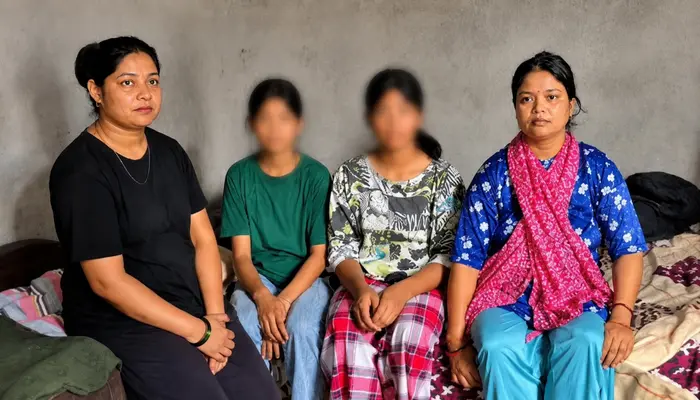
Case Summary
In the Eidgah area of Baghpat city, a Hindu woman named Pooja faced sustained harassment and coercion to convert to Islam from a neighbouring Muslim family. According to reports, the victim was born into a Muslim family and was previously known as Ayesha. In 2001, she had a love marriage with a Hindu man named Madanpal and embraced Hinduism. After embracing Hinduism, she changed her name to Pooja. The victim was originally a resident of the Loni area of Ghaziabad and had three daughters from her marriage. Following her husband's death, she began living in Baghpat with her three daughters and continued to practise Hinduism. However, a neighbouring Muslim family subjected her to sustained harassment because she had embraced Hinduism. According to her, members of the Muslim family, including Suleman and his son Noor Muhammad, entered her house and vandalised a small temple she had established for worship. The idols kept inside the temple were broken, and a painting of a cow on the wall was erased. She also stated that the Muslim family objected to her practising Hinduism and celebrating Hindu festivals such as Holi and Diwali, and that pressure was being placed on her to return to Islam. Pooja maintained that she was unwilling to change her religion or reconvert to Islam. Furthermore, the pressure also extended to Pooja's youngest daughter. Her youngest daughter's school education was discontinued, and she was pressured to study Urdu. According to a report, on the morning of August 20, 2026, an attempt was made to forcibly take her 15-year-old daughter away. When the family resisted, physical assault, verbal abuse, and stone-pelting also took place. Pooja refused to change her religion or return to Islam under pressure. She stated that she intended to continue following Hinduism and was not prepared to return to Islam. She also faced pressure to reach a compromise in the matter but remained unwilling to change her religion. According to media reports, members of Pooja's family recorded several videos in connection with the incident. The videos showed a large number of people from the Muslim community present at Pooja's house, while one video showed a Muslim man arguing with Pooja. Following the harassment and religious pressure, Pooja sought assistance and security from Uttar Pradesh Chief Minister Yogi Adityanath. She approached the police and submitted a complaint against the neighbouring Muslim family. Based on her complaint, the police registered a case under Sections 115(2), 351(2), and 352 of the Bharatiya Nyaya Sanhita (BNS). The Circle Officer (CO) of Baghpat, while speaking to the media over the phone, claimed that preliminary information indicated a dispute between the neighbouring families over a pet cat. The police stated that the truth of the accusations concerning the religious pressure, temple, idols, and other incidents would be established through the investigation.
Why it is Hate Crime ?
The first primary category selected in this case is: Predatory Proselytisation. The subcategory selected is: Harassment, threats, coercion for conversion. Harassment covers a wide range of behaviours of an offensive nature. It is commonly understood as behaviour that demeans, humiliates, and intimidates a person, including threats and coercion. Harassment and threats, in this case, find their root in discriminatory grounds which have the effect of nullifying a person’s rights or infringing upon his freedom to exercise his rights specifically owing to the victim’s religious identity. Verbal and physical threats and psychological or physical harassment are often used against Hindu victims because they choose to practice their professed religion. Religious harassment also includes forced and involuntary conversions by harassment, threats or coercion. Coercion includes intimidatory tactics like force-feeding a Hindu victim beef to convert to another religion, forceful circumcision, etc. In several documented cases, non-Hindu perpetrators or those who harbour specific animosity towards Hinduism harass victims simply based on their religious identity. Such cases often also include harassment to ensure the Hindu victim abandons his/her professed religion and adopts the religion of the perpetrator. Such cases where Hindu victims are harassed to convert to the perpetrator’s religion are rooted in animosity towards the victim’s religious identity and are therefore documented as religiously motivated hate crimes. The other sub-category selected here is - Proselytisation by grooming, brainwashing, manipulation or subtle indoctrination, with the tertiary category being - Conversion of minor. Religious brainwashing essentially means the often subtle and forcible indoctrination to induce someone to give up their religious beliefs to accept contrasting regimented ideas. Religious grooming or brainwashing also involves propaganda and manipulation. It involves the systematic effort, driven by religious malice and indoctrination, to persuade “non-believers’ to accept allegiance, command, or doctrine to and of a contrasting faith. Cases of such grooming or brainwashing are far more nuanced than direct threats, coercion, inducement and violence. In such cases, it is often seen that there is repeated, subtle and continual manipulation of the victim to induce disaffection towards their own faith and acceptance of the contrasting faith of the perpetrator. While subtle indoctrination is widely acknowledged as predatory, an element which is often understated in such conversions or the attempts of such conversion is the role of loyalty and trust which might develop between the perpetrator and the victim. Fiduciary relationships are often abused to affect such religious conversion. For example, an educator transmitting religious doctrine of a competing faith to a Hindu student. The Hindu student is likely to accept what the teacher is transmitting owing to existence of the fiduciary relationship. The exploitation of the fiduciary relationship to religiously indoctrinate victims would also be included in this category. Since the underlying animosity towards the victim’s faith forms the basis of predatory proselytization, such cases are considered religiously motivated hate crimes. The second primary category selected is: Attack on Hindu religious representations. The first subcategory selected is: Violence against religious structures or centres. In Hinduism, a religious structure is also considered divine. Hindus believe that not just the Deity but the religious structure itself is sacred. In this sub-category, we would document attacks against religious structures which are not consecrated temple spaces. Such religious spaces could be temporary in nature – for example – the religious spaces erected specifically for festivals like Durga Puja, etc. This category would also document cases of attacks against religious centres. These spaces in their own right may not be ‘sacred’ per se; however, they are often spaces where religious gurus live, religious teaching is imparted, or belong to religious institutions. Any attack against religious structures is a result of animosity towards the religion itself, which manifests itself through the religious spaces; therefore, such attacks are considered religiously motivated hate crimes. Religious centres are also manifestations of the religion, its teachings or gurus and therefore, attacks against such centres would be considered religiously motivated hate crimes. The other subcategory selected is: Desecration of Hindu religious symbols. Icons and symbols, or a religious representation of a spiritual ideal, are widely revered in Hinduism. Iconography is of vital significance in the Hindu milieu. It helps connect people’s spiritual beliefs with the real world. Iconography within the Hindu faith takes several shapes and forms. Murtis are of great significance to Hindus, to which daily rituals, prayers and offerings are done. Besides the murtis, there are several other symbols which have deep significance in the Hindu faith – the Om and Swastika, for example. Since these Hindu religious symbols hold paramount importance in Hinduism, any desecration of symbols, icons, murtis, religious representations and manifestations is driven by animosity towards the faith itself, which manifests itself through these murtis, icons and symbols. Therefore, any desecration of these Hindu religious symbols and representations is considered a religiously motivated hate crime under this category. The other primary category selected here is - Attack not resulting in death. Within it, the sub-category selected here is - Attacked for refusal to convert. When there is pressure, threat or coercion employed upon the Hindu victim to convert to a different religion, in several cases, the victim refuses to succumb to the pressure/threats. Once the victim refuses, the perpetrator proceeds to attack/assault the victim owing to his/her refusal to convert. In such cases, the pressure/threat/intimidation/coercion/violence itself is driven by animosity towards the victim’s Hindu faith. The violence then is another hate crime driven by the victim’s refusal to abandon his professed faith, Hinduism, and convert to the religion of a non-Hindu perpetrator. Since the victim’s faith is at the heart of the pressure to convert and the ensuing violence towards the victim, such cases are considered religiously motivated hate crimes. This incident has been included in the tracker because a Hindu woman who had voluntarily embraced Hinduism was subjected to religious pressure and the desecration of Hindu religious symbols. The destruction of the Hindu temple in her home, the breaking of idols of Hindu deities, the erasure of a cow image, objections to her observance of Holi and Diwali, and pressure to abandon Hinduism and return to Islam are significant reasons why this case has been added to the hate crime database. Firstly, the victim previously followed Islam but voluntarily embraced Hinduism and adopted the name Pooja. Her continued identification as a Hindu represented her chosen religious identity and her decision to practise Hinduism. The pressure placed on her to abandon this identity and convert to Islam targeted her right to remain Hindu after choosing to convert. Pressuring a Hindu individual to discard her religious faith and embrace another was a direct attack on her religious identity and dignity. It was not a matter of personal choice; it was coercion rooted in hostility towards the victim's Hindu identity. This is an important hate-crime marker because the hostility was connected to the religion she had chosen to follow rather than to an unrelated personal characteristic. Secondly, the damage to the temple inside the woman’s home by the Muslim family directly targeted a space dedicated to Hindu worship and religious observance. The idols of Hindu deities kept within the temple were also broken and damaged. These idols were not ordinary household objects but sacred representations central to Hindu devotional practice, through which devotees offer prayers and worship. Their destruction therefore affected the victim’s ability to maintain and practise her Hindu faith within her own home. In the context of the pressure on her to abandon Hinduism and the targeting of the temple and its idols provided a distinct religious marker, demonstrating that the hostility extended to the physical symbols and spaces through which she expressed her chosen Hindu identity. A picture of a cow that was drawn on the wall of the victim’s house was also erased. The cow holds a particularly revered position within Hindu religious and cultural traditions and is associated with sacredness, purity and respect in Hinduism. The removal of the cow image therefore involved the erasure of a visible Hindu religious symbol from her home. This showed the perpetrators' immense hostility towards Hinduism. Thirdly, the other important religious marker is that the Hindu woman's celebration of Holi and Diwali was targeted. The neighbouring family objected to her celebrating the Hindu festivals. Holi and Diwali are two of the major festivals observed by Hindus, and interference with their celebration restricted her ability to practise and express her Hindu faith through important religious festivals. The objection therefore affected the victim’s expression and observance of central Hindu festivals. Fourth, the woman’s youngest daughter, who was a minor, was subjected to pressure to study Urdu, which was a means of exposing her to Islamic religious and cultural influence. In the context of the broader dispute, the pressure did not concern education in isolation but was presented alongside demands that the victim abandon Hinduism and convert to Islam. The use of Urdu as a means of exposing the minor daughter to Islamic influence therefore formed part of the wider pattern of religious pressure and extended that pressure to the next generation of her Hindu family. It is important to note here that the daughter was a minor, which means the element of consent and genuine change of conscience was missing ab initio. Minors, due to their young age and lack of maturity, are particularly vulnerable to manipulation and coercion. They may not have the ability to fully understand the implications of converting to another religion or recognising such deception, and the Muslim perpetrators purposely targeted and exploited this vulnerability of the victim. Fifth, the attempt to forcibly take the victim’s 15-year-old daughter away represented a further escalation in the pressure faced by Pooja and her family. The incident was particularly significant because it occurred in the midst of the dispute over Pooja’s religious identity and her refusal to return to Islam. The use of coercive conduct against a minor family member was intended to intimidate the family and pressure Pooja into submitting to the demands being made against her. The assault, verbal abuse and stone-pelting that followed when the family resisted further demonstrated the coercive nature of the confrontation. This occurred within the broader pattern of reported religious pressure, which provided additional context to the victim’s account of being intimidated into submission. In this case, the police attempted to deny the communal angle and claimed the dispute between the neighbouring families had arisen over a pet cat. It is important to note here that the police, in many such cases, where the motive behind the crime is obvious but not explicitly mentioned, deny that the crime committed was in any way motivated by a religious bias or say that there was ‘no communal angle’ to the crime. Several factors are generally at play here. Many a time the police downplay incidents of low-level communal crime because it is their jurisdiction that comes under question. The police also often say that there was ‘no communal angle’ to a crime when there was one because they wish to ensure that, owing to the crime already committed, there is no further flare-up in the area. Likewise, the Left media and the leftist elite are also inclined to emphasise this "no communal angle" trope, especially wherever the victim of the crime is a Hindu. However, only a police statement or a media report, for instance, cannot be enough to determine whether there is a communal angle present in the crime that has been committed. In fact, to determine whether the crime is communal in nature or not, we need to give emphasis to the ground realities. For example, in the case of Rinku Sharma, the Bajrang Dal activist who was mercilessly stabbed in his house in front of his family members in Delhi’s Mangolpuri area in the year 2021, the leftist media and the leftist ecosystem had tried to peddle that there was no communal angle to the crime. Even the police denied that the crime was communal in nature. However, Opindia spoke to several people who are on the ground with the family of Rinku Sharma, and we were told that the communal tension in the area is palpable. The family of Rinku Sharma has said that the Muslims of the area have held a grudge against Rinku ever since he celebrated the Ram Mandir verdict. Like the case of Rinku Sharma, those cases where even if the police have denied a communal angle or the leftist media have gone on an overdrive to peddle the ‘no communal angle’ trope, the ground reality, like the victim’s family or relative's testimonies, make it clear that there was an obvious religious bias that led to the crime, will be documented in this tracker. Going by the same logic, therefore, despite the police indicating that a dispute over a pet cat had emerged, the specific conduct documented in the case contained sufficient religious markers for the incident to be included in the hate-crime database. The pet-cat dispute provided a competing explanation for the broader conflict, but it did not by itself explain or negate the acts that specifically concerned the victim's Hindu identity and religious practice. Taken altogether, the case involved multiple religious markers directed against the Hindu woman’s chosen Hindu identity and practice. This is why this case has been added to the hate crime database. Disclaimer: The Hinduphobia Tracker records incidents based on when an event occurred or when the victim’s ordeal began. The available media reports did not specify the exact date on which the incident began. However, the earliest media coverage of the incident was published on 26 August 2026. Therefore, for documentation purposes, we have recorded the date based on when the incident was first reported in the media, 26th August 2026.
Victim Details
Total Victim
2
Deceased
0
Gender
- Male 0
- Female 2
- Third Gender 0
- Unknown 0
Caste
- SC/ST 0
- OBC 0
- General 0
- Unknown 2
Age Group
- Minor 1
- Adult 1
- Senior Citizen 0
- Unknown 0


Case Status
Complaint registered


Perpetrators Details
Perpetrators
Muslim Extremists
Perpetrators Range
Unknown
Perpetrators Gender
unknown
 Sources




