‘Sar Tan Se Juda’ slogans resurface during Eid in Gonda, echoing a history of threats against Hindus
 Gonda, Uttar Pradesh, India
  25 August, 2026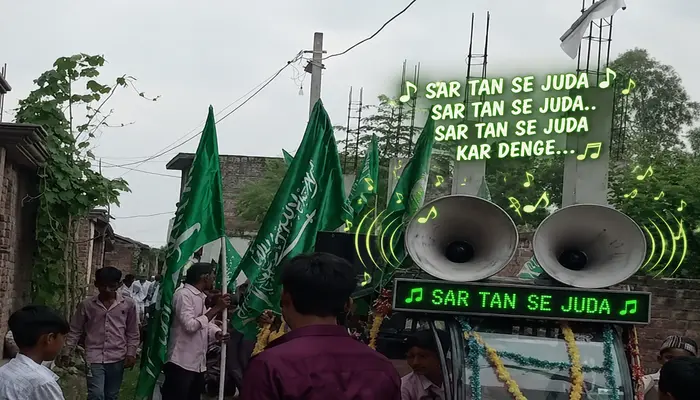
Case Summary
In Belwa village, under the Motiganj police station limits in Gonda, Uttar Pradesh, Muslims publicly raised the Islamic beheading slogan, “Sar Tan Se Juda”, during an Eid procession. The slogan has a history of being used to target and intimidate members of the Hindu community. The incident occurred on 26 August 2026, when the Muslim community organised a Jalsa-e-Mohammadi procession on the occasion of Barawafat. During this time, violent Islamic slogans, “Gustakh-e-Nabi ki ek saza, sar tan se juda” (one punishment for blasphemy against the Prophet, beheading), were played from a sound system. The slogan was played along with a Muslim religious song through a DJ system and loudspeaker mounted on an e-rickshaw participating in the procession. A video showing the incident subsequently circulated on social media, following which the police took cognisance of the matter and initiated action. Sadar Superintendent of Police Abhishek Dawachha directed Motiganj police to register a case, seize the vehicle and sound equipment involved, and take legal action. Motiganj Station House Officer Tej Narayan Gupta said the initial investigation found that the mobile phone used to play the song also contained the audio carrying the Islamic slogan. Police seized the e-rickshaw, DJ sound system and loudspeaker and brought the vehicle to the police station. The process of registering a case was underway, with further action to be taken on the basis of the investigation and evidence. Before the Barawafat procession, peace committee meetings had been conducted across police station areas in the district, where organisers and local residents had been instructed not to play such violent Islamic songs or slogans and to avoid activities that could disturb communal peace. Despite these instructions, the slogan was played during the procession, prompting police intervention and seizure of the equipment used to broadcast it.
Why it is Hate Crime ?
This case has been added to the tracker under the primary category- Hate speech against Hindus. Within it, the sub-category selected is- Violent threats. Violent threats, explicit, implicit or implied, is the most dangerous form of hate speech since it goes beyond discriminatory and prejudicial language to express the intent of causing harm to an individual or a group of people based on their religious identity and faith. There could be several different kinds of threats that are issued to Hindus based on religious animosity. An explicit threat would mean the direct threat of violence towards an individual Hindu, a group of Hindus or Hindus at large. Physical violence, death threats, threats of destruction of property belonging to Hindus and threats of genocide would mean explicit threats against Hindus for their religious identity. Implicit threats may not be a direct threat but implied through the use of symbols of actions – for example – in the Nupur Sharma case, other than explicit threats, there were also implicit threats when Islamists took to the streets to burn and beat her effigies. It implies that they want to do the same to Nupur Sharma – thereby is considered an implicit threat. Violent threats can be delivered in person, through letters, phone calls, graffiti, or increasingly through social media and other online platforms. It would be important to understand that a threat – explicit or implicit, online or offline – to an individual who happens to be a Hindu does not qualify as a religiously motivated threat. Such a threat, while vile and dangerous, could be owing to non-religious reasons and/or personal animosity. To qualify as a religiously motivated threat, it would need to exhibit an indication that the individual is being targeted for religious reasons and/or owing to his/her religious identity as a Hindu. The case has been added to the hate crime database because the public use of the slogan “Gustakh-e-Nabi ki ek saza, sar tan se juda” constituted an explicit threat of religiously motivated violence directed at Hindus. The slogan, which called for the beheading of anyone deemed disrespectful to Prophet Muhammad, carried an unmistakable message of violence against those who were perceived to have committed blasphemy. Its invocation in a public religious procession therefore went beyond an expression of religious devotion or disagreement and conveyed a threat of extreme physical violence against individuals who did not conform to the religious beliefs of those raising or playing the slogan. “Gustakh-e-Rasool/Nabi ki Ek hi saza, sar tan se Juda, sar tan se Juda”, which translates to “There is only one punishment for being disrespectful to Rasool (Prophet Muhammad), their head separated from their torso, their head separated from the torso”, is an Islamist clarion call, that has become a staple feature of violent protests that have so far claimed the lives of at least 6 Hindus, including Kanhaiya Lal in Udaipur and Umesh Kolhe in Amravati, after Muslim fundamentalists, egged on by the dog-whistling of Alt News co-founder Mohammed Zubair against former BJP spokesperson Nupur Sharma, resorted to violence for what they perceived as ‘blasphemy’ against Prophet Muhammad. From Kanpur in India’s northern plains to the southern metropolis of Bengaluru, from Kolkata in the east to Hyderabad in the south, protests in the name of blasphemy have erupted in almost every corner of the country as Islamists took to the streets, running amok and shouting “Sar Tan Se Juda” chants over the perceived belief of blasphemy against the Prophet. Though a radical Muslim outfit in Pakistan coined the slogan, it has gained popularity among Muslims in regions beyond its geographical origins. Over the years, we have seen large crowds of Muslims chanting the “Sar Tan Se Juda” slogan, which is nothing but a direct incitement to violence, leading to murders committed in the name of blasphemy. The radicalised outcry is not merely a statement of disapproval; it is a call for the execution of an individual through beheading, based on their religious identity. When this slogan is raised, it sends a clear and terrifying message not just to the individual targeted but also to anyone else who might share similar views or dare to express them. This tactic of intimidation aims to silence dissent and suppress freedom of expression, particularly in religious discourse. It aims to instil fear in the broader Hindu community. Muslim extremists use this tactic to settle personal scores with non-Muslims, particularly Hindus, by levelling fabricated charges of blasphemy against them, which causes outrage and paints a target on them. The underlying hatred and animosity toward non-Muslims, especially Hindus, drive these false blasphemy accusations as a means to subjugate and victimise them. In the present case, the slogan was played through a sound system mounted on an e-rickshaw participating in a Barawafat/Jalsa-e-Mohammadi procession in Belwa village. The fact that the slogan was broadcast publicly as part of a religious procession gave it a collective and demonstrative character. It was not a private statement made by an individual but a violent message disseminated through loudspeakers in a public space during a Muslim religious gathering. The use of a sound system ensured that the message was heard beyond the immediate participants in the procession, thereby extending its intimidating effect to the wider public, including members of the Hindu community. The religious context was also significant. The slogan specifically invoked the Prophet Muhammad and prescribed beheading for those considered to have shown disrespect towards him. Thus, the threat was framed explicitly in religious terms and was directed at persons on the basis of their perceived relationship with Islam and its religious figures. By incorporating such a violent formulation into a Muslim religious procession, the participants associated religious observance with a message of punitive violence against perceived religious offenders. This transformed what should have been a religious procession into a platform through which an explicitly violent religious threat was publicly disseminated. The timing and setting further reinforced the intimidating nature of the act. The procession took place during Barawafat, a Muslim religious occasion commemorating the birth of Prophet Muhammad. Rather than restricting the religious observance to devotional expression, the sound system was used to broadcast a slogan calling for beheading in the name of the Prophet. The police had also conducted peace committee meetings before the procession and had specifically instructed organisers and residents not to play violent Islamic songs or slogans or undertake activities that could disturb communal harmony. The subsequent broadcasting of the “Sar Tan Se Juda” slogan despite these instructions demonstrated that its use was not merely incidental to the procession. It was a public invocation of a violent religious threat in circumstances where organisers had already been warned against provocative material. This is not an isolated incident. This is also not the first time that the “Sar Tan Se Juda” slogan has been publicly raised by Muslims in a manner that threatens and intimidates Hindus. The Hinduphobia Tracker has documented nearly 69 such incidents between 1 January 2023 and 27 August 2026 in which the slogan was raised to target Hindus, issue violent threats or create an atmosphere of fear and religious intimidation. The repeated use of this slogan across different parts of the country demonstrates that its invocation is not merely an isolated act of religious expression but a recurring pattern of violent intimidation directed at the Hindu community. Overall, the incident met the parameters for inclusion in the hate crime database because the conduct involved the public dissemination of an explicitly religiously framed threat of extreme violence. The use of the “Sar Tan Se Juda” slogan in a Muslim religious procession was not merely an expression of faith; it invoked beheading as punishment for perceived religious transgression and thereby contributed to an atmosphere of fear, intimidation and communal hostility. For these reasons, the incident was classified as a religiously motivated hate crime and added to the Hinduphobia Tracker's hate crime database.


Case Status
Case sub-judice


Perpetrators Details
Perpetrators
Muslim Extremists
Perpetrators Range
Unknown
Perpetrators Gender
unknown
 Sources




