Hindu symbols desecrated; Muslims fly and trample images of Hindu deities during Eid procession in Chittorgarh
 Chittaurgarh, Rajasthan, India
  25 August, 2026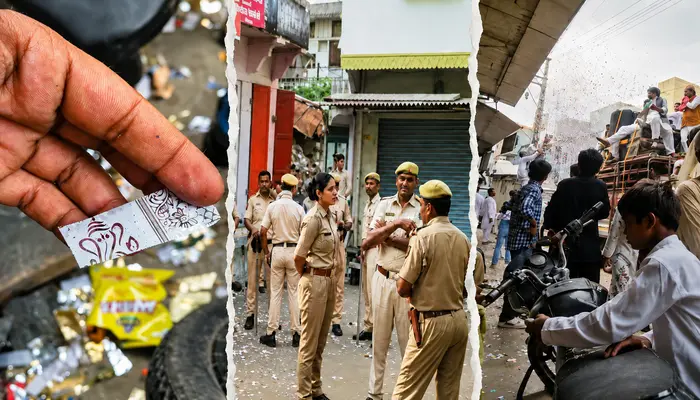
Case Summary
In Chittorgarh, Rajasthan, tensions broke out during an Eid Milad-un-Nabi procession, a Muslim religious procession, after pamphlets or plastic sheets featuring images of Hindu deities, including Lord Ganesha, were flown in the air. According to reports, on 26 August 2026, as the Muslim religious procession moved from Gandhinagar towards Dhuncha Bazaar via Gol Pyaau, sheets bearing images of Hindu deities were thrown into the air, including in the sensitive Dhuncha Bazaar and Lohar Mohalla areas. The sheets were thrown in a manner that caused them to fall to the ground and be trampled upon by Muslim participants, thereby insulting and desecrating the images of Hindu deities. Members of the Hindu community objected to the display of the images and had previously approached the administration, requesting that such pamphlets depicting Hindu deities not be used during the procession. Despite the earlier objection, the sheets were flown again as the procession proceeded through the area, resulting in a confrontation between members of the two communities. Slogans were raised and tensions escalated, prompting police and administrative officials to intervene. The authorities separated the two sides and brought the situation under control, after which the procession continued under police protection. Additional police personnel were deployed in sensitive parts of the city and the administration maintained heightened surveillance to prevent further escalation.
Why it is Hate Crime ?
This case has been added to the tracker under the primary category of - Attack on Hindu religious representations. Within it, the sub-category selected here is - Desecration of Hindu religious symbols. Icons and symbols or a religious representation of a spiritual ideal are widely revered in Hinduism. Iconography is of vital significance in the Hindu milieu. It helps connect people’s spiritual beliefs with the real world. Iconography within the Hindu faith takes several shapes and forms. Murtis are of most significance to Hindus, to which daily rituals, prayers and offerings are done. Besides the murtis, there are several other symbols which have deep significance in the Hindu faith – the Om and Swastika for example. Since these Hindu religious symbols hold paramount importance in Hinduism, any desecration of symbols, icons, murtis, religious representations and manifestations, is driven by animosity towards the faith itself which manifests itself through these murtis, icons and symbols. Therefore, any desecration of these Hindu religious symbols and representations is considered religiously motivated hate crimes under this category. The case qualified as a hate crime because the conduct involved the deliberate degradation of symbols that have a specific and profound religious significance for Hindus. The object of the conduct was not a neutral or ordinary item; the sheets carried representations of Hindu deities, making the treatment of those images inseparable from the religious identity they represented. Actions directed at sacred representations can therefore amount to hostility or contempt towards the faith and the community associated with those representations. Hindu deities hold a deeply sacred place in Hindu religious belief, worship and cultural identity, with Lord Ganesha being one of the most widely revered Hindu gods and a central figure in Hindu devotional practice. His image is not merely decorative but represents a deity who is worshipped by millions of Hindus. In this context, the use and subsequent disrespectful treatment of images of Lord Ganesha during a Muslim religious procession carried a distinctly religious significance. Hindu deities have no intrinsic connection to the observance of Eid Milad-un-Nabi, making their incorporation into such a procession difficult to view as something ordinary. Given the sacred status of the images and the prior objections raised by members of the Hindu community, the conduct indicated a deliberate disregard for Hindu religious sentiments and was an attempt to demean symbols central to Hindu faith and identity. The manner in which the images were treated was particularly significant. Flying representations of Hindu deities in the air and subsequently trampling and dancing upon them transformed the conduct from mere possession or display of religious imagery into behaviour that demeaned Hindu sacred symbols. Trampling upon an image of a Hindu deity has a clear symbolic dimension because it physically places a sacred representation underfoot and treats it with contempt. Such conduct was an affront to the religious beliefs and dignity of Hindus, rather than as behaviour without any religious significance. The religious identity of the targeted symbols also distinguished the incident from a general inter-community dispute. The harm arose specifically because the objects involved represented Hindu gods. The significance of the conduct therefore derived from the religious meaning attached to those images, establishing a direct connection between the behaviour and Hindu religious identity. The fact that the imagery involved revered Hindu deities meant that the conduct had the potential to demean Hindus precisely because of what those symbols represented. The subsequent confrontation was a consequence of the religiously offensive conduct and did not constitute the primary basis for classification. The central issue was the treatment of Hindu religious representations in a manner that demeaned their sacred character. Since the conduct specifically involved Hindu deities and subjected their representations to treatment carrying an inherently degrading religious meaning, the incident had a clear nexus with Hindu religious identity and therefore classified as a hate crime.


Case Status
Complaint filed


Perpetrators Details
Perpetrators
Muslim Extremists
Perpetrators Range
Unknown
Perpetrators Gender
unknown
 Sources




