Hindus attacked, religious banners torn by Muslim mob during Eid Milad-un-Nabi procession in Mumbai
 Mumbai, Maharashtra, India
  25 August, 2026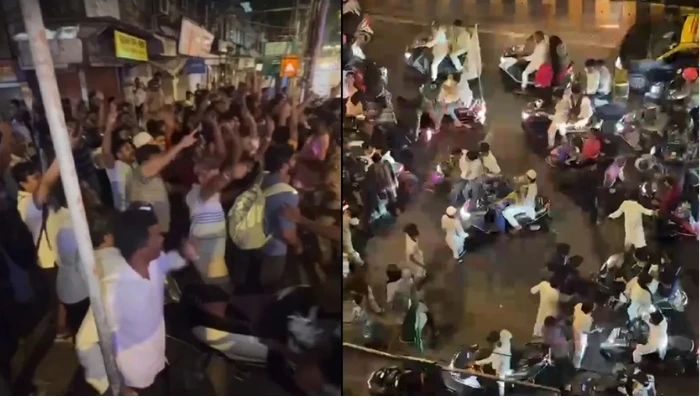
Case Summary
In Mumbai's Parel-Chinchpokli area, tensions escalated into clashes after a Muslim mob taking part in an Eid Milad-un-Nabi procession attacked local Hindus, raised provocative slogans, and tore Hindu religious posters and banners. The Bhoiwada Police booked Rehan Masood Sayyad, 19, Adil Khan Ahmed Khan, 19, and Miraj Mohammad Firoz Rais, 18. At teh time of documenting this incident, the Police were working to identify other people involved. The incident occurred near Laxmi Cottage in the Lalbaug-Parel area on 26 August 2026. The confrontation began after some local residents objected to the loud honking of horns by two-wheeler riders participating in the procession. As the procession passed through the locality, participants riding motorcycles and carrying flags raised slogans of "Labaik Ya Rasool Allah", meaning "Here I am, at your service, O Messenger of Allah." Tensions escalated further after Hindu religious banners and posters near Laxmi Cottage were torn. Local Hindus then responded by raising "Jai Shri Ram" slogans. According to a social media account, members of the Muslim crowd assaulted Hindus who were walking on the road. Stones were also pelted during the clash. Several people sustained injuries and were taken to KEM Hospital in Parel for treatment. Senior police officers reached the spot and used mild force to disperse the crowd and restore order. Additional police personnel were deployed across Parel, Chinchpokli and adjoining areas as a precaution. Roads leading towards the affected area were temporarily blocked to prevent further escalation, while traffic restrictions were imposed on routes including the Byculla-Lalbaug-Parel bridge. Mumbai Police Joint Commissioner (Law and Order) Dr Manoj Sharma said that senior officers were present at the spot and that the situation was completely calm. He also appealed to the public not to believe rumours. The three accused were booked under several provisions of the Bharatiya Nyaya Sanhita (BNS). The charges include provisions relating to unlawful assembly, disobedience of orders by members of an unlawful assembly, liability of members for offences committed by the group, rioting, rioting while armed with a deadly weapon, assaulting or obstructing a public servant, voluntarily causing hurt or grievous hurt, and voluntarily causing hurt to a public servant. Police also invoked Sections 137 and 133 of the Maharashtra Police Act, relating to maintaining public order and regulating conduct in public places. The accused were additionally booked for violating prohibitory orders issued by the Mumbai Police Commissioner regarding unlawful assembly.
Why it is Hate Crime ?
The primary category selected in this case is: Attack on Hindu religious representation, and within this, the subcategory selected is: Desecration of Hindu religious symbol. Icons and symbols or a religious representation of a spiritual ideal are widely revered in Hinduism. Iconography is of vital significance in the Hindu milieu. It helps connect people’s spiritual beliefs with the real world. Iconography within the Hindu faith takes several shapes and forms. Murtis are of most significance to Hindus, to which daily rituals, prayers and offerings are done. Besides the murtis, there are several other symbols which have deep significance in the Hindu faith – the Om and Swastika for example. Since these Hindu religious symbols hold paramount importance in Hinduism, any desecration of symbols, icons, murtis, religious representations and manifestations, is driven by animosity towards the faith itself which manifests itself through these murtis, icons and symbols. Therefore, any desecration of these Hindu religious symbols and representations is considered religiously motivated hate crimes under this category. The other primary category selected is: Attack not resulting in death. The subcategory selected is Communal Clash/Attack. Communal clash is a form of collective violence that involves clashes between groups belonging to different religious identities. For a communal clash between Hindus and non-Hindus to qualify as a religiously motivated hate crime, the trigger of the violence itself would have to be anti-Hindu in essence. For example, if there is a Hindu religious procession that comes under attack from a non-Hindu mob and after the initial attack, Hindus retaliate in self-defence, leading to a communal clash between the two religious communities. While at a later stage both communities are involved in the clash/violence, the initial trigger of the violence was by the non-Hindu mob against the Hindus, and therefore, it could safely be termed as anti-Hindu violence. Further, the trigger would also have to be religiously motivated. In the cited example, the attack by the non-Hindu mob was against religious processions and therefore can be concluded to be religiously motivated. In some cases, the trigger may be non-religious; however, it develops into religious violence against Hindus at a later stage. In such cases too, the foundational animosity towards Hindus becomes the motivating factor of the crime, and therefore, it would be classified as a religiously motivated hate crime against Hindus under this category. The case was included in the Hinduphobia Tracker because the communal violence was triggered by conduct that directly interfered with Hindu religious expression. The tearing of Hindu religious banners and posters, followed by the raising of a provocative religious slogan during the procession, turned an altercation into a confrontation with a clear religious dimension. Even though the incident developed into a communal clash, the sequence leading to it remained significant. The initial altercation arose after local Hindus objected to two-wheelers in the Eid Milad-un-Nabi procession honking loudly in a predominantly Hindu locality. The situation escalated when participants in the procession raised “Labbaik Ya Rasool Allah” while Hindu religious banners and posters near Laxmi Cottage were torn. The Hindus subsequently responded by raising “Jai Shree Ram”. The religiously charged conduct therefore preceded the retaliatory slogans and the subsequent violence. The tearing of Hindu religious banners and posters was not a neutral act of public disorder. These representations carried religious significance for the Hindu community, and their destruction during a religious procession showed disregard for Hindu religious expression and the sentiments of local devotees. The subsequent stone-pelting further transformed the provocation into physical violence, resulting in injuries and requiring police intervention. Moreover, the conduct showed a conscious disregard for the religious rights of Hindus in their own locality. The participants did not merely pass through the area; the confrontation escalated through religiously charged slogans and the destruction of Hindu religious representations. This demonstrated hostility towards Hindu religious expression and created circumstances in which local Hindus were drawn into a communal confrontation. Taken together, the sequence of conduct showed that the perpetrators' actions were not limited to an ordinary disagreement over the procession. The destruction of Hindu religious representations, use of religiously provocative slogans and subsequent violence demonstrated contempt for Hindu religious expression and a willingness to provoke Hindu devotees. The motive was therefore to disrupt Hindu religious expression and escalate the confrontation along communal lines, making the incident a religiously motivated hate crime against Hindus.


Case Status
Complaint registered


Perpetrators Details
Perpetrators
Muslim Extremists
Perpetrators Range
From 10 to 100
Perpetrators Gender
male
 Sources




