Hindu man threatened by Muslim wife’s family after she converted to Hinduism and married him in Uttar Pradesh
 Hathras, Uttar Pradesh, India
  24 August, 2026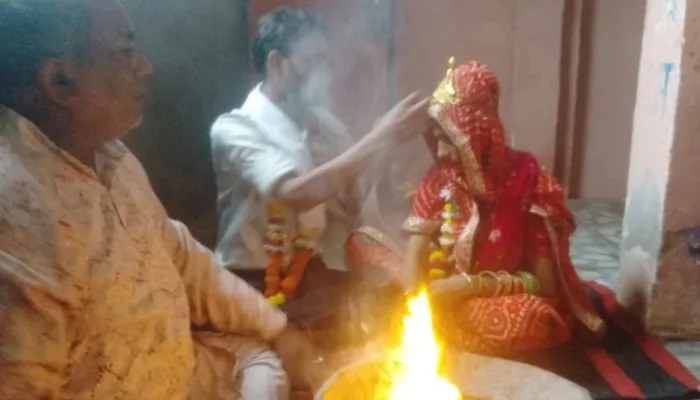
Case Summary
In Hathras, Uttar Pradesh, a Hindu man named Vijay was subjected to death threats from his Muslim wife’s family members. This occurred after she voluntarily embraced Hinduism and married him according to Hindu rituals. The Muslim woman, identified as Nisha, a resident of Kanshi Ram Colony, and Vijay, a resident of Ghantaghar, had known each other for around 15 years and decided to marry by mutual choice. Nisha stated that she left Islam and embraced Hinduism of her own free will, after which she married Vijay according to Hindu customs. She specifically stated that neither her religious conversion nor the marriage had taken place under pressure, fear or coercion. Photographs and videos of their Hindu wedding subsequently circulated widely on social media, bringing the matter into public attention. Following the marriage, Vijay and Nisha stated that members of Nisha’s family began issuing death threats to them. Fearing for their lives, the Hindu man and his wife approached the police and administrative authorities seeking protection for themselves, their family and property so that they could continue living together without interference. The couple stated that they were frightened by the threats and sought protection for their lives and property. An affidavit was prepared through advocate Mukesh Chaturvedi, in which Nisha affirmed that she had voluntarily adopted Hinduism and married Vijay according to Hindu rituals by her own choice. The couple also stated in the affidavit that they were adults and wished to live together voluntarily. They further stated that they had not taken the decision to convert or marry under any pressure or fear and wanted to continue living together of their own choice. Circle Officer Himanshu Mathur stated that the matter was being examined and that neither Nisha nor Vijay had personally appeared before the police at that stage. Kotwali In-Charge Inspector Satendra Raghav stated that no formal written complaint regarding the threats had yet been received and that necessary action would be taken once a complaint was submitted. The couple’s request for protection was therefore awaiting further action from the police and administrative authorities.
Why it is Hate Crime ?
The primary category selected for this case is: Men attacked for being associated with non-Hindu women. The subcategory selected for this case is: Attacked by a non-Hindu partner or/and her family. When Hindu men are in a relationship with non-Hindu women, there are cases where the man is forced to convert his religion, and upon his refusal to do so, the partner or/and her family attacks the victim. Such relationships may be consensual, with the religious identity of the non-Hindu woman known to the victim. Somewhere along the relationship, the non-Hindu woman or her family starts forcing/pressurizing the Hindu man to convert. In some of these cases, the association could be non-consensual as well, or the religious identity of the non-Hindu woman could be previously unknown to the Hindu victim. In such cases, the Hindu man is first forced/pressurized to change his religion by the non-Hindu woman or her family. The force/pressure could involve threats. The trigger for directing violence against the Hindu man is, in these cases, his refusal to comply and change his religion under threat and/or force. In other cases that have been documented, it is also seen that the Hindu partner is assaulted by the non-Hindu woman or her family simply for his relationship with the non-Hindu woman and by virtue of him following the Hindu faith and not the religion of the non-Hindu woman. In such cases, the relationship is consensual in most cases, and the religion of both partners is known to the other. Often, in such cases, there is no direct force/pressure to convert either; however, the attack is a result of the Hindu man being in a relationship with the non-Hindu partner and not following her religion/following Hinduism specifically. Such cases are driven by specific religious motivations and against the religious identity of the victim and are therefore qualified as hate crimes. This case has been added to the tracker because the death threats faced by the Hindu victim, Vijay, showcased religious hostility towards him for being a Hindu man married to a Muslim woman. The hostility was particularly significant because his Muslim wife had voluntarily abandoned Islam, embraced Hinduism and married him according to Hindu rituals. The opposition to the marriage therefore went beyond ordinary familial disagreement and was connected to the religious identity of the Hindu man and the fact that the Muslim woman had chosen to enter a Hindu marriage. It is important to note that both Vijay and his wife, Nisha, were adults and were free to make their own decisions regarding their relationship and whom they wished to marry. Nisha specifically stated that she had converted from Islam to Hinduism entirely of her own free will, without any pressure, fear or coercion, and that she had married Vijay according to Hindu rituals by her own choice. Despite their autonomy and the consensual nature of both the conversion and the marriage, Vijay and Nisha were subjected to death threats from her family. This demonstrated that the hostility faced by Vijay was not based on any coercion or wrongdoing on his part, but emerged in the context of his Hindu identity and his marriage to a Muslim woman who had voluntarily embraced Hinduism. The fact that the threats emerged after the Muslim woman’s conversion to Hinduism further highlighted the religious nature of the hostility. Vijay was not simply opposed as an individual; he was a Hindu man whose relationship with a Muslim woman had resulted in her leaving Islam and adopting Hinduism. Her decision to marry him therefore represented a crossing of religious boundaries, making his Hindu identity central to the circumstances that provoked the hostility. The death threats consequently reflected an attempt to intimidate and punish a Hindu man in the context of his religious identity and interfaith marriage. This incident also demonstrated how Hindu men become targets of hostility when they enter relationships with Muslim women without adopting Islam. In this case, the situation was even more significant because the Muslim woman had instead voluntarily embraced Hinduism. The hostility towards Vijay therefore stemmed from the fact that the Hindu identity of the male partner remained intact while the Muslim woman had moved away from Islam and entered a Hindu marital and religious framework. In the Islamic faith, a marriage is considered invalid if a Muslim woman marries a non-Muslim man who does not convert to Islam. In many such cases, the religious identity of the Hindu male partner becomes a key trigger for hostility, particularly when the relationship results in the Muslim woman leaving Islam rather than the Hindu man converting to Islam. Even where conversion to Islam is not explicitly demanded, hostility towards the Hindu man manifests through threats or violence intended to oppose the relationship and enforce religious boundaries. Vijay’s case reflected this dynamic, as he remained a Hindu man while his Muslim wife voluntarily embraced Hinduism and married him according to Hindu customs. In this incident, Nisha was also targeted because of her newly adopted Hindu identity, making the threats against her religiously driven. After voluntarily leaving Islam and embracing Hinduism, she had the same right as any other Hindu to practise her chosen faith without intimidation. The fact that the threats emerged after she adopted Hinduism and married a Hindu man indicated that her new religious identity was central to the hostility she faced. Rather than merely opposing her personal decision to marry, her family’s actions sought to intimidate her after she had exercised her freedom to leave Islam and embrace Hinduism. This demonstrated deep-rooted hostility towards Hinduism and towards Nisha for identifying with the Hindu faith, making the offence religious in nature. Overall, since this case meets the parameters of a hate-driven offence, it is being added to the hate crime database of the Hinduphobia Tracker. Disclaimer: The victim count has been recorded as 2, comprising Vijay and Nisha. Although Nisha was born into a Muslim family, she voluntarily embraced Hinduism of her own free will and married Vijay according to Hindu rituals. After adopting Hinduism, she was threatened along with her Hindu husband by members of her family. Therefore, both Nisha and Vijay have been counted as victims for documentation purposes. The Hinduphobia Tracker records incident dates based on when the crime occurs rather than when it was reported by the media. However, in the present case, the media reports did not specify the exact date on which the threats occurred. Therefore, 25 August 2026, the date on which the incident was reported by the media, has been selected as the indicative incident date for documentation purposes only.
Victim Details
Total Victim
2
Deceased
0
Gender
- Male 1
- Female 1
- Third Gender 0
- Unknown 0
Caste
- SC/ST 0
- OBC 0
- General 0
- Unknown 2
Age Group
- Minor 0
- Adult 2
- Senior Citizen 0
- Unknown 0


Case Status
Complaint not filed


Perpetrators Details
Perpetrators
Muslim Extremists
Perpetrators Range
Unknown
Perpetrators Gender
unknown
 Sources




