Hindu family and Hanuman temple targeted by Muslim Mob in retaliation for objecting to derogatory remarks on Hindu deities
 Jamtara, Jharkhand, India
  21 August, 2026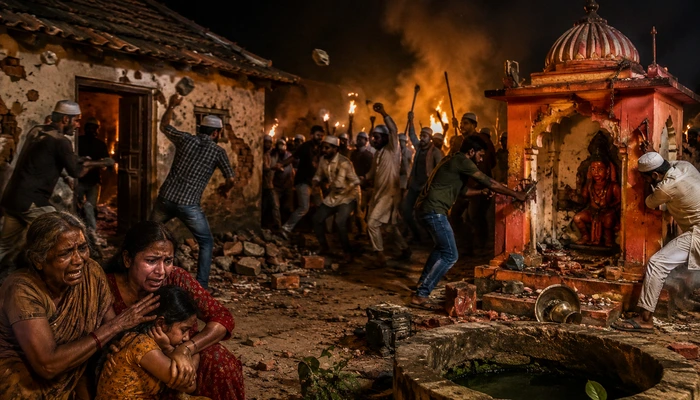
Case Summary
In Jamtara's Thanardih village, a large Muslim crowd targeted Hindu families and desecrated and vandalised a nearby Hanuman temple after the Hindus raised objections to derogatory remarks against Hindu deities. The crowd stormed the house of a Hindu family, assaulted residents, pelted their homes with stones, and damaged the temple, where they reportedly spat inside, removed the temple bell and two motor pumps, and damaged the wall of its well. The incident began on 21 August 2026, after a video containing derogatory remarks about Hindu deities and Hindus circulated in the Karmatand police station area of Jamtara district. The video was linked to Muslim cleric Afroz Alam and associated with the Kurwa weekly market, also known as Kurwa Saptahik Hatiya. Hindu organisations submitted a complaint, following which Karmatand Police arrested Afroz Alam and sent him to judicial custody. Following the video's circulation, Bhudev Mahto, a resident of Thanardih, posted a comment on social media objecting to remarks against Hindu gods and goddesses. The post was made in response to Afroz Alam's remarks. On the night of 22 August 2026, a large crowd gathered around Bhudev Mahto's house. Padma Devi, a local resident, stated in her complaint that around 1,000 to 1,200 unidentified people were present, while a separate FIR concerning the confrontation with police named 23 persons and more than 500 unidentified individuals. According to Mamta Devi, Bhudev Mahto's wife, and his mother Paudha Devi, eight to ten Muslim men from the crowd forcibly entered their home, assaulted family members, and threatened to kill them at gunpoint. The family also reported that around ₹50,000 in cash and jewellery was taken from the house. They further stated that the electricity had been disconnected before the attack. Separately, Padma Devi stated that members of the crowd targeted the Hanuman temple situated opposite her residence. She stated that they spat inside the temple, removed its bell and two motor pumps, and damaged the wall of the temple well. When local villagers objected, the crowd raised religious slogans. Her complaint also stated that nearby Hindu houses were vandalised and subjected to stone-pelting, injuring several residents. Police were subsequently called to the area and arrived as the situation escalated. The police intervention led to the safe removal of Bhudev Mahto from the area. During the confrontation, members of the crowd reportedly manhandled police personnel and damaged a police vehicle, following which additional forces were deployed.
Why it is Hate Crime ?
The first primary category selected in this case is: Attack not resulting in death. Within this, the subcategory selected is: Attacked for opposing radicals or trying to save victim. In several cases, Hindus are attacked for opposing religiously motivated crimes being committed against a fellow Hindu or simply for voicing an opinion opposing radical elements, who either have in the past or continue to persecute Hindus. In such cases, the initial attack against the victim, against which the Hindu was trying to defend the victim, would also need to be classified as a religiously motivated hate crime. Since the initial crime itself was religiously motivated and the subsequent crime of attempting to save the victim or speaking against the radical elements ends up inviting a violent attack, it would also be classified as a religiously motivated hate crime under this category. The other primary category selected in this case is: Attack on Hindu religious representation. Within this, the first subcategory selected is: Attack on temples In Hinduism, a temple is the abode of the Deity. The Deity in the Temple is consecrated, thereby making it a real, breathing entity. Hindus believe that not just the Deity but the temple premises themselves are sacred to Hindus since Hindus hold the faith that the entire Temple space is an amalgamation of the divine energy of the deity. Given the central significance of Temples in Hindu Dharma, any attack against a Hindu Temple or its peripheral premises is an attack on the faith itself and is born out of animosity towards the faith, of which the Temple is a central tenet. Any manner of attack against a Temple and/or its premises would therefore be considered a religiously motivated hate crime. The second subcategory selected is: Desecration of Hindu religious symbol. Icons and symbols, or a religious representation of a spiritual ideal, are widely revered in Hinduism. Iconography is of vital significance in the Hindu milieu. It helps connect people’s spiritual beliefs with the real world. Iconography within the Hindu faith takes several shapes and forms. Murtis are of great significance to Hindus, to which daily rituals, prayers and offerings are performed. Besides the murtis, there are several other symbols which have deep significance in the Hindu faith – the Om and Swastika, for example. Since these Hindu religious symbols hold paramount importance in Hinduism, any desecration of symbols, icons, murtis, religious representations and manifestations is driven by animosity towards the faith itself, which manifests itself through these murtis, icons and symbols. Therefore, any desecration of these Hindu religious symbols and representations is considered a religiously motivated hate crime under this category. The third subcategory selected is: Defiling religious customs. Sanatan Dharma is not a religion of one book, which is to say that while it has religious scriptures that form the central tenets of the faith, there are several traditions followed through thousands of years, mostly passed from generation to generation orally. There are several such customs and traditions that are followed by various Hindus and Hindu sects. Defiling of these traditions and customs is a breach of an individual or group’s religious practices. Such practices can range from dietary restrictions like not eating non-vegetarian food for a certain period of the year, not eating non-vegetarian food at all, not eating beef since the cow is considered holy in Hinduism, the sanctity of religious customs followed in the house (like many ISCKON devotees), etc. Any malicious action leading to the breach of such traditions or defilement of these traditions owing to animosity towards the faith or for the sake of activism stems not only from the lack of faith in the religion itself but also from disregard for the faith of the devotees who follow the customs/traditions and implicit bias against the faith and the tradition itself. Since these specific traditions are central to the faith of the devotees of that specific sect of Hindus, any non-compliance with these traditional rules would be considered a religiously motivated hate crime. The other primary category is: Hate speech against Hindus, and within this, the subcategory selected is: Anti-Hindu slurs, mocking faith. Anti-Hindu slurs and the deliberate mocking of the Hindu faith owing to religious animosity involve the usage of derogatory terms, stereotypes, or offensive references to religious practices, symbols, or figures. One of the common anti-Hindu slurs used against Hindus is “cow-worshipper” and “cow piss drinker”. The intention of using this term is to demean and mock Hindus as a group and their religious beliefs since Hindus consider the cow holy. Additionally, some symbols and the slurs attached to them have a historical context that exacerbates the insult, hate, stereotyping, dehumanisation and oppression against Hindus. Cow worship has been used for centuries to denigrate Hindus, insult their faith and oppress Hindus specifically as a religious group. There has been overwhelming documentation about how cow slaughter has been used to persecute Hindus with cow meat being thrown in temples and places of worship. There has also been overwhelming documentation where cow meat (beef) has been force-fed to Hindus to either forcefully convert them to Islam or denigrate their faith. Apart from cow worship, the Swastika – which holds deep religious significance for the Hindus – has also been misinterpreted and distorted to use as a slur against Hindus. Similarly, the worship of the Shivling has been used by supremacist ideologies and religions to denigrate Hindus owing to religious animosity. Such slurs and denigration stem out of inherent animosity and hate towards Hindus and their faith, therefore, it is categorised as hate speech targeted at Hindus specifically owing to their religious identity. This case has been added to the hate crime database because the violence arose in response to an objection to derogatory remarks targeting Hindu deities and subsequently escalated into an attack on Hindu residents and a Hindu place of worship. A Muslim crowd targeted Hindu villagers' homes, assaulted residents, threatened them with death, and took away cash and jewellery. The same crowd also attacked the local Hanuman temple, where they spat inside the premises, removed temple bells and motor pumps, damaged the wall of the temple well, and raised religious slogans outside the temple. The first religious marker in this case is the targeting of Hindu families after a resident objected to derogatory remarks made by a Muslim cleric against Hindu gods and goddesses. The assault, threats, and intimidation that followed therefore occurred in direct response to the resident's objection to an insult against his faith. The original remarks themselves targeted Hindu religious beliefs and sacred figures, while the subsequent retaliation was directed at those who objected to that insult. The sequence establishes a clear religious link between the initial derogatory remarks, the Hindu resident's objection, and the violence that followed. Hindu deities occupy a central place in Hindu religious life and are worshipped through prayers, rituals, festivals, and other established practices. They are not merely cultural or historical figures for devotees but sacred objects of worship. Derogatory remarks targeting Hindu gods and goddesses therefore demean figures at the heart of Hindu devotion and, by extension, the faith of those who worship them. The second important religious marker is that the Muslim crowd also targeted the local Hindu temple, taking the violence beyond individual residents and directly into a sacred place of worship. The attackers spat inside the Hanuman temple, removed and took away temple bells and motor pumps, and damaged the wall of the temple well. The act of spitting inside a temple was particularly degrading because it directly violated the sanctity of a space regarded as sacred by Hindus. Hindu temples are not merely physical structures. They are sacred spaces where devotees worship and maintain an ongoing religious relationship with the deity. The sanctity of the temple extends beyond the idol to the premises in which worship is performed. Spitting inside the temple and damaging its property therefore amounted to a direct desecration of a Hindu place of worship. The conduct showed clear disregard for the religious significance of the site and for the Hindu community that worships there. The targeting also extended beyond the temple to Hindu families in the locality. The Muslim crowd surrounded and attacked Hindu homes, pelted them with stones, assaulted family members, and issued death threats. Cash and jewellery were also taken from the house. The fact that both Hindu residents and a Hindu place of worship were targeted shows that the violence was not confined to an individual dispute. It extended to members of the Hindu community as well as a sacred institution associated with them. Another important religious marker was the raising of Islamic religious slogans outside the Hanuman temple during the confrontation. This was not an innocuous or unrelated expression. The slogans were raised while a Hindu place of worship was being desecrated and Hindu residents were being assaulted and threatened. In that context, their use had a clear communal meaning and served to assert religious dominance and intimidate the Hindu residents. The attackers were not merely involved in a physical confrontation while separately raising religious slogans. The two acts occurred together, making the religious message conveyed by the slogans difficult to separate from the violence directed at Hindus and their place of worship. Their use in the middle of the attack therefore reinforced the message of hostility towards the Hindu community and added a clear religious dimension to the violence. The entire sequence reflects a deeper hostility towards Hindus and those who stood up in defence of their faith. The original trigger was an objection to derogatory remarks against Hindu gods and goddesses, yet the response was not limited to another verbal argument. A Hindu family was attacked, their home was targeted, and a Hindu temple was desecrated. There was no ordinary or legitimate reason for a dispute over social media remarks to culminate in spitting inside a Hanuman temple, removing temple property, damaging its premises, and raising religious slogans outside it. The question, therefore, is what purpose such acts served if not to intimidate and humiliate Hindus and to punish those who objected to the denigration of their faith. The deliberate desecration of a sacred Hindu space, alongside the assault on Hindu residents, reflects an intrinsic hostility towards Hindus, their religious beliefs, and those who seek to defend them, and for these reasons, this incident warrants inclusion in the tracker.


Case Status
Case sub-judice


Perpetrators Details
Perpetrators
Muslim Extremists
Perpetrators Range
Unknown
Perpetrators Gender
unknown
 Sources




